Is the CCNA (Cisco Certified Network Associate) certification your next best move to enhance your career, or should you focus on CompTIA Security+?
At first glance, a CCNA vs Security+ comparator might seem a slightly odd one. CCNA is all about demonstrating your knowledge of Cisco enterprise network architecture, whereas Security+ is firmly focused on cyber security, so we’re talking about two very different areas of emphasis.
That said, these certifications are similar in that they each appear regularly on entry and junior-level tech industry job listings. Where the role involves elements of both network maintenance and cyber security, you might see both qualifications listed as desirable or required.
With this in mind, here’s our Security+ vs CCNA comparator. Read on to gain a better understanding of what each certification covers, prerequisites for study, real-life applicability, and how each one can shape your career options.
What Are CCNA and Security+ Certifications?
CCNA and CompTIA Security+ are both widely-recognized and sought-after certifications, suitable for entry and junior-level students. However, they cover very different areas of tech industry knowledge.
CCNA validates candidates’ proficiency surrounding Cisco enterprise network architecture. By contrast, and as its name suggests, Security+ is an information security certification. It focuses on areas such as threat analysis, security monitoring, governance and incident response.
The following diagram illustrates where both certifications sit on a typical skills development roadmap.

If you are starting from scratch in terms of knowledge, it's a good idea to start with some IT essentials training. You would then aim for a networking certification such as CCNA. A cyber security foundational course - Security+ being a great example - forms the third leg in this model training journey.
Here’s an overview of both certificates, their objectives and target audiences.
CCNA

CCNA is a vendor-specific network accreditation provided by Cisco Systems, Inc.
By way of background, Cisco is a global technology leader and manufacturer of networking and communications equipment, and a provider of cloud, security, and collaboration solutions. According to Statista, the company has a 41% share of the enterprise network infrastructure market. Its nearest rival, Huawei, occupies just 10% of that market.
So in all likelihood, a very high proportion of the potential employers you approach will have Cisco architecture in place. They’ll want you to have a solid foundational knowledge of a Cisco networking and switching environment. CCNA provides validation of this knowledge - which is why it’s sought after.
The CCNA certification is designed for entry-level and junior-level network professionals. It validates candidates’ knowledge on topics such as network access, IP connectivity, routing and switching, automation, and security: i.e. precisely the areas you’ll need to understand for maintaining and administering a Cisco environment.
CCNA also serves as the foundation for more advanced accreditations, such as the Cisco Certified Network Professional (CCNP).

CompTIA Security+

Security+ is an entry-level cyber security certification from CompTIA (The Computer Technology Industry Association). This is a globally-recognized IT trade body that offers a wide range of industry-standard certifications.
The CompTIA website describes Security+ as “the first security certification a candidate should earn. It establishes the core knowledge required of any cyber security role and provides a springboard to intermediate-level cyber security jobs.”
In contrast to CCNA, Security+ is vendor-neutral. Rather than honing in on a specific type of architecture, it aims to help you build and verify your knowledge relating to the type of security issues you’ll encounter across a wide range of network environments.
In terms of focus, acquiring the Security+ certification enables you to demonstrate skills and knowledge relating to the following broad concepts:
- Assessing the security posture of an enterprise environment and the knowledge necessary to recommend and implement appropriate security measures.
- Monitoring and securing hybrid environments, including cloud, mobile, and IoT.
- Operating with an awareness of applicable laws and policies, including principles of governance, risk, and compliance.
- Identifying, analyzing, and responding to security events and incidents.
Career Progression and Certification Pathways
CCNA and Security+ both sit near the start of an IT career, but they shape very different professional journeys. CCNA builds your technical depth in networking, while Security+ establishes a broad cybersecurity foundation. Depending on your goals, you might pursue one or both, but usually not at the same time.
Where These Certifications Fit in Your Timeline
- CCNA is typically the next step after gaining some hands-on IT experience or earning an entry-level credential like CompTIA A+. It’s best suited for those who want to move toward network engineering, infrastructure, or IT operations. Mastering Cisco environments early opens doors to higher-level network roles and lays the groundwork for certifications like CCNP.
- Security+ fits slightly differently. It’s often the first security-focused certification learners tackle after covering IT or networking fundamentals. Its vendor-neutral scope makes it a solid entry point for those aiming at cybersecurity analysis, compliance, or security operations. Many students pursue Security+ after CCNA or Network+ to add security capabilities to their core technical skills.
Common Certification Pathways
Depending on your intended specialization, there are a few common ways professionals integrate these certifications into their progression:
Cisco Networking Track:
Start with IT Essentials (A+) to build your foundational hardware and troubleshooting skills, then progress to CCNA for hands-on networking expertise.
From there, move to CCNP and one of its specializations—such as Enterprise or Security—to deepen your technical scope. Pairing Security+ with this track helps network professionals apply cybersecurity awareness to their designs and configurations.
A+ → CCNA → CCNP → Security+ (optional for security-aware network roles)
Ideal for Network Administrators, Network Engineers, and Infrastructure Specialists focused on secure connectivity.
Security Track:
Security careers still require a solid understanding of networking. Begin with IT Essentials (A+), then build your networking foundation through Network+ or CCNA, depending on whether you prefer a vendor-neutral or Cisco-focused approach.
After that, Security+ validates your grasp of security fundamentals and prepares you for specialized certifications like CySA+, PenTest+, or cloud security credentials.
A+ → Network+/CCNA → Security+ → CySA+ / PenTest+ / Cloud Security
Ideal for SOC Analysts, Cybersecurity Technicians, and Blue Team professionals.
While both certifications are respected, most professionals choose the sequence that aligns with their career destination rather than collecting both simultaneously.
CCNA provides a technical foundation for infrastructure roles, while Security+ broadens your profile for cybersecurity paths.
Exam Details
Both Security+ and CCNA offer a great deal of study flexibility, allowing you to learn at your own pace. However, the content of each exam is very different to reflect the distinct objectives of each accreditation. More details are below.
CCNA
To earn your CCNA certification, you need to pass the 200-301 CCNA exam. This is a 120-minute test comprising about 100 multiple-choice questions and simulation tests. It’s scored out of 1,000, and the pass mark is 825.
You can take the exam in person or through an online proctored exam administered by Pearson VUE. If you’re taking it online, you’ll need to make sure your setup is configured to meet Cisco’s online testing requirements.
The exam covers the following six domains:
- Network fundamentals. How various network components work, types of network topology architectures, wireless principles, virtualization fundamentals, and switching concepts.
- Network access. Configuring VLANs across switches, understanding and comparing various Cisco Wireless Architectures and AP modes.
- IP connectivity. Interpreting and applying routing table components.
- IP services. Demonstrating your knowledge of a range of critical network services that enable you to deploy, manage and control an IP network consisting of Cisco architecture.
- Security fundamentals. Understanding key security concepts and risk mitigation processes.
- Automation and programmability. Understanding the role of automation in streamlining network management, including the use of vendor-specific management tools such as Cisco DNA Center.
In terms of subject emphasis, the exam is weighted as follows:

You can get more detailed information on the test sections from Cisco’s official exam description.
Security +
To earn your CompTIA Security+ accreditation, you’ll need to pass a 90-minute exam. The current exam version is SY0-701. According to CompTIA, you can expect the test to consist of “no more than 90 questions”. It is marked out of 900, and 750 is the passing score.
As with CCNA, you can take the Security+ exam either in person at a test center or online via the Pearson proctoring platform. Take a look at CompTIA’s testing options page for important information about online and in-person tests.
The exam content comprises five subject domains:
- General Security Concepts (12%): Covers foundational security principles, including confidentiality, integrity, and availability, as well as security frameworks and control types.
- Threats, Vulnerabilities, and Mitigations (22%): Focuses on identifying, analyzing, and mitigating various threats and vulnerabilities to secure organizational assets effectively.
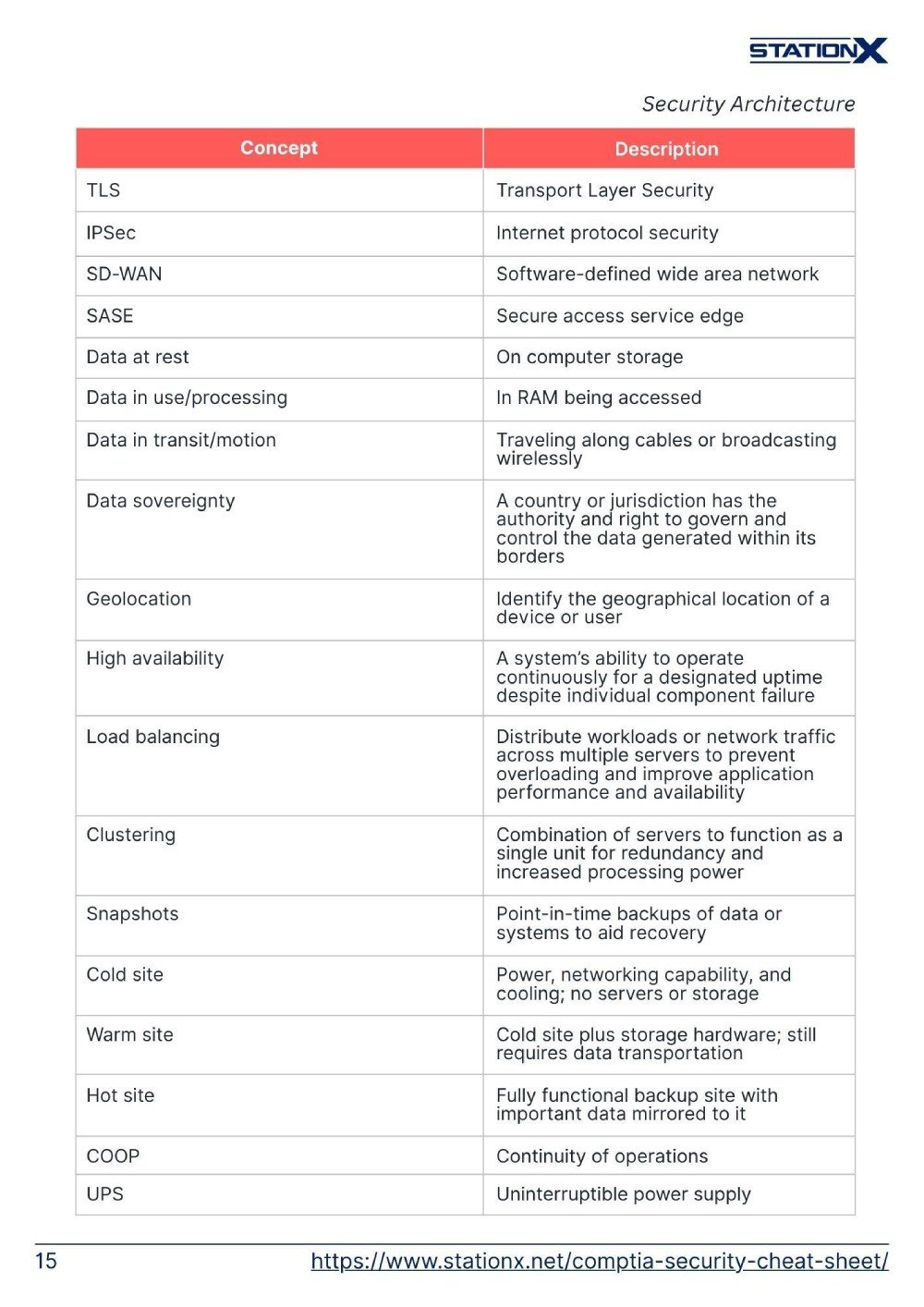
- Security Architecture (18%): Examines secure system and network design, implementation of security controls, and alignment with best practices.
- Security Operations (28%): Addresses the implementation and management of security measures, including monitoring, incident response, and maintaining operational resilience.
- Security Program Management and Oversight (20%): Covers managing security programs, ensuring compliance, and providing strategic oversight to align security efforts with organizational goals.
These subject domains are weighted in the exam as follows:

You can expect the exam to comprise mostly multiple-choice questions, along with some practical problem-solving challenges, which CompTIA refers to as Performance Based Questions (PBQs).
The Security+ multi-choice questions will very often present you with a scenario and ask you to select the best course of action. Likewise, you may be asked questions to test your understanding of related concepts (different types of penetration testing techniques, for instance).
PBQs involve carrying out basic actions in a simulated environment. For example, you might be asked to drag and drop security hardware components into their correct positions within a network map.




Winner: A Draw
We’re talking here about whether one exam is fundamentally “better” than another. We’ll come onto questions such as difficulty levels, costs, and job opportunities a little later in this guide.
Each of these exams has very well-defined objectives. They are each concerned with foundational concepts, albeit linked to very different subject areas. Because they are so different, there is no ‘either/or’ dilemma and no danger of accidentally taking one when you should have taken the other. In fact, for an entry-level student who is keen to establish their credentials in networks and cyber security, BOTH exams may be worth considering.
Eligibility Requirements
While these are both junior certifications, their recommended experience, and credentials differ.
CCNA
There are no formal eligibility requirements for the CCNA certificate; i.e. you don’t have to have any other type of certification already to take the exam. However, Cisco does recommend at least one year of experience in deploying and managing Cisco solutions.
If you lack this specific experience, then don’t be discouraged. Online courses are a highly effective way of gaining the background knowledge you need in preparation for the test.
Security+
There are no formal eligibility requirements to sit the Security+ exam. However, as a non-essential recommendation, CompTIA suggests you have at least two years of experience in IT administration with a security focus.
As a soft requirement, CompTIA recommends a foundational networking certification. Of course, they recommend their own Network+, but the CCNA is another valid option to satisfy this recommendation. Again, it is not required, but highly suggested.
Winner: CCNA
This all comes down to those ‘soft’ recommendations. CompTIA’s suggestions for recommended work experience are more substantial than Cisco’s. Fortunately, however, you can compensate for any absence of in-the-field experience for both exams with the right preparation courses.
Exam Difficulty
Both of these are entry-level exams, although neither could be described as quick and easy to prepare for. There’s a lot of information to cover in each certification.
CCNA
CCNA requires you to have a good knowledge of fundamental networking topics such as the role of different network components, access, connectivity and security.
It’s also important to note that this is a vendor-specific certification; i.e. it’s testing your familiarity with a particular type of environment. So in addition to broad concepts, there is also a considerable amount of Cisco-specific information for you to process and learn.
You will, for instance, need to demonstrate your ability to use Cisco IOS commands for configuring this vendor’s components in a simulated environment. Likewise, for questions linked to the configuration of Cisco’s own management automation tools and software modules, you’ll need to have an understanding of basic scripting languages.
The Security+ exam is designed to test your foundational knowledge across a broad range of cyber security topics. The scope is wide but be reassured that this is an entry-level exam. So long as you are willing to put in the hours of study, you should be well-equipped for success.
Those hands-on Security+ PBQs we mentioned earlier require plenty of practice. Remember that CompTIA doesn’t just want you to learn about cyber security concepts; it wants you to get used to applying them in real life. See the example below.

Past candidates may warn you about CompTIA’s unfortunate habit of phrasing questions in a confusing way. The tip here is always to read the questions carefully to make sure you’re certain about what they’re asking.
If you would like further information on what to expect, check out our recently updated Security+ Cheat Sheet, and our article, 10 Tips to Pass the CompTIA Security+ Exam on Your First Attempt.
Winner: Security+
This is another tough one to call because once again, the focus on each exam is so different.
In terms of subject matter, CompTIA requires you to ‘go big’; i.e. to study a wide range of topics surrounding the whole area of cyber security. With CCNA, your focus is much narrower; however, you're drilling deeper into the subject and will be expected to know more detailed information relating to the Cisco ecosystem.
Perceptions of difficulty differ from student to student. On the whole, though, we think that more people will find CCNA tougher than Security+.
Job Opportunities
To try and produce a useful like-for-like comparison, we’ve carried out an up-to-date search of jobs via Indeed in the United States where each certification was mentioned in the job spec. We also searched for jobs where both certifications were mentioned. Here’s what we found:
CCNA
There are currently just under 11,000 opportunities listed.

The majority are for network engineer, technician and IT support roles. Most tend to be for fairly junior positions. This is to be expected, as the further up the chain you go, the more likely the CCNA requirement is to be superseded by the need for more advanced accreditation.
To give you realistic benchmarks, here are some CCNA-related job roles in the US along with typical salary ranges, based on recent data:
Network Engineer (Junior–Mid) - $70K–$95K
Network Administrator - $65K–$85K
Systems Administrator - $70K–$90K
Cisco Network Engineer - $80K–$105K
Network Support Specialist / Technician - $55K–$75K
IT Support Engineer (Network Focus) - $60K–$80K
Infrastructure Engineer (Cisco Environment) - $85K–$110K
Wireless Network Engineer - $80K–$115K
Field Network Engineer / Implementation Specialist - $75K–$100K
VoIP / Unified Communications Engineer - $80K–$110K
This goes to show that the CCNA certification isn’t just valued by companies with Cisco architecture. For entry-level roles, employers often want to know that you understand the basic principles linked to network engineering. Regardless of the exact type of components you’ll be working with, CCNA is a good way of demonstrating this.
Tip: for a side-by-side view of networking accreditations, check out our Network+ vs CCNA guide.
Security+
There are currently just over 8,000 opportunities listed.

As with CCNA, there are many roles along the lines of junior network engineer, technician and IT support. There are also a high proportion of junior roles where the tasks involved are more security-focused, such as assistant security analysts and information security administrators.
Here are some typical Security+ job titles and their average US salary ranges:
- Cyber Security Manager - $110K–$145K
- Business Analyst - $75K–$95K
- Software Developer - $85K–$115K
- Security Consultant - $95K–$125K
- Cloud Security Engineer - $80K–$110K
- Penetration Tester - $75K–$100K
- Compliance Analyst - $70K–$90K
- Network Security Engineer - $85K – 115K
- Security Analyst II - $60K–$85K
Combined CCNA and Security+
There are currently 1,269 jobs listed where employers list both CCNA and Security+ as required or desirable

These tend to be quite wide-ranging support roles that involve elements of network performance management, alongside security monitoring.
A fairly typical example is a network service technologist. The employers want someone to maintain the network, including routers, bridges and network connections. The applicant will also be responsible for threat monitoring, and helping develop safe usage and incident response policies. The rate is $71,000.
Winner: CCNA
CCNA just beats Security+ due to the greater volume of job adverts that specify it.
However, if you are interested in roles that combine elements of network maintenance and security monitoring, BOTH certifications deserve consideration.
Cost and Recertification
Each exam has its own initial cost and specific requirements to maintain. Let's see how these compare.
CCNA
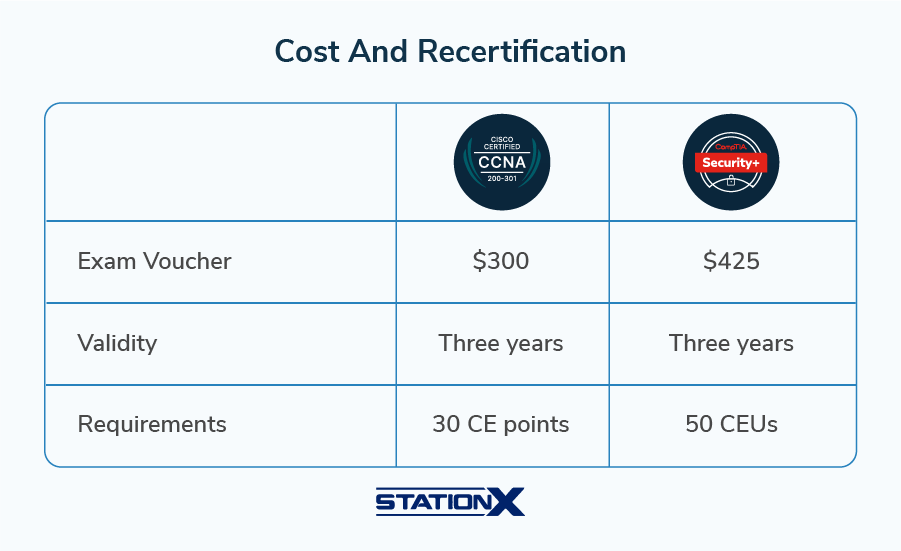
The CCNA certification exam costs $300 per attempt.
The certification is valid for three years. After that, you have the option of recertifying, either through a single activity, or multiple ‘Continuing Education’ steps.
For the single activity, you can
- Retake the CCNA exam, or
- Obtain a higher level Cisco exam.
The multi-step recertification process requires you to earn credits via Cisco’s Continuing Education Portal. For this, you will be presented with a list of eligible activities through the Cisco Continuing Education platform, e.g. Cisco live technical sessions, bootcamps, seminars, and certain industry events. CCNA recertification requires you to accumulate 30 CE points.
Security+
The Security+ certification costs $425 per attempt.
The certification is valid for three years. After that, you must renew either by retaking the exam or earning educational credits, referred to by CompTIA as continuing education units (CEUs).
In broad terms, CEUs can include taking other security-related courses, earning certifications, and attending conferences and other industry events. You need to earn 50 CEUs to recertify via this route.
It is also possible to renew your Security+ accreditation by earning a more advanced CompTIA certificate, such as Pentest+ or CySA+.
If you renew Security+ by earning a more advanced certificate, there is no additional recertification fee. If you renew using non-CompTIA certifications, renewal requires a $150 fee.
Winner: CCNA
This comes down to numbers. The validity periods and recertification processes are similar for both certifications. However, CCNA is a less expensive exam to take.
CCNA vs Security+ - The Final Verdict

Our Verdict: Security+ vs CCNA isn't a straightforward comparison—unlike CCNA vs Network+ or SSCP vs Security+, these certifications cover fundamentally different domains. Both are equally valuable for IT careers.
Our Recommendation: Start with CCNA before Security+. A strong networking foundation is essential for security roles—from penetration testing to incident response—and many entry-level security positions still require CCNA or equivalent networking knowledge.
Ready to Get Started?
- Preparing for CCNA? Check out our CCNA Certification Training Course Bundle with 30+ hours of content and hands-on labs
- Ready for cybersecurity? Build your foundation with our CompTIA Security+ Course & SY0-701 Practice Test Bundle and save 30% on your CompTIA Security+ Voucher
- Want a complete career path? Join our Master's Program for access to 30,000+ courses, labs, mentorship, and personalized roadmaps