CompTIA’s SecAI+ is the newest certification designed specifically for AI security professionals, and interest around topics like CompTIA SecAI+ salary is already emerging, even though the certification itself is brand new. As organizations rapidly adopt artificial intelligence, demand is growing for professionals who understand how to secure AI systems and manage AI-driven risk.
While there are no job postings explicitly listing SecAI+ yet, we can analyze what today’s AI security and applied cyber security roles pay to project where SecAI+-certified professionals are likely to fit in the market.
SecAI+ is positioned as the logical next step after Security+, building on foundational cyber security knowledge and extending it into AI-specific threats, controls, governance, and secure implementation.
This article explores what a future-facing CompTIA SecAI+ salary could look like by examining today’s AI security job market, role expectations, and pay trends. Let’s dive in.
- Overview of the CompTIA SecAI+ Certification
- What Does the CompTIA SecAI+ Certification Prepare You For?
- CompTIA SecAI+ Certification Salary and Job Opportunities
- Experience, Skills, and Realistic Career Expectations
- Career Progression with CompTIA SecAI+
- CompTIA SecAI+ Salary Conclusion
- Frequently Asked Questions
Overview of the CompTIA SecAI+ Certification
CompTIA SecAI+ is an intermediate-level AI security certification designed for cyber security professionals who want to specialize in protecting artificial intelligence systems and managing AI-related risk. It is the first certification in CompTIA’s new expansion series, reflecting the growing importance of AI within cyber security.
The SecAI+ exam follows a format similar to that of other CompTIA credentials. At the time of writing, the exam is expected to include up to 60 questions, combining multiple-choice and performance-based questions, with a 60-minute time limit.
The current exam series code is CY0-001, and the exam uses a scaled passing score of 600 on a 100–900 scale.
The SecAI+ exam voucher costs $359 USD, in line with other intermediate-level CompTIA certifications.
It is a three-year certification, renewed through CompTIA’s Continuing Education Units (CEUs), similar to Security+. This encourages ongoing learning as AI threats, regulations, and defensive techniques evolve rapidly.
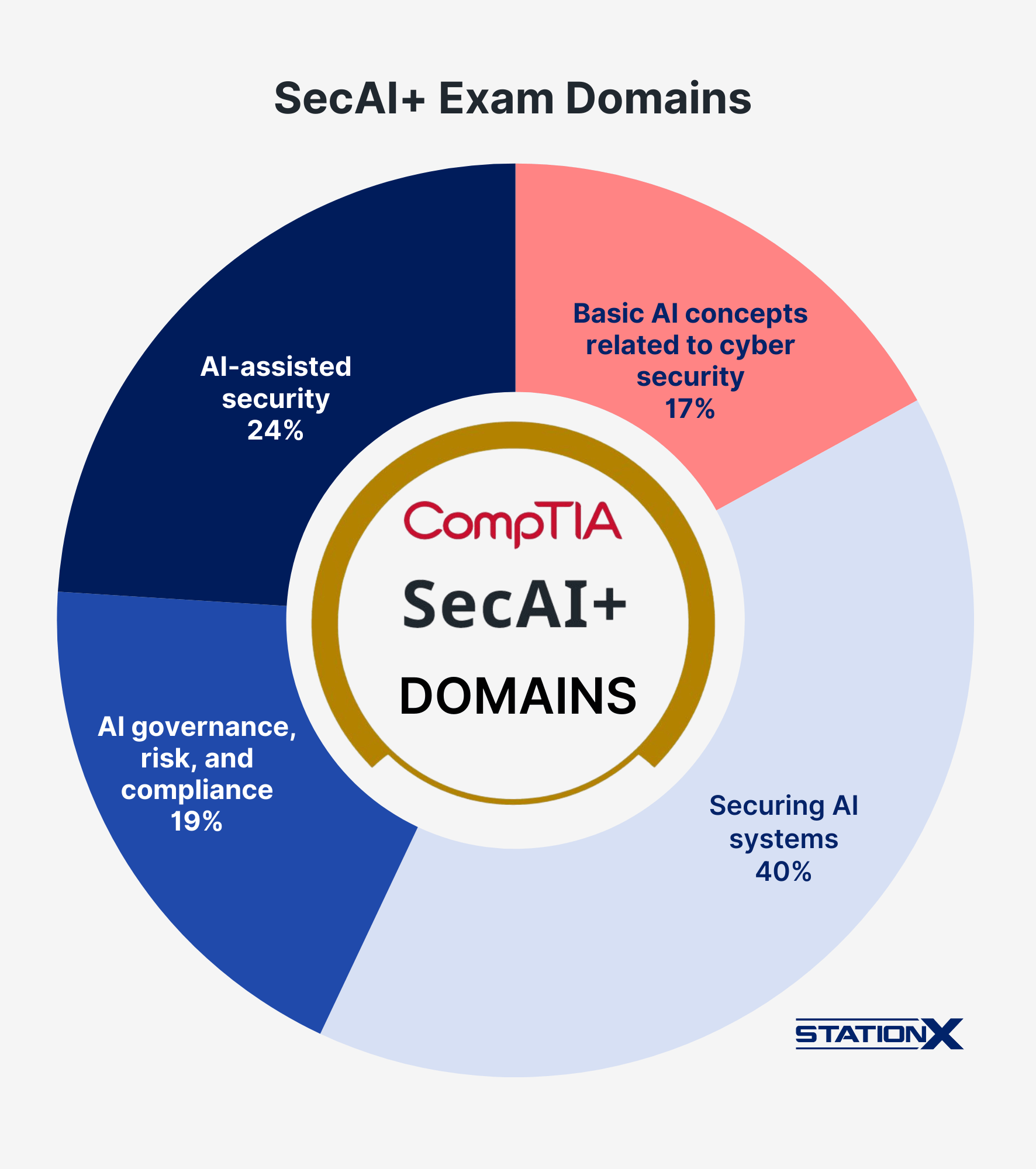
The exam domains focus on the full lifecycle of AI security, including:
- Basic AI concepts related to cyber security (17%) - Core AI concepts, security use cases, and emerging AI-driven threats.
- Securing AI systems (40%) - Protecting AI models, data, and deployments across modern infrastructures.
- AI-assisted security (24%) - Using AI to enhance detection, automate response, and streamline security workflows.
- AI governance, risk, and compliance (19%) - Managing regulatory, ethical, and risk considerations throughout the AI lifecycle.
A key strength of SecAI+ is that it builds directly on Security+ knowledge, extending traditional cyber security concepts, such as risk management, access control, and incident response, into AI-driven systems. Rather than replacing Security+, SecAI+ complements it by adding AI-specific security skills that are increasingly in demand.
Like other CompTIA certifications, SecAI+ is ISO/IEC 17024 accredited, reinforcing its credibility and global recognition. It is also widely expected to become a standard credential for government and DoD-aligned roles, much like Security+ did for baseline cyber security requirements, pending formal DoD 8570/8140 alignment.
Over time, holding a globally recognized security certification that addresses AI risk can support access to roles with broader responsibility, stronger market demand, and the potential for higher salaries as organizations across the cybersecurity field increasingly prioritize AI security capabilities.
CompTIA Voucher Hub
Planning your next CompTIA exam? Save up to 30% with our CompTIA Voucher Hub — official partner discounts for all CompTIA certifications, including Security+, Network+, A+, and more.
What Does the CompTIA SecAI+ Certification Prepare You For?
Although job postings don’t yet list SecAI+ by name, the certification is designed to closely align with AI security job roles that already exist. By building on traditional cyber security foundational skills and adding AI-specific threats, controls, and governance, SecAI+ helps certified professionals develop practical skills needed across a modern cybersecurity career.
This includes support for entry level roles such as security administrator or IT security administrator, as well as progression toward more specialized positions with strong job prospects and competitive pay near or above the national average.
In practice, SecAI+ helps align security teams with data and ML teams, an increasingly critical requirement as AI adoption accelerates, while positioning candidates for higher paying roles and higher salaries over time as they gain experience and move into advanced AI security job roles.
AI Security Analyst
An AI Security Analyst focuses on monitoring AI-enabled systems for cyber threats, vulnerabilities, and abnormal behavior. In this job role, you may work alongside data scientists, engineers, and network administration teams to detect adversarial attacks, data poisoning, model drift, and misuse of generative AI. Effective threat management and security monitoring are key factors in protecting production AI environments.
SecAI+ prepares you with essential AI/ML fundamentals, threat modeling techniques, and security operations knowledge. As a globally recognized credential within the cyber security industry, the certification proves you understand AI-specific risks, though it is not just a credential. Entry-level salaries for this role are competitive, and higher pay becomes achievable as experience grows and skills deepen.
AI/ML Security Engineer
An AI/ML Security Engineer is responsible for securing AI pipelines end-to-end, from training data and model development to deployment and inference. This role involves implementing security controls across cloud, on-premises, and hybrid environments while defending against AI-specific attack vectors.
SecAI+ supports this path by reinforcing DevSecOps concepts, cloud security practices, and AI-specific defensive strategies. While additional hands-on experience and other certifications are often required for senior roles, SecAI+ helps skilled professionals demonstrate foundational and essential skills valued by employers across commercial and government sectors.
AI Governance and Compliance Specialist
As regulations around AI continue to expand, AI Governance and Compliance Specialists play a critical role in ensuring AI systems meet legal, ethical, and regulatory requirements. These professionals develop policies for responsible AI use, bias mitigation, transparency, and auditability.
SecAI+ prepares candidates to align AI initiatives with frameworks and regulations such as GDPR and the NIST AI Risk Management Framework, while integrating governance and risk management throughout the AI lifecycle.
Threat Intelligence Analyst (AI-Focused)
AI-focused Threat Intelligence Analysts research emerging threats targeting AI systems, including prompt injection, model inversion, and adversarial machine learning. This role involves analyzing attacker tactics and producing intelligence reports that inform defensive strategy.
SecAI+ provides structured knowledge of AI threat landscapes and attacker techniques. Combined with experience and other certifications, it supports progression from entry-level positions to higher paying roles with stronger salary growth.
Security Consultant (AI Specialization)
A Security Consultant specializing in AI advises organizations on the secure design, deployment, and management of AI systems. This job role includes AI security assessments, compliance guidance, and enterprise risk evaluations for both commercial and government sectors.
SecAI+ helps validate the broad, cross-functional knowledge needed to communicate effectively with executives, engineers, and compliance teams around AI risk. While advancement depends on experience and practical skills, the certification supports movement into consulting job roles with higher pay and strong job prospects as demand for AI security expertise grows.
AI Red Team Operator
An AI Red Team Operator actively tests AI systems by simulating real-world adversarial attacks such as prompt injection, model extraction, and data manipulation.
While offensive security specialists may pursue niche credentials such as new AI-focused red teaming certifications from OffSec, SecAI+ offers a broader foundation that spans defensive security, offensive awareness, and governance, making it well-suited for professionals who want a holistic view of AI security rather than a purely offensive focus.
Overall, SecAI+ positions candidates for early- to mid-career AI security roles, especially those evolving from traditional cyber security positions into AI-aware responsibilities as organizations scale their use of artificial intelligence.
For skilled cybersecurity professionals, including those with backgrounds as a certified ethical hacker or general security analyst, SecAI+ supports long-term growth within a resilient cyber security career, particularly as demand increases for AI-capable defenders across industries.
CompTIA SecAI+ Certification Salary and Job Opportunities
Since SecAI+ is brand new, no job postings list it as a requirement yet. However, this is normal for newly released certifications. To understand the career and salary impact of SecAI+, we can examine existing AI security roles, compare them with Security+ career outcomes, and project where SecAI+ is likely to land as adoption grows.
According to Glassdoor salary data as of this writing, professionals working in cyber security and AI-adjacent security jobs often command strong pay, and SecAI+ could help position you for many of these roles as it gains market recognition.
First, it is important to state clearly that SecAI+ is a baseline certification for AI security. You’re not likely to land senior AI engineer roles on certification alone; employers will still value hands-on experience, projects, and complementary skills.
As AI adoption grows and demand for AI security talent skyrockets, SecAI+ may become a standard certification for government, DoD, and private-sector AI security roles.
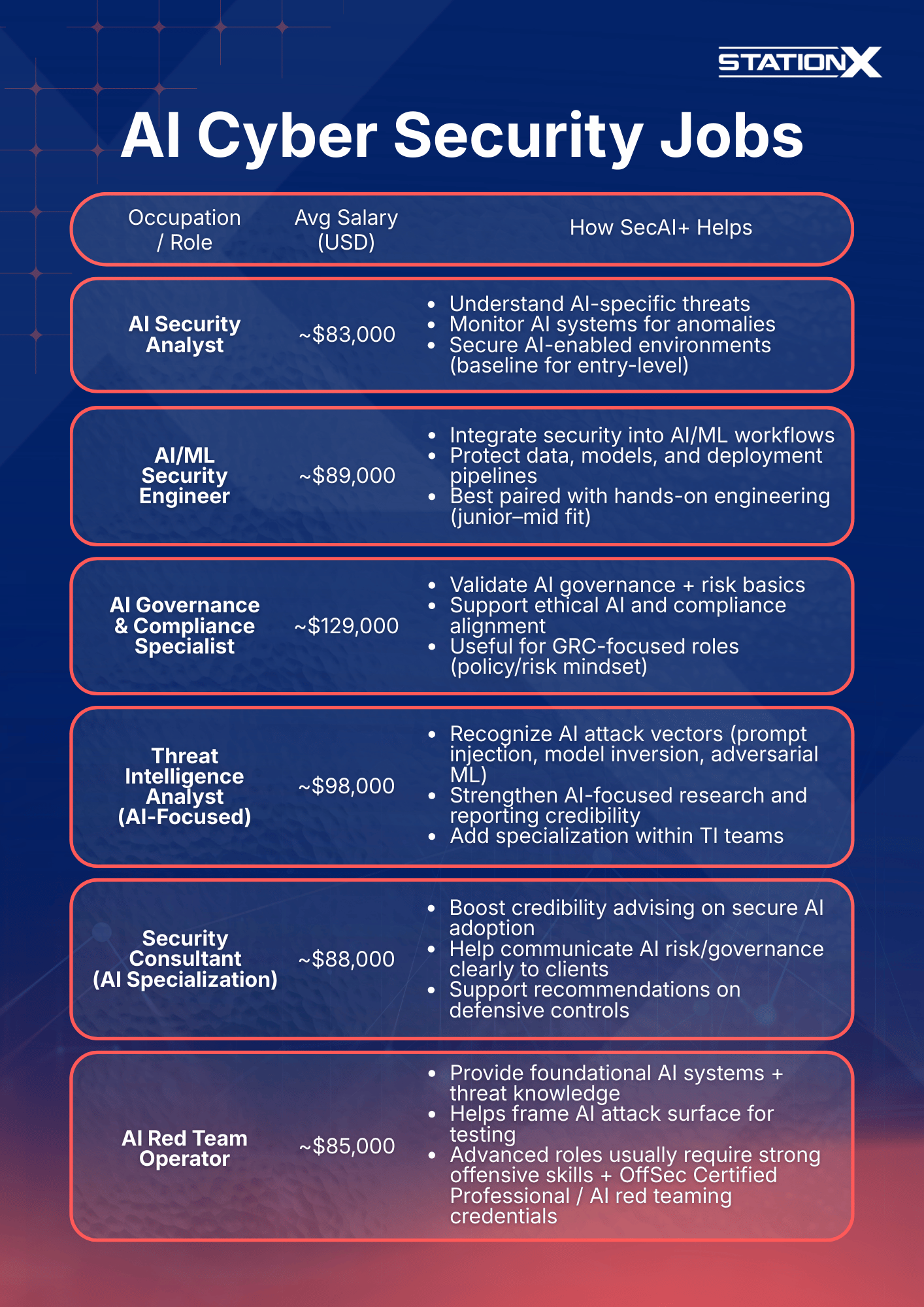
Below are current roles that closely match the level and scope of SecAI+. Based on Glassdoor data and industry averages as of this writing, the salary figures shown reflect entry-level to early-career estimates in the USA, consistent with the SecAI+ certification's intermediate nature.
AI Security Analyst
- Average salary: ~$83,000
- Typical range: $64,000 - $100,000
What employers want beyond SecAI+:
Python or scripting experience, basic machine learning fundamentals, familiarity with SIEM tools, and exposure to cloud platforms such as AWS, Azure, or GCP.
How SecAI+ helps:
SecAI+ demonstrates that you understand AI-specific threats, can monitor AI systems for anomalies, and know how to secure AI-enabled environments, making it a strong baseline credential for entry-level AI security analyst roles.
AI/ML Security Engineer
- Average salary: ~$129,000
- Typical range: $103,000 - $157,000
What employers want beyond SecAI+:
DevSecOps experience, containerization (Docker/Kubernetes), CI/CD pipelines, and cloud security architecture.
How SecAI+ helps:
SecAI+ shows that you understand how to integrate security into AI/ML workflows, including protecting data, models, and deployment pipelines. On its own, it won’t land senior engineering roles, but it supports junior-to-mid-level positions when paired with hands-on engineering experience.
AI Governance and Compliance Specialist
- Average salary: ~$89,000
- Typical range: $57,000 - $106,000
What employers want beyond SecAI+:
Experience with risk management frameworks (NIST, ISO 27001), auditing, policy development, and regulatory compliance.
How SecAI+ helps:
SecAI+ validates your knowledge of AI governance, risk, and compliance, including ethical AI use and alignment with frameworks like GDPR and the NIST AI Risk Management Framework, making it highly relevant for GRC-focused roles.
Threat Intelligence Analyst (AI-Focused)
- Average salary: ~$98,000
- Typical range: $80,000 - $128,000
What employers want beyond SecAI+:
OSINT skills, threat modeling, familiarity with MITRE ATT&CK, and strong research and reporting abilities.
How SecAI+ helps:
SecAI+ proves you understand AI-specific attack vectors such as prompt injection, model inversion, and adversarial machine learning, an increasingly valuable specialization within threat intelligence teams.
Security Consultant (AI Specialization)
- Average salary: ~$88,000
- Typical range: $70,000 - $117,000
What employers want beyond SecAI+:
Client-facing experience, security assessments, and familiarity with multiple frameworks, including NIST AI RMF and the OWASP ML Top 10.
How SecAI+ helps:
SecAI+ adds credibility when advising organizations on secure AI adoption, helping consultants speak confidently about AI risk, governance, and defensive controls.
AI Red Team Operator
- Average salary: ~$85,000
- Typical range: $60,000 - $115,000
What employers want beyond SecAI+:
Strong offensive security skills, penetration testing experience, scripting, and hands-on knowledge of ML model attacks.
How SecAI+ helps:
SecAI+ provides essential foundational knowledge of AI systems and threats, but advanced red team roles typically require pairing it with offensive certifications like OSCP or specialized AI red teaming credentials from OffSec.
Experience, Skills, and Realistic Career Expectations
As with PenTest+ and similar certifications, experience does not always mean prior job titles. Some employers will look for direct AI security experience, while others accept general cyber security experience combined with AI projects.
It’s important to set realistic salary expectations. A foundational certification like SecAI+, as a CompTIA security certification, is designed primarily for entry level and early-career professionals.
At the entry level, salaries are competitive but typically grow with experience; over time, that progression can lead to higher pay and higher salaries, especially for those who continue to build practical skills. This approach also supports long-term job security, as AI security remains a growing specialty.
Valid experience can include:
- Home labs and test environments
- Personal AI security projects
- Cloud-based AI deployments
- Research, write-ups, or GitHub portfolios
Certifications alone rarely secure jobs anymore, but when combined with hands-on practice and guided learning, they become powerful career accelerators. This is true for both experienced professionals and those earlier in their careers, especially as organizations face increasingly complex cyber threats that require practical, applied skills.
Programs like the StationX Master’s Program can help turn certification into job-ready capability by providing structured learning paths and career guidance aligned with certifications like SecAI+. By reinforcing skills that employers value, our program can help professionals position themselves competitively relative to national average salary benchmarks and improve long-term career prospects as demand for AI security expertise continues to grow across industries facing evolving cyber threats.
Remote Cyber Security Jobs Database
Looking to work from anywhere? Tap into our Remote Cyber Security Jobs Database — over 360 remote-friendly companies, 70+ cyber employers hiring remotely, and 50+ niche job boards all organised into one curated resource.
Career Progression with CompTIA SecAI+
Rather than replacing existing credentials, SecAI+ extends a traditional security certification path into AI-focused roles, much as cloud or penetration testing certifications enable specialization.
With growing industry recognition, SecAI+ aligns with modern digital infrastructure and cloud services that underpin today’s AI systems, while remaining consistent with established security certification standards.
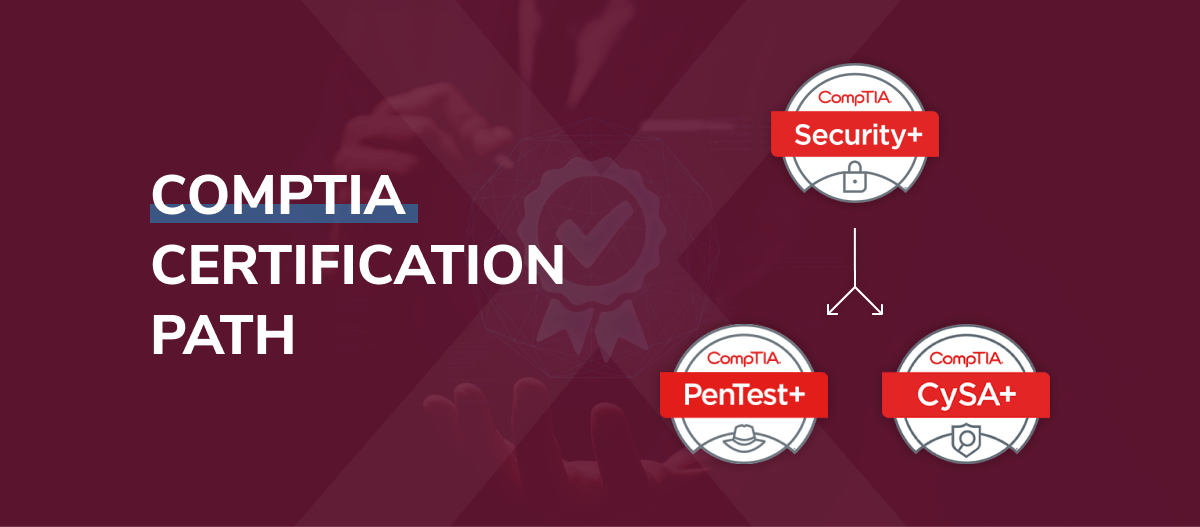
CompTIA’s recommended progression reflects this structure:
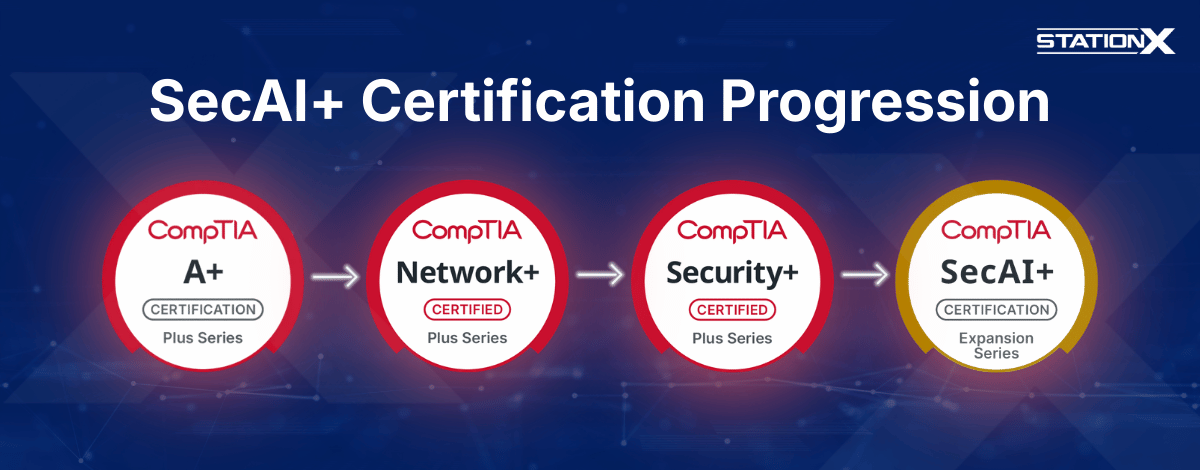
This progression moves from IT fundamentals to networking, core security, and finally an AI-specific security certification. Its value is influenced by local demand and local economic conditions, particularly in regions investing heavily in AI and cloud adoption. Pairing SecAI+ with hands-on experience or instructor-led courses further strengthens its relevance in real-world security roles.
Entry Point
For professionals who already hold Security+ or have equivalent hands-on security experience, SecAI+ is a natural next step. It builds on core cyber security concepts and applies them directly to AI systems, models, and data pipelines.
At this stage, SecAI+ helps:
- Position you for AI-focused security roles as organizations adopt AI at scale
- Support a transition from a general Security Analyst to an AI Security Analyst
- Signal to employers that you understand AI-specific threats, controls, and governance, even if your prior role wasn’t explicitly “AI security.”
This mirrors how Security+ is often used as an entry credential for cyber security; SecAI+ fills that same role for AI-aware security positions.
Mid-Career Growth
With experience, projects, and continued exposure to AI systems, SecAI+ can support progression into more senior technical roles, including:
- Senior AI Security Analyst
- Lead AI/ML Security Engineer
- AI Security Architect
At this level, SecAI+ acts as a foundational credential, while career growth is driven by hands-on work securing production AI systems, mentoring junior staff, and contributing to architecture and design decisions.
Advanced Roles
As AI security matures, leadership- and strategy-focused positions are emerging. With sufficient experience, professionals may advance into roles such as:
- AI Security Manager
- Chief AI Security Officer (CAISO) - an emerging executive role focused on AI risk and resilience
- AI Risk and Compliance Director
In these leadership and senior roles, SecAI+ provides early credibility as a credential, but success depends heavily on advanced skills, management experience, governance expertise, and strategic oversight of AI risk across enterprise IT systems. While SecAI+ alone will not qualify someone for leadership positions, it can support progression into senior roles that offer higher pay, broader responsibility, and stronger pay ranges.
Median salary figures for these roles tend to increase significantly as professionals move beyond entry-level qualifications and develop the advanced capabilities required for organization-wide AI security leadership.
Further Education and Specialization
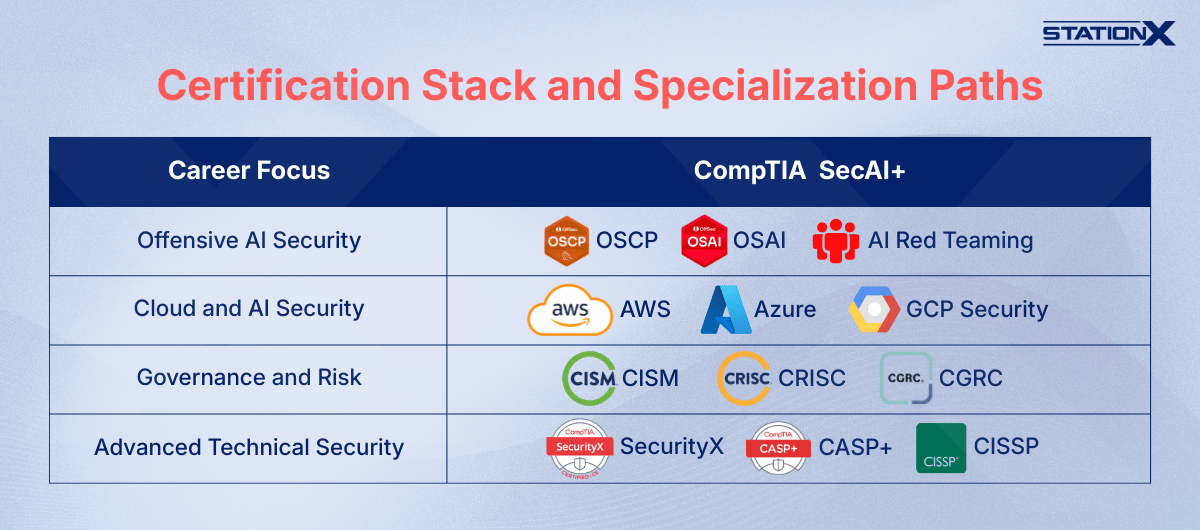
To deepen expertise, SecAI+ pairs well with additional certifications depending on your career focus:
- Offensive AI security: OSCP and AI red teaming certifications from OffSec
- Cloud and AI security: AWS, Azure, or GCP security certifications
- Governance and risk: CISM, CRISC, or CGRC
- Advanced technical security: SecurityX or CISSP
Like other CompTIA certifications, SecAI+ is also expected to stack cleanly within CompTIA’s renewal ecosystem. Similar to how PenTest+ can earn Security+ CEUs, SecAI+ may eventually contribute CEUs toward the renewal of other CompTIA certifications, making it easier to maintain multiple credentials over time.
Overall, SecAI+ is best viewed as a career accelerator rather than a career endpoint: a way to future-proof a cyber security career as AI becomes a core part of enterprise technology and risk.
CompTIA SecAI+ Salary Conclusion
CompTIA SecAI+ is poised to become the industry-standard certification for AI security professionals, much as Security+ became for general cyber security. While job postings don’t yet list SecAI+ by name, AI security roles tied to network security, security operations, and secure systems are expanding rapidly, with average salary figures already competitive across the market.
For systems administrators and security practitioners, SecAI+ builds on existing skills in security operations and risk management to address AI-specific threats.
SecAI+ validates the capabilities that hiring managers increasingly seek: securing AI-enabled systems, strengthening risk management practices, and protecting modern infrastructures that blend network security with AI workloads.
For professionals transitioning from traditional cyber security or those seeking government positions as AI adoption grows, SecAI+ offers a structured entry point that aligns skills with where security hiring and salary growth are headed.
To support this journey, hands-on training and real-world practice remain essential. As dedicated SecAI+ training resources become available, platforms like the StationX Master’s Program can help professionals apply what they’ve learned in real environments by offering practical labs, guided projects, and career support, ensuring you’re not just certified but truly job-ready in the AI security field.
As an authorized CompTIA partner, we can give you up to 30% off your CompTIA SecAI+ exam voucher (depending on your location); just visit our voucher page.
You can also see our Information Security Training Bundles, granting lifetime access to top courses for a one-time purchase. Learn ethical hacking, cyber security, and prepare for top certifications.
We have bundles on:
- Pentesting, red teaming, and web app hacking
- Certification prep, including CompTIA, ISC2, AWS, Cisco, and Azure
- DevSecOps and Coding
- Linux
- AI
- And much more!