

CompTIA A+ vs Security+ is a common comparison for anyone starting out in IT or looking to specialize in cyber security. While both can be valuable stepping stones in your tech career, the right choice depends on your current skill level and the direction you want to take, whether that’s building a foundation in IT support or advancing into cybersecurity.
Knowing how they differ in focus, difficulty, and career outcomes will help you choose the right certification for your experience level and professional goals.
What Are A+ and Security+ Certifications?
CompTIA A+ and Security+ are both designed by CompTIA, a non-profit IT certification and training organization. Internationally recognized, CompTIA is one of the most respected vendor-neutral certification-issuing organizations within the IT industry.
CompTIA offers a total of 15 IT certifications. Four of those certifications are considered core certifications. Both CompTIA Security+ and A+ are core certifications.
However, don’t let that label of core deceive you. These certifications are not interchangeable and have drastic differences you should be made aware of before deciding which one to take.

About A+
A+ is an entry-level IT certification. It tests your fundamental understanding of an array of IT concepts that you must know in order to break into the field of IT and progress as an IT professional.
Obtaining the A+ certification shows employers that you have baseline knowledge necessary for entry-level IT positions.
Even though A+ is geared toward beginners, it expects test takers to understand a wide range of topics such as:
- Hardware components and how they work together
- Operating systems such as Windows, Linux, and Mac
- Software troubleshooting
- Essential networking protocols
- Security against network and device vulnerabilities
- Virtualization and cloud computing
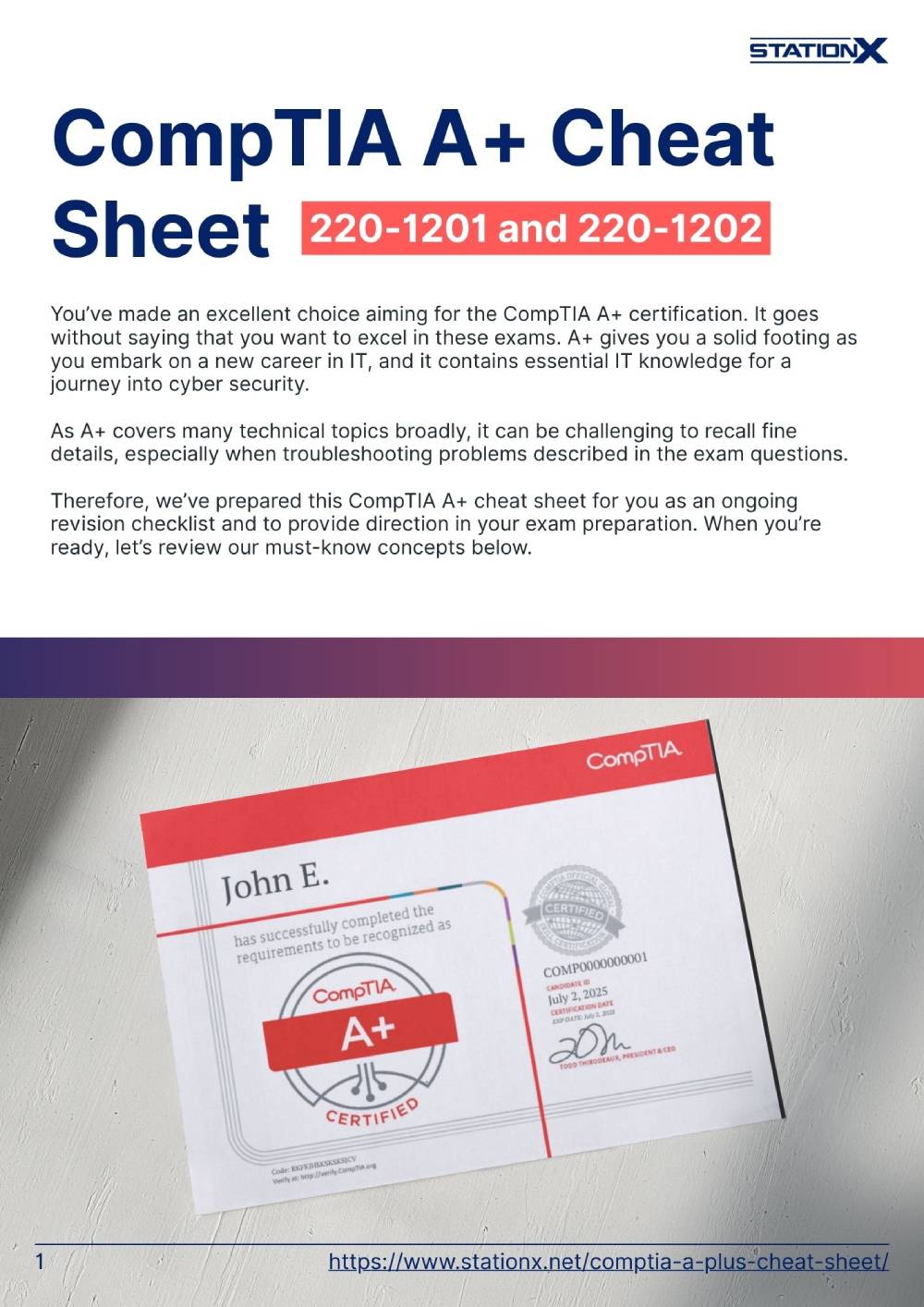
There are so many areas of focus the certification wishes to cover that it requires students to take two tests (Core 1 and Core 2) to prove their understanding of the myriad of IT concepts.
CompTIA also updates the exam every three years to ensure it’s covering pertinent IT topics.



About Security+
When comparing CompTIA A+ vs Security+, it’s vital to distinguish that A+ is an IT entry-level certification while Security+ is an entry-level cyber security certification. The latter drills down into cyber security-specific topics, while A+ covers a broad range of IT topics.
If you aspire to become a cyber security professional, you may want to start by obtaining CompTIA’s A+ certification before moving on to Security+. That being said, if you already have ample experience in IT and networking, it is reasonable to skip A+ and take Security+.
Obtaining Security+ demonstrates to employers that you have a baseline understanding of the most significant cyber security topics.
The exam covers a myriad of cyber security topics, including but not limited to:
- Threats, attacks, and vulnerabilities
- Identity and access management
- Risk management
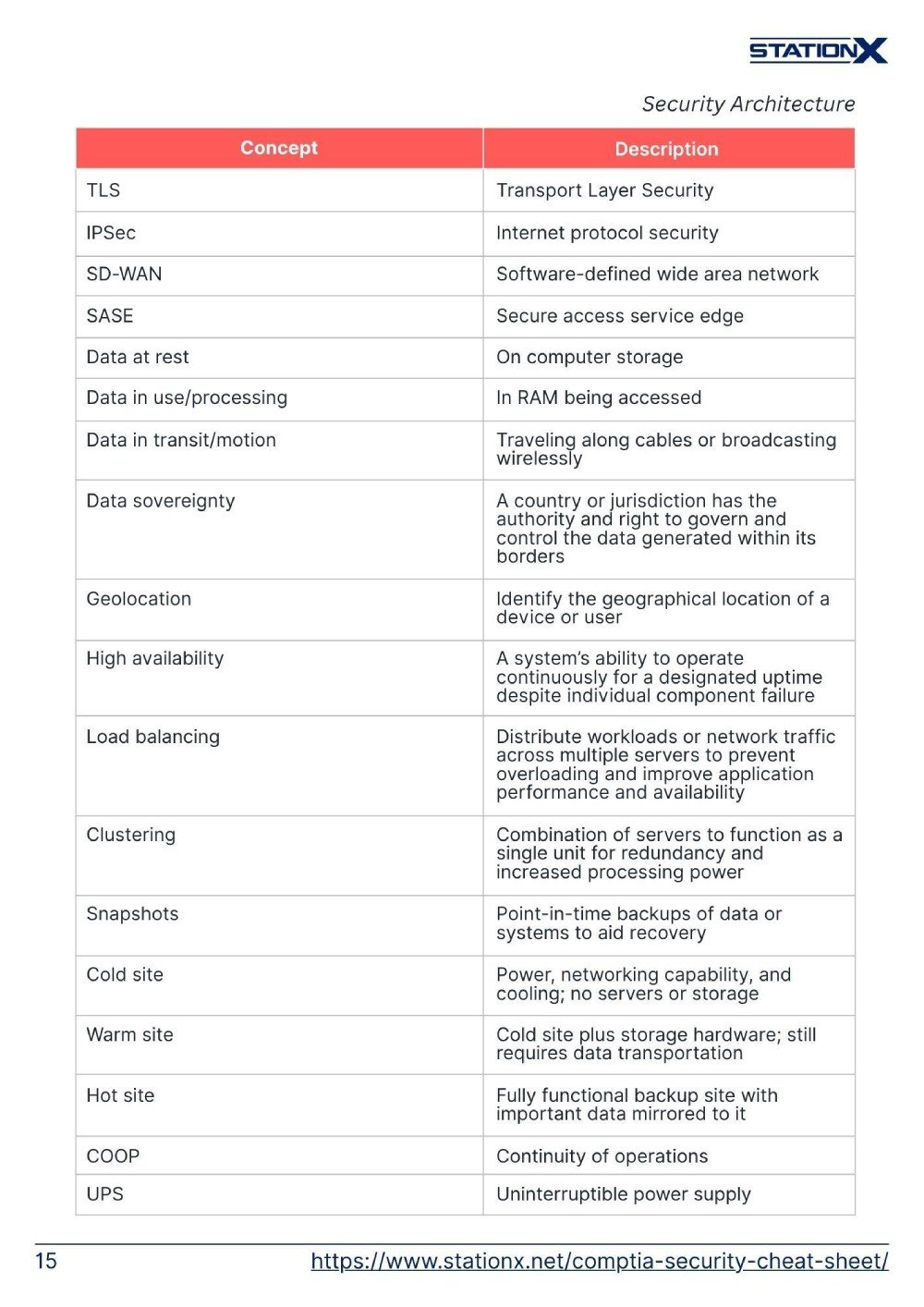
- Security architecture and design
- Cryptography and PKI
Just like A+, CompTIA consults with leading tech-companies and professionals to update their exam every three years on the latest trends and technologies.




Career Progression and Certification Pathways
When planning your IT career, it’s important to understand where CompTIA A+ and Security+ fit in the bigger picture.
- A+ is typically where most aspiring IT professionals begin. It builds your foundation in hardware, operating systems, troubleshooting, and basic networking, the essential hands-on knowledge needed to land entry-level roles like IT support technician, help desk analyst, or junior systems administrator. From there, you can expand your skill set by pursuing Network+ to strengthen your understanding of networking concepts, and then move on to Security+ once you’re ready to focus on cyber security principles and defense strategies.
- Security+, on the other hand, is the next logical move once you’ve mastered the fundamentals or gained some IT experience. It prepares you for roles with a security focus, such as SOC analyst, systems security administrator, or junior security engineer, while also opening doors to more specialized certifications like CySA+, PenTest+, or SSCP.
Here’s how a typical progression might look:
- Beginner IT Path: CompTIA A+ → Network+ → Security+
- Security-Focused Path: CompTIA A+ → Network+ → Security+ → CySA+ / PenTest+
- Accelerated Path (for experienced IT pros): CompTIA A+ → Network+ → Security+ → Advanced certifications (CISA, CISSP, OSCP, Cloud Vendor Certifications)
Our takeaway? Start with A+ if you’re new to IT and need a solid foundation. If you already have experience or want to shift into cyber security, Security+ is your best entry point into that field and a key credential recognized worldwide by employers looking for cyber security-ready professionals.
Exam Details
As Security+ is a more advanced certification than A+, there will naturally be overlap between the two exams. To understand more complex areas of IT you have to build on what you already know. Despite that, these two exams differ quite a bit when it comes to content.
A+ Exam Details
As far as entry-level IT certifications go, they don’t come more thorough than CompTIA A+.
A+ is comprised of not one, but two tests (Core 1 & 2). Each exam consists of a maximum of 90 questions that you’ll have 90 minutes to answer.
In order to obtain A+ you must pass both exams with a passing score of at least 675/900 for Core 1 and 700/900 for Core 2.
The reason CompTIA requires you to take two exams to obtain A+ is because it covers a wealth of material.
Here are the breakdowns of each exam:
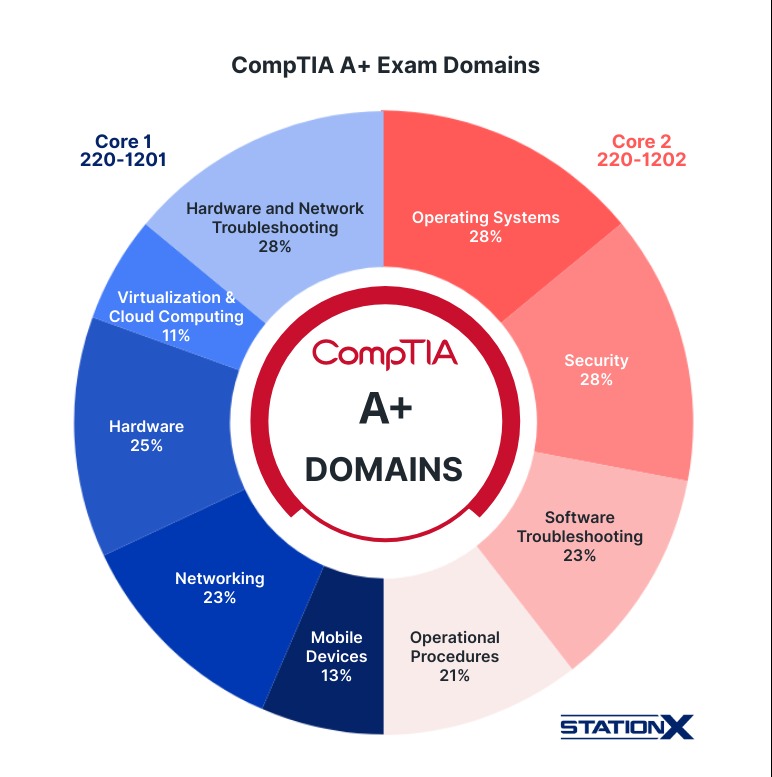
If you’d like an exhaustive list of everything A+ may cover, head to CompTIA to download to exam objectives.
The vast majority of questions will be multiple choice, however, there may be up to 10 weighted performance-based questions (PBQs). PBQs are more hands-on questions that will test your critical thinking skills in addition to your technical skills. The more PBQs you have, the fewer multiple-choice questions you will receive.
Security+ Exam Details
Security+ also contains a maximum of 90 questions to be answered in 90 minutes. Like A+, the number of questions you receive depends on the number of PBQs you must answer. Each test differs, but you can expect to take around four to six PBQs.
An important distinction between these two exams is that Security+ is only one exam, whereas A+ requires you to take two. To obtain your Security+ certificate, you need only pass this one exam with a minimum score of 750 out of 900 which breaks down to a score of 83.33%.
Security+ also differs in content. As you can see from the domain breakdown below, Security+ is a cyber security certification that focuses on the understanding of vulnerabilities, architecture, compliance, operations, and implementation.

For a more detailed breakdown of the exam, head over to CompTIA’s website where you can download a detailed list of all the exam objectives, or see our breakdown of the Security+ domains here.
It should also be noted that both the A+ and Security+ certification exams can be taken in person or online with the help of the test proctor company, Pearson OnVUE.
To take the exam online, you’ll have to abide by the following rules:
- Turn your microphone/camera on while taking the exam
- Clear the desk of all objects, including notepads and even water
- Stay within view of the video camera throughout the duration of the exam
- No water or drink is permitted
Should you break one of these rules during the exam, Pearson VUE will either warn you or end the test, failing you.
Whether you schedule to take the test in person or online, you’ll have ample test times to choose from. You should easily be able to take the test at a date and time of your convenience.
Verdict: Tie
Considering these exams are both testing your understanding of different topics, it’s difficult to say that one test is better than the other with regard to the content covered.
Again, A+ is an entry-level IT certification that will test you on various basic IT topics. Security+ assumes you have a solid understanding of IT and networking but also delves into cyber security. The winner of this section depends entirely on your career goals and prior knowledge.
Eligibility Requirements
Some IT certifications require test takers to have prerequisite certifications or experience before taking an exam. This isn’t the case with CompTIA A+ or Security+.
While anyone can take either test, there are soft requirements that CompTIA recommends for test takers.
A+ Requirements
There are no hard requirements to take A+.
That being said, A+ does recommend students have between nine to 12 months of hands-on experience in the lab or field before taking the exam.
While this is CompTIA’s recommendation, we recommend test takers study pertinent material regardless of experience. Diligently studying with the help of quality resources should be more than enough to pass this exam.
We would also say that the recommendation is really the knowledge of someone with nine to 12 months of experience. Quality study materials are more than a sufficient substitute for this.
With so much material covered, whether you went to school for IT or already work in the field, there are bound to be areas you need to freshen up on. IT is an ever-expanding field with innumerable topics. Taking the time out to study the A+ exam objectives is vital to achieving a passing score.
Security+ Requirements
Security+ doesn’t have any hard requirements either. Should you wish to take the exam, you need only to log onto CompTIA and choose your test slot.
Before paying hundreds for the exam, you better make sure you’re prepared.
CompTIA recommends that test takers have two years of hands-on experience working as a security/systems admin or a comparable role.
Like A+, we don’t think work experience is an absolute must and that with diligent studying, you can pass Security+.
While many Security+ test takers first obtain the A+ certification, CompTIA doesn’t require you to do so. That being said, taking A+ will benefit you when studying for Security+.
Verdict: A+
CompTIA has more manageable soft requirements for A+ than Security+. With a recommended nine to 12 months of job experience instead of the recommended two to three years before taking Security+, the former is the clear winner.
Regardless of the exam you plan to take, both certifications can be obtained by effectively studying. It’s quite often that these certifications (especially A+) will be obtained prior to any professional experience.
Exam Difficulty
Despite A+ being an entry-level IT certification and Security+ being an entry-level cyber security certification, both exams require thorough studying in order to pass.
A+ Difficulty
A+ isn’t like most other IT certifications.
This certification is spread out between two exams, each with a maximum of 90 questions and a max time limit of 90 minutes.
While it is an entry-level certification, it tests students on a vast range of topics. Look no further than CompTIA’s exam objectives to understand the depth of knowledge you will be tested on. We break down the topics on our CompTIA A+ Cheat Sheet.
It’s true that while these questions may not be as complex as more advanced certifications, but if you don’t have a strong background in technology, you may find the material surprisingly difficult to master.
To pass this exam you’ll need to score 650/700 for Core 1 and 700/900 for Core 2. You are required to pass both tests to obtain A+. If you fail one of the two tests, you are required to retake the failed test in order to obtain the certification. You can write the exams in any order.
Security+ Difficulty
Security+ covers a litany of cyber security related topics. Despite the range of topics covered, most multiple choice questions do not require an in-depth understanding of the material covered. It is a very broad but shallow exam, requiring surface knowledge of many things.
If you have taken the A+ or Network+, you will notice considerable overlap between these two certifications and Security+. While the overlap will help you prepare for this test, you’ll still have to invest in learning more about cyber security-related topics.
To pass the exam you’ll need a score of at least 83%. To prepare for the exam, take a look at this Security+ Cheat Sheet.
Verdict: Security+
It may seem odd that Security+ is the easier of the two exams. While it may be easier to pass than either individual A+ Core exams, A+ requires you to take two exams, unlike Security+. Not only this, but we’re assuming if you’re taking A+, you have little to no experience in IT.
Security+, on the other hand, is just one test and overlaps a great deal with less advanced CompTIA certificates.
Job Opportunities
Both of these certifications are designed to help your resume stand out to employers. Companies hiring for entry-level IT positions and entry-level cyber security positions will be on the lookout for A+ and Security+.
A+ Job Opportunities
CompTIA is one of the most respected and widely known IT certification issuers. For that reason, so many companies want candidates to have CompTIA certifications to their name. They prove that you have a certain level of IT know-how.
Being that A+ prepares you for entry-level tech jobs, it’s these kinds of jobs that will list A+ as a requirement in the job description.
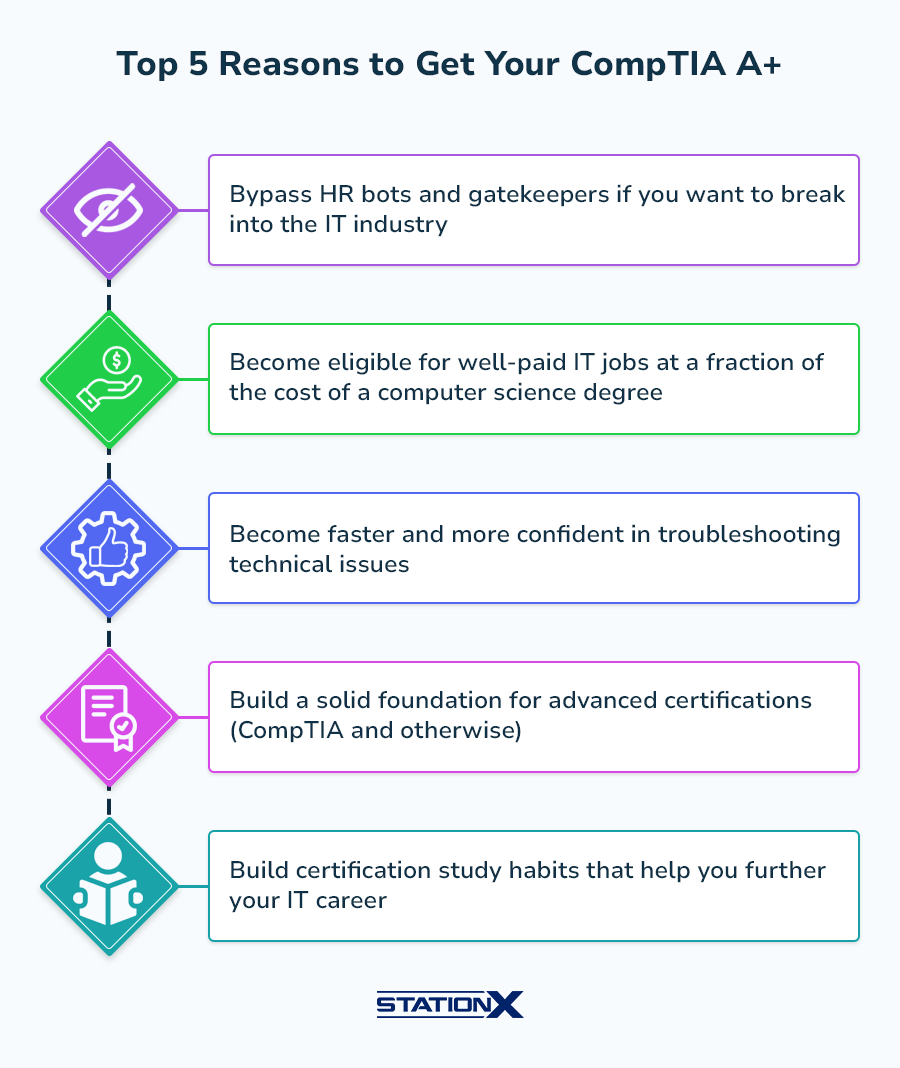
Some of the jobs that list A+ as a requirement include:
- Business Analyst - $60K – $130K
- IT Server Technician - $50K – $75K
- IT Specialist - $55K – $80K
- Data Support Technician - $45K – $65K
- Help Desk Technician - $45K – $65K
- IT Support Manager - $65K – $100K
- MSP Personnel - $50K – $80K
- IT Instructor - $55K – $85K
- Field Service Technician - $45K – $70K
A+ is a step towards qualifying you for the aforementioned jobs, however, employers often want candidates to have prior work experience and pertinent hard skills.
According to Indeed, 8,352 jobs ask applicants to have CompTIA’s A+ certification.

Security+ Job Opportunities
Once you obtain Security+ you’ll qualify for jobs that want A+ in addition to entry-level cyber security positions.
These positions are more advanced and, as such, have higher salaries.
According to CompTIA, once you obtain Security+ you may qualify for the following positions:
- Cyber Security Manager - $110K–$145K
- Business Analyst - $75K–$95K
- Software Developer - $85K–$115K
- Security Consultant - $95K–$125K
- Cloud Security Engineer - $80K–$110K
- Penetration Tester - $75K–$100K
- Compliance Analyst - $70K–$90K
- Network Security Engineer - $85K – 115K
- Security Analyst II - $60K–$85K
While more advanced than A+, having the Security+ on your resume doesn’t automatically qualify you for certain jobs. You’ll also need a grasp of technical tools and perhaps other certifications and hands-on experience to be considered for certain positions.
After searching Indeed, we found 7,467 jobs asking that applicants have Security+.

Career Pivots
The CompTIA A+ and Security+ certifications are career pivot points that let you redefine where your technical skills can take you. Each marks a transition in how you think about technology, problem-solving, and responsibility.
With A+, you lay the foundation for future pivots, such as:
- IT Support → Systems Administration - turning troubleshooting experience into infrastructure management skills.
- Help Desk → Network Operations - applying your foundation in connectivity and device management to network-level oversight.
- Hardware Technician → Cloud Support Specialist - translating your understanding of on-prem systems to hybrid or cloud environments.
These pivots, of course, require their own training, certifications, and experience — but they represent realistic next steps once you’ve built a strong foundation with A+.
With Security+, you’re positioned to advance from roles like:
- IT Administrator → Security Analyst - shifting from maintaining systems to defending them against active threats.
- Network Engineer → SOC Analyst - using your understanding of traffic and configurations to detect and respond to attacks.
- Compliance Assistant → Risk Management Specialist - leveraging your security awareness to align technical practices with governance frameworks.
These transitions also require additional learning and hands-on experience, but Security+ is often the credential that opens the door to them.
In essence, A+ helps you get in the room, and Security+ helps you move up in it. Together, they form a powerful foundation for continuous career evolution, from hands-on tech roles to strategic cybersecurity positions.
Verdict: Security+
If you could pick one certification to put on your resume, it’d be Security+. Even if you’re applying for an IT job that has little to do with cyber security, Security+ is still the more desirable certification. If you have Security+, it means you should have a grasp of the topics covered by A+ and a solid foundation in cyber security.
Cost and Recertification
CompTIA certifications aren’t cheap. Each certification will cost you hundreds of dollars. Recertification may also be pricey, depending on how you choose to recertify.
A+ Cost
To take the CompTIA A+ exam you’ll have to pay $265 per exam. Remember that CompTIA requires A+ test takers to take two exams. In reality, the final cost is $530.
If you fail one exam, you’re able to retake the failed test, but there are no discounts for retaking the exam.
The A+ certification expires every three years. To renew it you may:
- Complete CompTIA CertMaster CE
- Earn a more advanced CompTIA certification, such as Network+ or Security+
- Earn a qualifying non-CompTIA industry certification (not all certifications enable renewal)
Renewal fees are not required should you renew via the CertMaster or advanced CompTIA certifications.
You can also renew by qualifying for 20 Continuing Education Credits (CEUs) over the three-year period. You can earn CEUs by:
- Gaining professional work experience
- Participating in IT industry events
- Publishing white papers, blog posts, or books related to the certification
- Earning a qualifying non-CompTIA industry certification
You need 20 CEUs a year to renew the A+ certification. With an annual fee of $25 you’ll pay $75 to renew if you choose to do so with CEUs.
Security+ Cost
Security+ costs $425 per attempt. There is no discount for a retake.
You can often find discounted vouchers online, or you may qualify for a discount if you’re a student.
Like A+, the certification is valid for three years. After which, you can renew by retaking the exam, obtaining a more advanced certification like CySA+, or Pentest+, or earning 50 Continuing Education Units (CEUs).
If you choose to renew with CEUs, you’ll pay $50 a year, which comes to a total of $150 for three years.

Verdict: Security+
A+ requires test takers to pay $253 for each of the two A+ exams. This totals $506. Should you fail one exam, you’ll have to pay $253 to retake it. Security+ is only one exam totaling $425.
A+ vs Security+: What’s Better?
Our verdict is the Security+ certification.
While both A+ and Security+ are valuable certifications, Security+ carries more weight in the IT and cyber security industry. It signals to employers that you not only understand the fundamentals of IT, but also grasp key cybersecurity principles, making you eligible for a wider range of higher-paying roles.

If you’re preparing for either certification, StationX offers complete training bundles that cover every topic on the exams.
For A+, check out our CompTIA A+ Training Bundle, which includes 40+ hours of video lessons, hundreds of practice questions, and flashcards. As an authorized CompTIA partner, we also offer discounted CompTIA A+ Core 1 and Core 2 exam vouchers, helping you save while you certify.
For those ready to move into cyber security, our CompTIA Security+ Course & SY0-701 Practice Test Bundle is the perfect next step. Plus, you can save up to 30% on your Security+ exam voucher when you purchase through StationX.
And for the full roadmap to success, the StationX Master’s Program provides everything you need to build a long-term, successful career in IT and cyber security, including access to 30,000+ courses, labs, mentorship, and study groups.
Whichever path you choose, we wish you good luck on your IT and cyber security journey!


The Complete CompTIA A+ Training Bundle (Version 15) includes:
- CompTIA A+ Course: CompTIA A+ Core 1 Objectives (220-1201)
- CompTIA A+ Course: CompTIA A+ Core 2 Objectives (220-1202)
- CompTIA A+ Core 1 Practice Test Online (220-1201)
- CompTIA A+ Core 2 Practice Test Online (220-1202)
- CompTIA A+ Study Material: Core 1 Exam Domain Flashcards (v15)
- CompTIA A+ Study Material: Core 2 Exam Domain Flashcards (v15)
The CompTIA Security+ Course & SY0-701 Practice Test Bundle includes:
- CompTIA Security+ Study Guide: SY0-701 Total Course
- CompTIA Security+ Training: Self-Paced Course
- CompTIA Security+ SY0-701 Exam Questions and Answers
- CompTIA Security+ Practice Test Series: Ace the SY0-701
- CompTIA Security+ Exam Objectives Flash Cards: SY0-701 Prep

Guarantee Your Cyber Security Career with the StationX Master’s Program!
Get real work experience and a job guarantee in the StationX Master’s Program. Dive into tailored training, mentorship, and community support that accelerates your career.
- Job Guarantee & Real Work Experience: Launch your cybersecurity career with guaranteed placement and hands-on experience within our Master’s Program.
- 30,000+ Courses and Labs: Hands-on, comprehensive training covering all the skills you need to excel in any role in the field.
- Pass Certification Exams: Resources and exam simulations that help you succeed with confidence.
- Mentorship and Career Coaching: Personalized advice, resume help, and interview coaching to boost your career.
- Community Access: Engage with a thriving community of peers and professionals for ongoing support.
- Advanced Training for Real-World Skills: Courses and simulations designed for real job scenarios.
- Exclusive Events and Networking: Join events and exclusive networking opportunities to expand your connections.
TAKE THE NEXT STEP IN YOUR CAREER TODAY!



Very interesting outlines