If you’re searching for the CompTIA SecAI+ passing score, you’re not alone. One of the first details candidates want to understand is how CompTIA scoring works and what it actually takes to pass the exam. For SecAI+, the passing score is 600 on a scale of 100 to 900, a format that can be confusing without the right context.
CompTIA SecAI+ (exam code CY0-001) was launched on February 17, 2026, making it the world’s first AI security certification. Designed for cyber security professionals securing AI systems and managing AI-related risk, SecAI+ reflects CompTIA’s move toward AI-focused specialization.
Understanding what is the passing score for SecAI+ matters because CompTIA exams use a scaled scoring model rather than a simple percentage. A score of 600 does not mean 60% correct, and misinterpreting this can lead to ineffective study strategies. Knowing how the scoring system works allows you to prepare more strategically, especially for performance-based questions and heavily weighted domains.
In this article, we’ll explain what the CompTIA SecAI+ passing score really means, what to expect based on CompTIA’s exam patterns, how the exam is structured, and how to prepare effectively so you can approach test day with confidence.
What Is the CompTIA SecAI+ Passing Score?
The CompTIA SecAI+ passing score is 600 on a scale of 100 to 900, which immediately stands out compared to other CompTIA security certifications. To understand why this score makes sense and how to interpret it correctly, it helps to look at CompTIA’s standard scoring pattern across its certification portfolio.
CompTIA’s Standard Scoring Pattern
CompTIA uses a scaled scoring system for most of its exams, with scores ranging from 100 to 900. This is not a percentage-based system. A passing score does not mean you answered a fixed percentage of questions correctly, and not all questions are weighted equally.
Historically, many intermediate-level CompTIA security certifications have used a 750/900 passing score, including:
These exams are well-established, broad in scope, and often serve as baseline or gateway certifications across the cyber security industry.
SecAI+ differs in two important ways:
- It is a new expansion-series certification focused on a specialized domain (AI security).
- It targets professionals who already have foundational security knowledge, rather than serving as a universal baseline like Security+.
Because of this, a 600/900 passing score aligns with CompTIA’s pattern of adjusting scaled scores based on exam design, domain weighting, and performance-based evaluation rather than overall difficulty alone.
Remember - a lower scaled passing score does not mean an easier exam. It reflects how CompTIA calibrates scoring across domains, question types, and real-world skill validation.
Why CompTIA Uses Scaled Scoring
CompTIA uses scaled scoring to ensure fairness and consistency across different versions of the same exam. Because question pools, difficulty levels, and exam forms can vary slightly, scaled scoring allows CompTIA to normalize results so candidates are evaluated equitably regardless of which version they take.
Another key reason is the inclusion of performance-based questions (PBQs). PBQs are designed to test real-world skills and are typically weighted more heavily than standard multiple-choice questions. In addition, harder questions are generally worth more points than easier ones, reflecting the depth of knowledge required to answer them correctly.
Importantly, you won’t know which questions carry more weight during the exam. This is intentional. It encourages candidates to treat every question seriously and focus on overall competency rather than trying to game the scoring system.
CompTIA SecAI+ Exam Overview
The CompTIA SecAI+ certification exam validates that a successful candidate has the knowledge and skills required to secure modern AI-driven environments. The exam focuses on understanding core AI concepts, applying technical controls to protect AI systems, leveraging AI to enhance an organization’s overall security posture, and understanding how governance, risk, and compliance (GRC) requirements impact AI technologies globally.
SecAI+ is designed for professionals who already have a solid grounding in IT and cyber security and are ready to extend those skills into AI-specific security challenges. CompTIA positions this exam at a level equivalent to 3-4 years of general IT experience and approximately 2 years of hands-on cyber security experience.
FREE Cyber Security Career Guide
Thinking of a career in cyber security? Our Cyber Security Career Guide walks you through the industry landscape, skill-paths, certifications, and realistic timelines to become job-ready.
Exam Details
Before diving into preparation strategies, it helps to understand how the SecAI+ exam is structured.
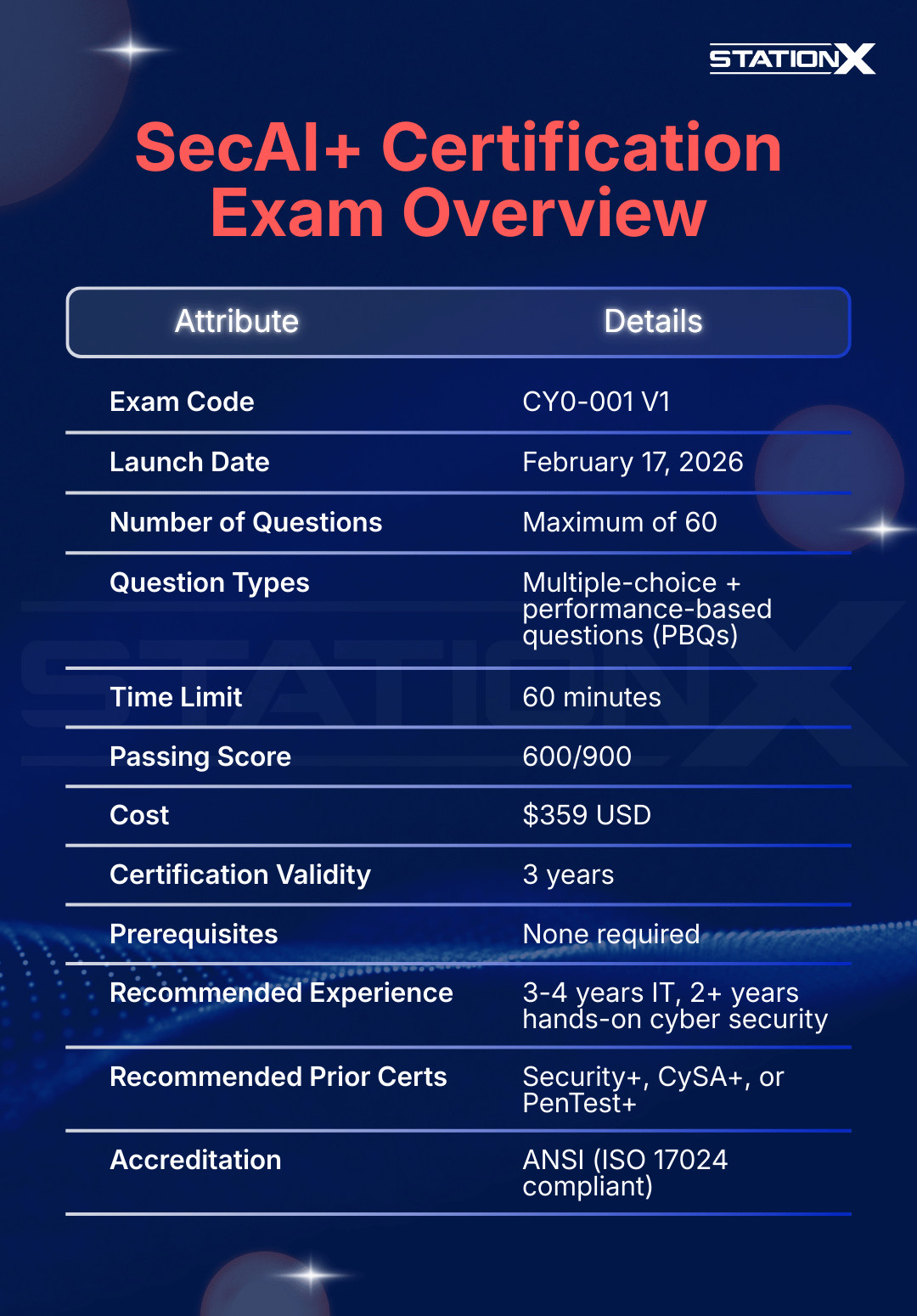
The table below summarizes the key exam attributes based on CompTIA’s published information and patterns from similar certifications, highlighting what candidates can realistically expect when planning their study timeline and exam approach.
Exam Domains and Weighting
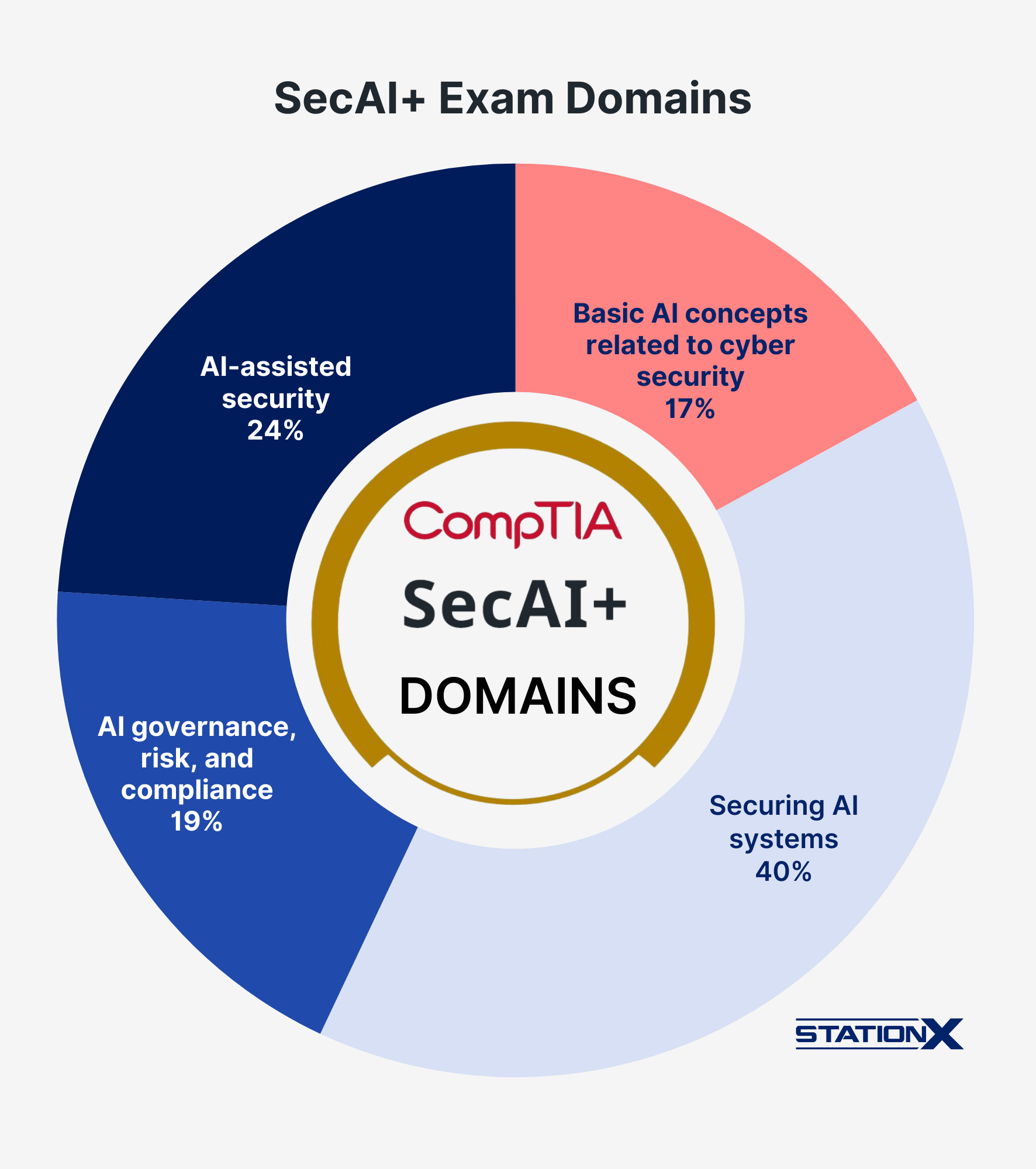
To build an effective study plan, it’s important to understand how the SecAI+ exam is weighted.
1.0 Basic AI Concepts Related to Cybersecurity (17%)
Covers foundational AI knowledge needed by security professionals, including common AI types (LLMs, ML, NLP), model training techniques, prompt engineering, data security concepts, and the importance of securing AI across its entire lifecycle with human oversight.
2.0 Securing AI Systems (40%)
Focuses on protecting AI systems from real-world attacks using threat modeling frameworks (OWASP, MITRE ATLAS), implementing security and access controls, securing data, monitoring and auditing AI behavior, and detecting and mitigating AI-specific attacks such as prompt injection, poisoning, jailbreaking, and model theft.
3.0 AI-Assisted Security (24%)
Examines how AI can be used to enhance security operations, including automated detection, incident response, vulnerability analysis, and CI/CD security, while also understanding how attackers leverage AI to scale cyber attacks, social engineering, and exploitation.
4.0 AI Governance, Risk, and Compliance (19%)
Addresses organizational governance structures, responsible AI principles, AI-related risks, and global compliance requirements, including the EU AI Act and NIST AI RMF, and emphasizes how regulation and policy shape the secure and ethical use of AI.
This table outlines the four exam domains, their percentage of the exam, and the primary focus areas CompTIA emphasizes.
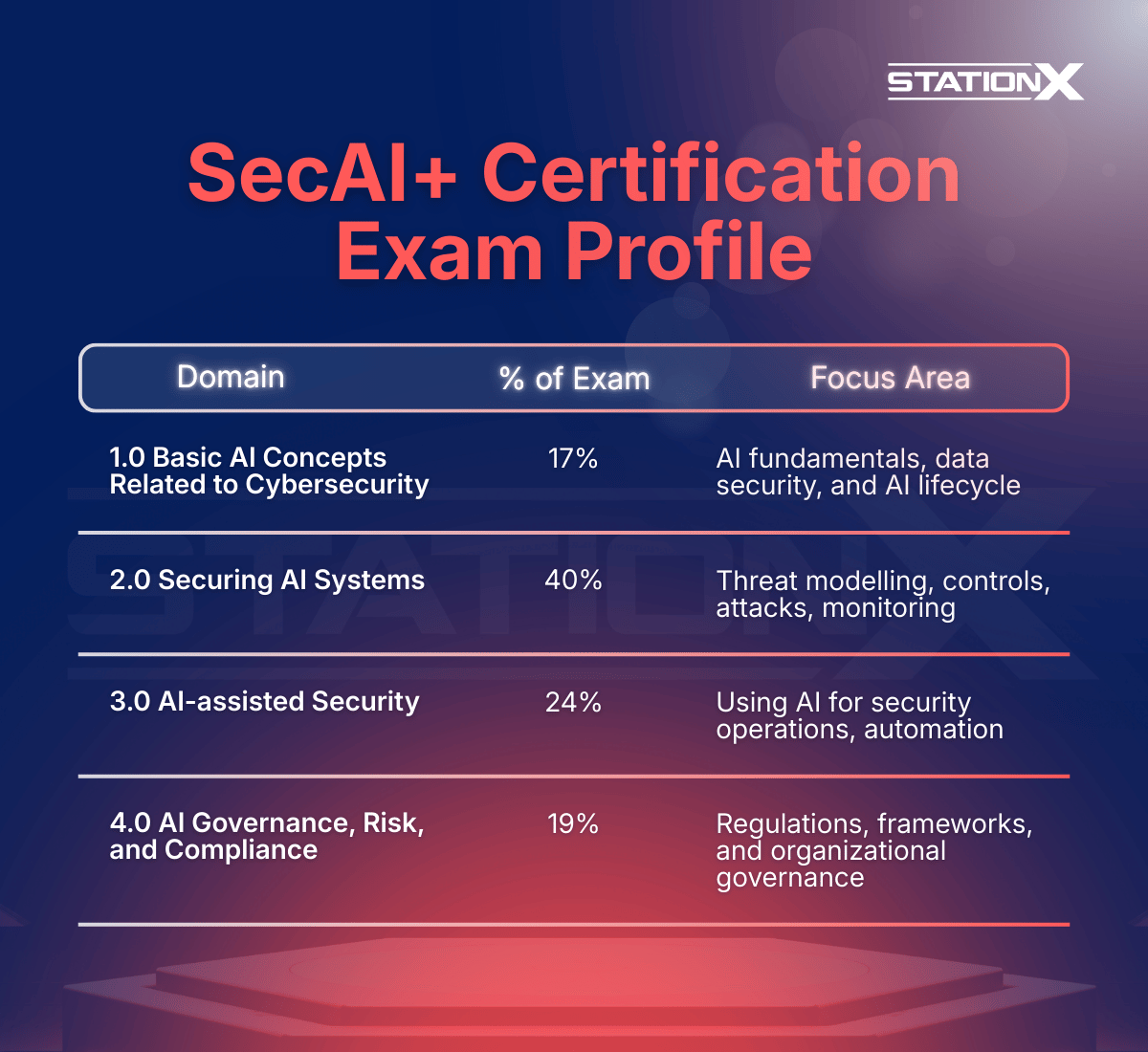
With nearly half of the exam focused on Securing AI Systems, Domain 2 deserves the majority of your study time. It concentrates on hands-on, real-world AI security concerns such as the OWASP LLM Top 10, MITRE ATLAS, AI threat modeling, and prevalent attack techniques, including prompt injection, model poisoning, jailbreaking, and other adversarial behaviors.
What Are Performance-Based Questions (PBQs)?
Performance-Based Questions (PBQs) are hands-on, simulation-style tasks that test your ability to apply knowledge in realistic scenarios. On CompTIA exams, PBQs are typically worth more points than multiple-choice questions because they measure real-world skills rather than recall.
For SecAI+, PBQs are expected to focus on practical AI security tasks such as:
- Configuring AI security controls (prompt firewalls, guardrails, rate limiting)
- Analyzing evidence of AI attacks (prompt injection, model poisoning, jailbreaking)
- Implementing access controls for AI systems and APIs
- Monitoring AI system logs to identify anomalies or misuse
- Applying data security controls (encryption, anonymization, masking)
Test-day strategy:
A common and effective approach is to skip PBQs at the start, complete all multiple-choice questions first, and then return to PBQs with the remaining time. This helps ensure you secure points more easily early and approach PBQs without time pressure.
How to prepare:
Hands-on practice matters most. Use official CompTIA labs (CertMaster Labs) and practical environments like the StationX Master’s Program to build the muscle memory needed to succeed on PBQs.
How SecAI+ Domains Translate to PBQs
These mappings are based on CompTIA’s official exam design approach and the official objectives published for SecAI+. While CompTIA does not release exact PBQ formats in advance, the domains clearly signal the key topics candidates will be tested on through hands-on, performance-based scenarios.
Focusing your PBQ practice around these areas helps ensure you’re evaluated fairly across different exam versions, since CompTIA uses scaled scoring rather than relying on raw scores alone.
1.0 Basic AI Concepts Related to Cybersecurity
PBQ focus: Understanding and explaining AI components and data flows
- Identify appropriate AI types or models for a given security scenario
- Interpret prompt structures (system vs. user prompts, zero-/few-shot)
- Assess data handling issues (data integrity, provenance, RAG misuse)
- Identify risks across stages of the AI lifecycle (training vs. inference)
PBQs here are usually lighter and diagnostic rather than deeply hands-on.
2.0 Securing AI Systems (Highest PBQ Density)
PBQ focus: Hands-on defense and attack mitigation
- Configure prompt firewalls, guardrails, rate/token limits
- Analyze AI attack evidence (prompt injection, poisoning, jailbreaking)
- Apply access controls to models, data, APIs, or agents
- Implement data security controls (encryption, masking, minimization)
- Review logs and monitoring outputs to detect misuse or anomalies
- Select compensating controls for identified AI attacks
Expect the most time-consuming and highest-value PBQs from this domain.
3.0 AI-Assisted Security
PBQ focus: Using AI as a security tool
- Choose AI-enabled tools for detection, response, or analysis
- Automate security tasks (incident triage, ticketing, CI/CD checks)
- Identify how AI improves or accelerates security workflows
- Recognize when AI increases risk (deepfakes, automated attacks)
PBQs often involve selecting or configuring the right AI-assisted approach.
4.0 AI Governance, Risk, and Compliance
PBQ focus: Decision-making and policy alignment
- Map AI use cases to regulatory or governance requirements
- Identify organizational roles responsible for AI oversight
- Assess AI risks (bias, privacy, IP, shadow AI)
- Select appropriate frameworks (EU AI Act, NIST AI RMF) for a scenario
These PBQs test judgment and framework knowledge rather than configuration.
How to Pass the CompTIA SecAI+ Exam
Here are some practical steps and tips to help you prepare effectively for the SecAI+ exam. Keep these in mind as you work toward the required security passing score, especially given the exam’s focus on real-world scenarios rather than rote memorization.
Success starts with understanding the exam format and the minimum passing score, then committing to thorough preparation through a structured and intentional study plan. Whether you decide to test online or at a test center, focus on strengthening security fundamentals and building the essential knowledge needed to analyze AI security scenarios under time pressure.
Following a structured approach and practicing how you apply concepts, not just recall them, will greatly improve your chances of earning a passing score on exam day.
Download and Study the Official Exam Objectives
Start with the official exam objectives - this is your single most important study document and should drive everything you do.
- Use it as your study roadmap, not just a reference
- Map each objective to notes, labs, and practice questions
- Prioritize Domain 2 (Securing AI Systems), which accounts for 40% of the exam
Get Hands-On Experience with AI Security Tools
Hands-on practice is critical, especially for performance-based questions (PBQs). The exam is designed to test applied skills, not just theory.
Recommended lab environment (aligned with the objectives):
- Hardware: Cloud VMs, GPUs (optional), sandboxed environments
- Software: Python/R, Jupyter notebooks, LLMs, vector databases, open-source tools (GitHub projects, Ollama)
Practice scenarios to master:
- Test prompt injection attacks against LLMs
- Configure prompt firewalls and guardrails
- Implement AI monitoring and logging
- Conduct AI threat modeling using OWASP LLM Top 10 and MITRE ATLAS
Master Key Frameworks
You should be able to recognize, explain, and apply the following frameworks without hesitation:
- OWASP LLM Top 10 - Core vulnerabilities in large language models
- OWASP ML Security Top 10 - Machine learning attack vectors
- MITRE ATLAS - Adversarial Threat Landscape for AI Systems
- NIST AI RMF - U.S. AI Risk Management Framework
- EU AI Act - European AI regulation (fines up to €35M or 7% of global revenue)
- MIT AI Risk Repository - Comprehensive AI risk taxonomy
Expect these to appear in both multiple-choice questions and PBQs.
Take Practice Exams Seriously
Practice exams are your readiness indicator, not just a confidence boost.
- Aim for consistent 85%+ scores before sitting the real exam
- Review every incorrect answer and understand why it was wrong
- Simulate real exam conditions (timed, no distractions)
- Use results to identify weak areas, especially Domain 2
Book Your Exam Strategically
- Exam launch: February 17, 2026
- Schedule your exam in advance to create urgency and structure (you can reschedule the date without penalty, up to a year from the purchase date)
- Choose the format that suits you best:
- Online (at-home): Convenient, flexible
- In-person testing center: Fewer technical risks, more controlled environment
A firm exam date turns studying into execution.
Exam Day Tips
Going into exam day with a clear plan can make a meaningful difference in your performance. Here are some practical tips to help you stay focused, manage your time effectively, and perform at your best:
- Arrive early, or log in at least 15 minutes early if you’re testing online, to avoid unnecessary stress or technical delays.
- Read every question carefully. CompTIA exams are known for precise and sometimes tricky wording, where a single term can change the correct answer.
- Skip PBQs at the start. Begin with multiple-choice questions to earn points more quickly, then return to performance-based questions, which are more time-consuming.
- Flag uncertain questions and revisit them at the end, rather than getting stuck.
- Don’t panic if the exam feels difficult. Take things one question at a time. Often, another question’s phrasing will give you a big hint about previously skipped questions.
- Manage your time intentionally. Keep an eye on the clock and pace yourself across all sections.
- For AI attack scenarios, especially in Domain 2, mentally map the situation to familiar frameworks like the OWASP LLM Top 10 and MITRE ATLAS to guide your analysis.
Staying calm, methodical, and framework-driven is often the difference between a near miss and a pass.
Remote Cyber Security Jobs Database
Looking to work from anywhere? Tap into our Remote Cyber Security Jobs Database — over 360 remote-friendly companies, 70+ cyber employers hiring remotely, and 50+ niche job boards all organised into one curated resource.
What Happens After You Pass?
Once you complete the exam, you’ll see a “Pass” notification on the screen immediately, no waiting period. Your official SecAI+ certificate and digital badge will arrive in your inbox from CompTIA within a few days.
After that, you should:
- Add SecAI+ to your LinkedIn profile and resume to signal your AI security specialization
- Share the credential with employers or clients as proof of validated skills
Certification status and renewal
SecAI+ is ANSI-accredited (ISO/IEC 17024-compliant), which gives it global recognition. The certification is valid for 3 years and requires CEUs for renewal.
While DoD 8570/8140 approval has not yet been confirmed, it is widely expected given CompTIA’s historical adoption across government and defense roles.
Next steps after SecAI+:
To continue advancing, consider pairing SecAI+ with higher-level or specialized certifications, such as:
- CISSP for senior security leadership
- Offensive AI / Red Teaming certifications for adversarial AI testing
- Cloud and AI certifications like Azure AI-102 or AWS Machine Learning Engineer
Achieving the required CompTIA SecAI+ exam score isn’t the finish line, but rather a strategic milestone that positions you to pursue more advanced, higher-impact roles in AI security.
Conclusion
The confirmed CompTIA SecAI+ passing score is 600 out of 900, but success on the exam isn’t about chasing a number, it’s about preparing strategically. That means understanding the exam structure, gaining hands-on AI security experience, mastering key frameworks such as OWASP, MITRE ATLAS, and NIST, and validating readiness through realistic practice exams.
As the world’s first AI security certification, SecAI+ positions you at the forefront of an emerging discipline within CompTIA exams, preparing certified professionals to support security teams as organizations scale their use of artificial intelligence. The certification validates your ability to secure AI systems and address AI-specific risks in real-world environments.
With the exam officially launched on February 17, 2026, now is the time to prepare. Pre-order official study materials, build your lab environment, and follow a structured plan.
For guided, hands-on preparation and career support, explore the StationX Master’s Program and get access to an extensive library of over 30,000 cyber security courses and labs, mentorship, career guidance, and more, all designed to help candidates build practical skills and move confidently into professional cyber security roles.
Pairing this with SecAI+ course bundles can further accelerate your readiness and help you approach exam day with confidence. Best of luck!
We have bundles on:
- Pentesting, red teaming, and web app hacking
- Certification prep, including CompTIA, ISC2, AWS, Cisco, and Azure
- DevSecOps and Coding
- Linux
- AI
- And much more!
Frequently Asked Questions

Guarantee Your Cyber Security Career with the StationX Master’s Program!
Get real work experience and a job guarantee in the StationX Master’s Program. Dive into tailored training, mentorship, and community support that accelerates your career.
- Job Guarantee & Real Work Experience: Launch your cybersecurity career with guaranteed placement and hands-on experience within our Master’s Program.
- 30,000+ Courses and Labs: Hands-on, comprehensive training covering all the skills you need to excel in any role in the field.
- Pass Certification Exams: Resources and exam simulations that help you succeed with confidence.
- Mentorship and Career Coaching: Personalized advice, resume help, and interview coaching to boost your career.
- Community Access: Engage with a thriving community of peers and professionals for ongoing support.
- Advanced Training for Real-World Skills: Courses and simulations designed for real job scenarios.
- Exclusive Events and Networking: Join events and exclusive networking opportunities to expand your connections.
TAKE THE NEXT STEP IN YOUR CAREER TODAY!