Many students looking to break into cyber security find themselves overwhelmed with the number of available certifications. CompTIA’s PenTest+ and EC-Council’s Certified Ethical Hacker (CEH) are respected entry-level hacking certifications, but their similarities make it difficult to determine which to pursue.
Any certification worth having requires you to invest time and money - neither of which you want to waste. With that in mind, we will look at the differences between CEH vs PenTest+ and help you find out which is best for you.
About CEH and PenTest+ Certifications
CEH and PenTest+ are entry-level hacking certifications, placing them in the lower-mid tier of the security certification landscape.
Both exams cover technical aspects of ethical hacking, such as tools, terminology, methodology, and commands, but there are differences in their respective domain focus.
About CEH
According to the EC-Council website, the Certified Ethical Hacker (CEH) equips you with “the essential skills to excel in cybersecurity”.
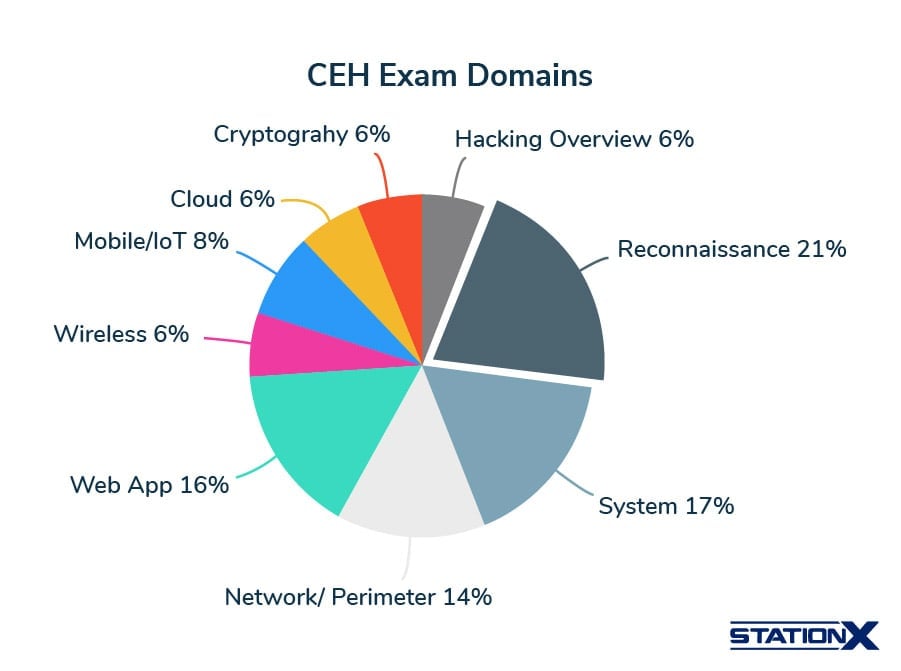
On the CEH exam, the focus is scanning and enumeration, exploiting vulnerabilities, malware analysis, and various attack strategies. PenTest+ covers many of the same techniques and attack vectors, but CEH dedicates 79% of its 125 questions to those topics.
While there is significant overlap between the two certifications, CEH will expect you to go deeper into technical topics such as footprinting, specific sniffing techniques, and avoiding detection.
About PenTest+
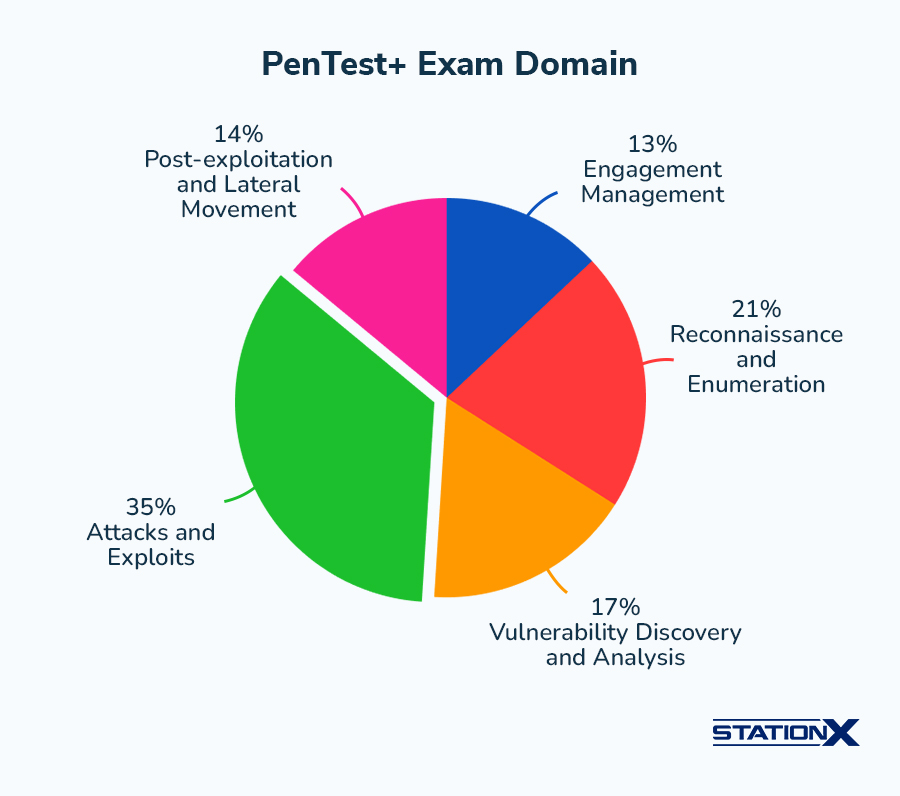
CompTIA’s PenTest+ is a mid-level cyber security certification that validates your ability to identify, exploit, and report system vulnerabilities across modern attack surfaces, including networks, web applications, cloud, IoT, and APIs. It’s designed to test real-world penetration testing skills while emphasizing professional conduct, reporting, and compliance.
Unlike certifications that focus solely on exploitation, PenTest+ takes a full lifecycle approach, from planning and scoping engagements to executing attacks and delivering actionable remediation reports. The exam covers both technical capabilities (using tools like Nmap, Nessus, and Wireshark, plus foundational scripting in Python, Bash, and PowerShell) and administrative knowledge, including client communication, scope management, and legal considerations.
Career Progression and Certification Pathways
When comparing CEH vs PenTest+, it’s important to understand that they serve slightly different purposes in a cybersecurity career. Both can support early progression toward offensive or security-related roles, but how you use them depends on your goals, experience level, and who you’re trying to impress.
CEH is often pursued first because of its name recognition. It’s been around longer, appears in thousands of job listings, and is especially favored by HR departments and government contractors that recognize it for DoD 8570 compliance. While it doesn’t test hands-on skills, it’s a strategic “HR bypass” that helps you get your foot in the door and demonstrate baseline ethical hacking knowledge.
PenTest+, on the other hand, is more conceptually aligned with what penetration testers do, including engagement planning, scope management, client communication, and report writing — the parts of the job clients care most about. While it’s not yet as recognized by recruiters, it carries CompTIA’s credibility, and for those seeking DoD 8570 approval at a lower cost than CEH, it’s the more affordable and compliance-friendly choice.
For those focused purely on proving real technical skill, certifications like OSCP or GPEN are the next step beyond either of these. CEH may open doors, but PenTest+ helps reinforce your understanding of what to do once you’re in.
Common Certification Pathways
Your choice between CEH and PenTest+ depends on whether you’re optimizing for visibility or technical growth. Treat both as useful but optional steps that you can insert based on your goals (DoD 8570, HR filters, foundation before hands-on certs).
1. Offensive Security Track
- Goal: Hands-on ethical hacking and red teaming
- Path: Security+ → (optional: CEH for HR recognition or PenTest+ for structured methodology validation) → OSCP / GPEN
CEH can help you get your foot in the door — it’s recruiter-friendly and often listed in entry-level ethical hacking job ads. PenTest+ can also fill this role and better maps to the testing lifecycle. Once you’ve built some experience, move to hands-on certs (OSCP) to prove real skill.
Ideal for: Penetration Testers, Red Team Operators, Ethical Hackers, Vulnerability Analysts
2. Compliance and Leadership Track
- Goal: Advance into governance, audit, or management roles
- Path: Security+ → CySA+ → (optional: CEH for DoD/HR filters if required by listings) → CISA / CISSP
Security+ builds foundational security knowledge. CySA+ validates blue-team analysis, monitoring, and reporting — a better fit for compliance/GRC trajectories than PenTest+. CEH may be added optionally for DoD 8570 recognition or to satisfy HR filters, but it’s not required for skills progression.
Ideal for: Security Consultants, Auditors, GRC Professionals, and IT Managers pursuing executive-level or compliance-focused careers.
In our opinion, you don’t need both CEH and PenTest+ since they overlap far too much.
- If your aim is to meet compliance requirements and stand out in the hiring process, CEH will get you noticed faster.
- If you’re more interested in planning, testing, reporting, and advising clients, PenTest+ is more relevant, while still meeting compliance standards at a cheaper price.
- And if you’re aiming for true hands-on mastery, move straight toward OSCP or GPEN once you’ve covered the basics.
Both certifications have their place, but only one should fit into your path, depending on whether you’re chasing recognition or results.
Exam Details
PenTest+ and CEH are often compared not only due to the overlap of material but the similarities in the exam format. They are each primarily multiple-choice exams that can be written through PearsonVue and you will receive your results immediately after completion.
That is not to say the exams are equal. So, let’s compare the length, question style, and passing score to determine which performs a more thorough examination of your skillset and knowledge base.
CEH Exam Details
Certified Ethical Hacker (CEH) consists of 125 multiple choice questions with no simulations. The passing score is dependent on the question bank you get and can range anywhere from 65% to 80%.
CEH questions tend to be more matter-of-fact than those on PenTest+. An example might be, “which of the following tools can be used for remote password cracking?” or “What type of attack involves pretending to be an employee and requesting a password reset?”
PenTest+ Exam Details
CompTIA’s PenTest+ has a maximum of 85 questions, combining multiple-choice and performance-based questions. Many of the multiple-choice questions follow the given this scenario format, which asks for the best answer under the prescribed conditions.
An example might be, “you discover several devices vulnerable to a buffer overflow attack, but there is no patch from the manufacturer. Which of the following mitigations would you recommend?”
The performance-based questions have you perform basic tasks, such as running Nmap with the correct flags for the required result or completing a missing snippet of Powershell or Bash script. While these may sound intimidating, they tend not to be overly complex.
The test is two hours and 45 minutes long and scored between 100 and 900 points with a passing grade of 750.
Winner: PenTest+
Being a pentester is more than just memorizing terms. As a pentester in the field, you will need to perform critical thinking. “Given this scenario, what do I do?”
CEH doesn’t give you this challenge, nor does it require you to perform any tasks expected of an ethical hacker.
Eligibility Requirements
If you find yourself confused when looking at prerequisites and required experience for these two exams, you’re in good company. We are often asked to clarify the requirements to sit for these exams, so let’s review these now.
CEH Requirements
CEH, however, gives you two options.
Option one: You take an official EC-Council partnered training course.
Option two: You have a minimum of two years in information security. You must submit an application fee of $100 (non-refundable) and await formal approval from EC-Council’s certification department.
These requirements put CEH further out of reach for some students, since you are paying for both the official training and the exam, or have already been working in the industry for a couple of years.
Learn more from our "How to Get the Certified Ethical Hacker (CEH) ANSI Certification" article.
PenTest+ Requirements
Pentest+ calls for knowledge equal to a Network+ and Security+ certification holder and three to four years of experience pentesting. This is not a requirement or prerequisite to writing the exam.
Pentesting is an advanced discipline within information security, so while a working knowledge equivalent to holding the Network+ and Security+ is recommended, you do not need any certifications to be eligible to write this exam.
The years of experience are also not a requirement, unlike the CISA or CISSP. The three to four years is simply used as a metric for the level of knowledge you should possess to be successful in passing this exam.
Winner: PenTest+
With no prerequisites, PenTest+ allows you to prepare however you feel most comfortable without requiring any industry experience.
Exam Difficulty
Exam difficulty is subjective. That said, our experience is that PenTest+ is the more difficult of the two exams. We see this opinion reflected in reviews, blogs, and forum posts from past students who have taken both.
When assessing why PenTest+ is generally considered more difficult, there are several factors to consider.
- First is the scope of the subject matter. Planning and report writing make up a combined 32% of the PenTest+ exam. That is 32% more content than CEH to cover in your studies.
- The second is the time frame. CEH gives you an hour and 15 minutes longer to write the exam. When you consider the number of questions, CEH gives you slightly less than 2 minutes per question. PenTest+ averages about the same over its 85 questions. However, you can have anywhere from one to six performance-based tasks, which take much longer than a simple multiple-choice question. This will cut down the time you can spend per question.
- Thirdly, the performance-based questions themselves add a level of difficulty not seen in CEH. These questions take more time, need to be thought out, and due to their complexity, may be eligible for partial scoring.
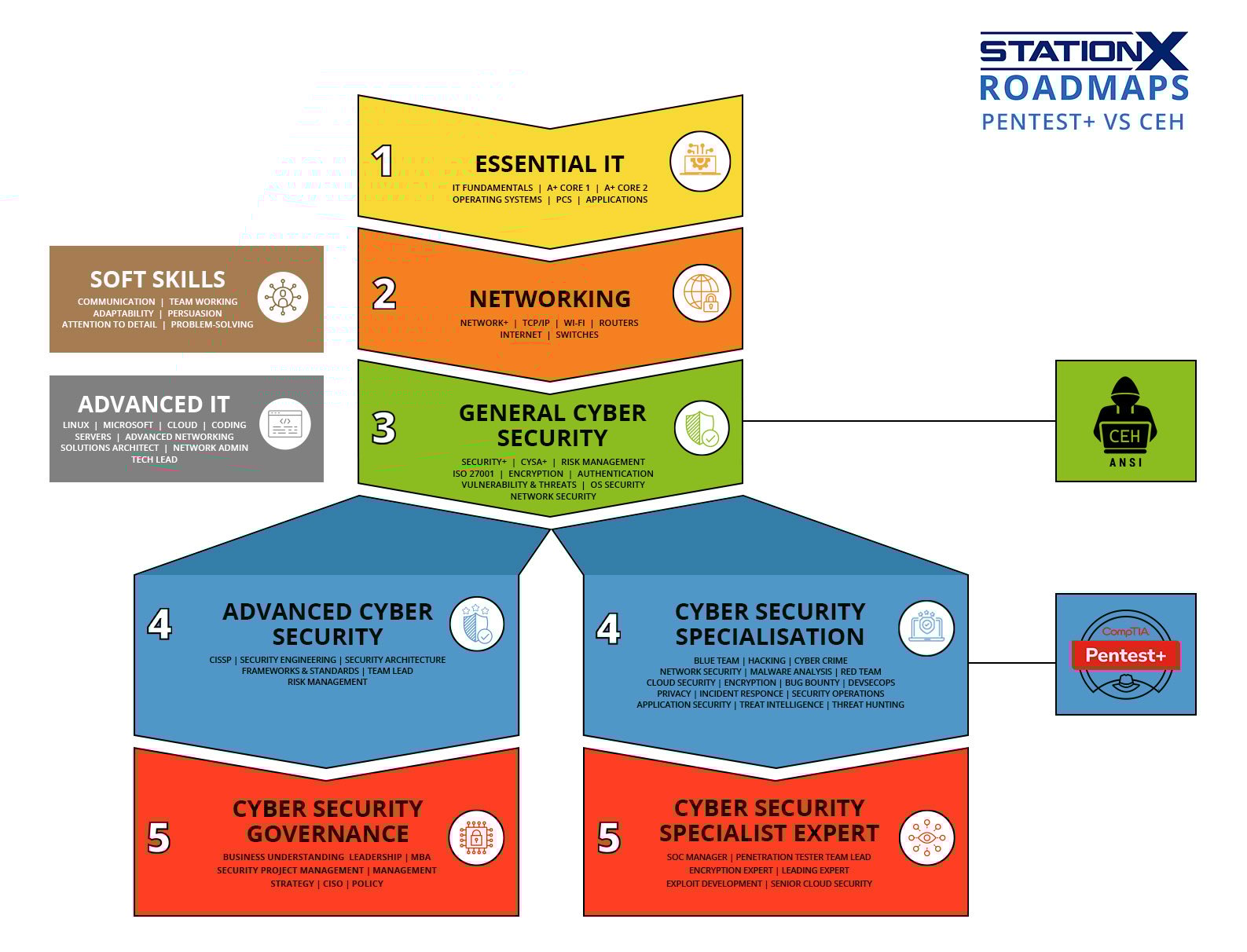
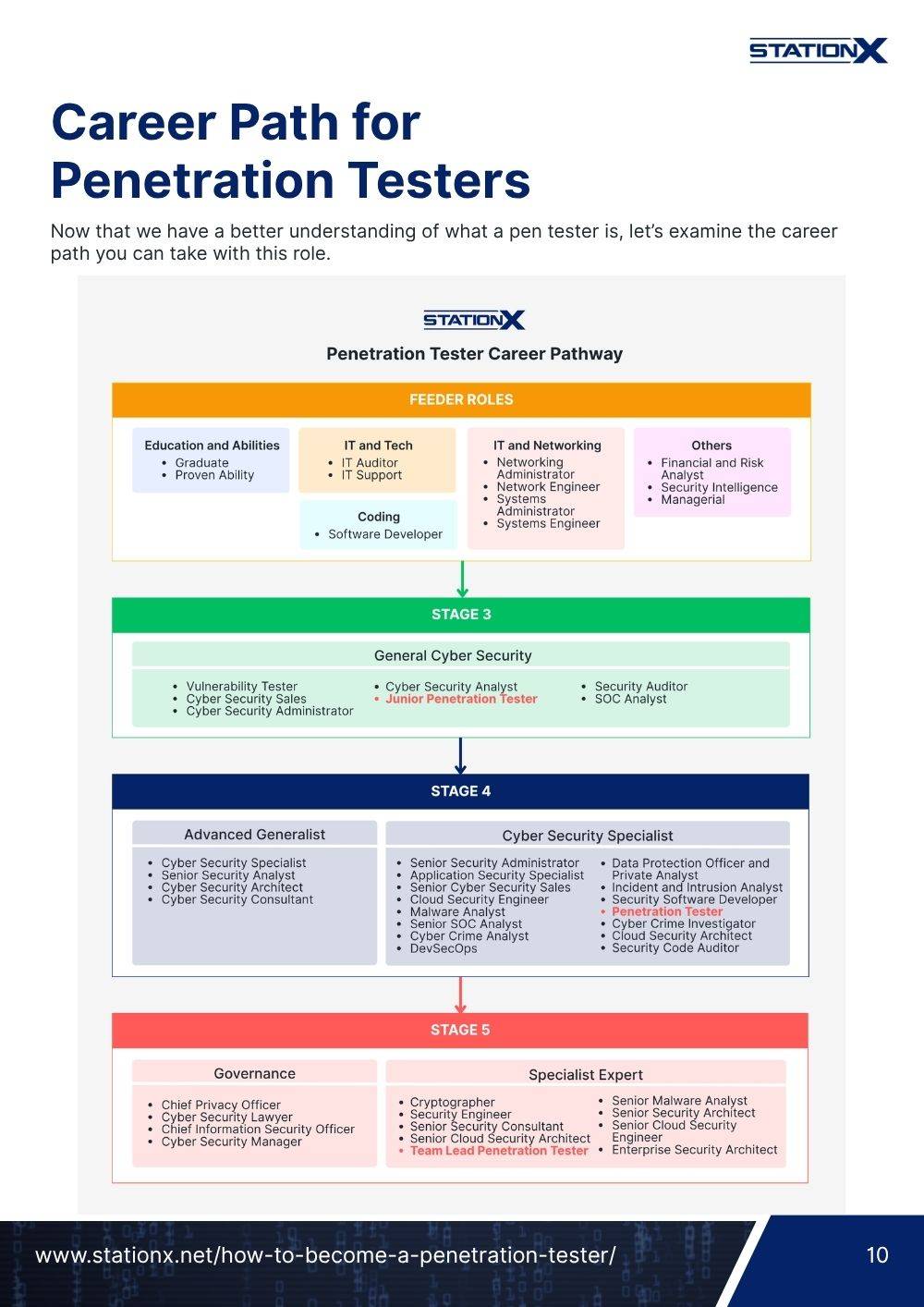
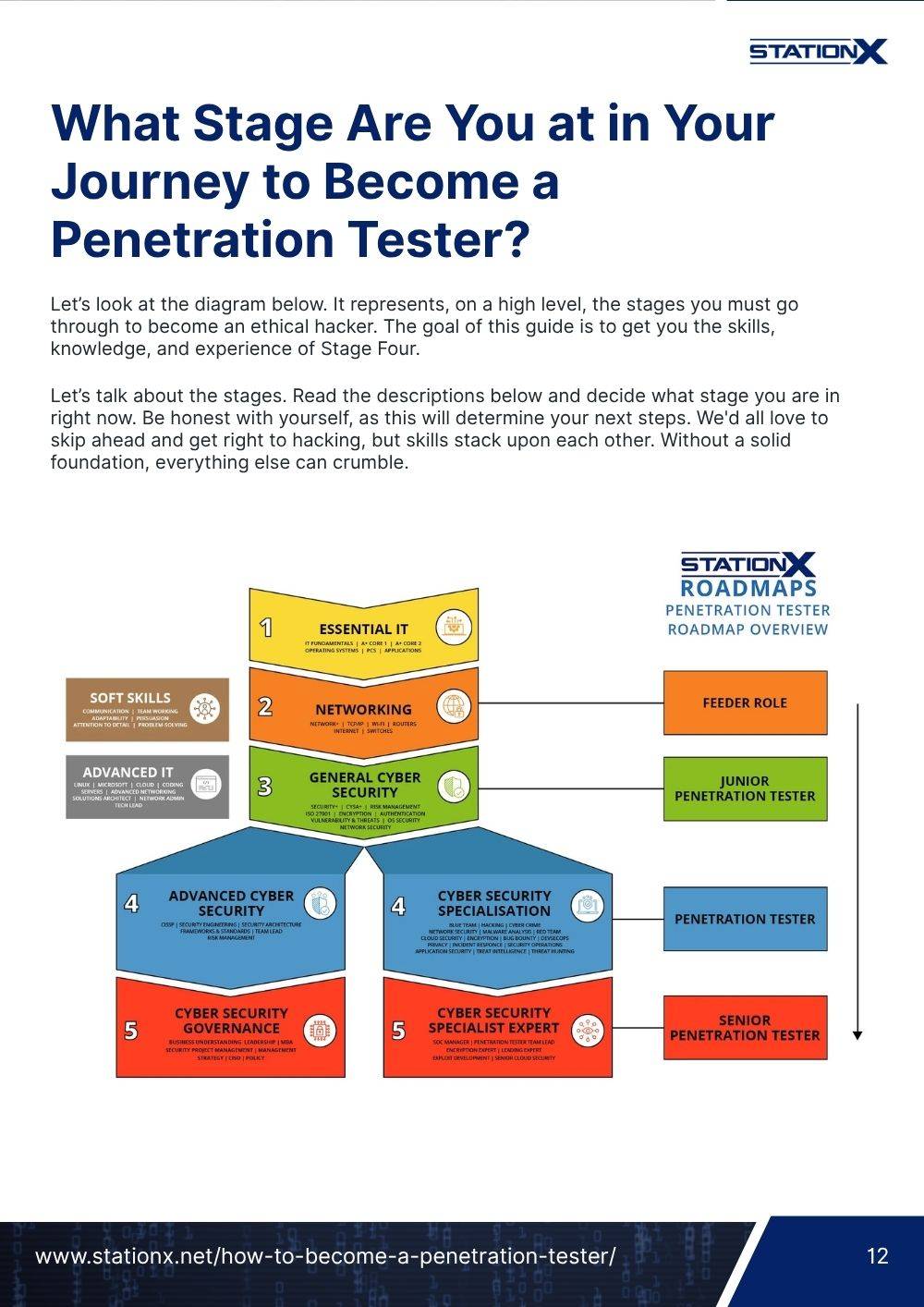
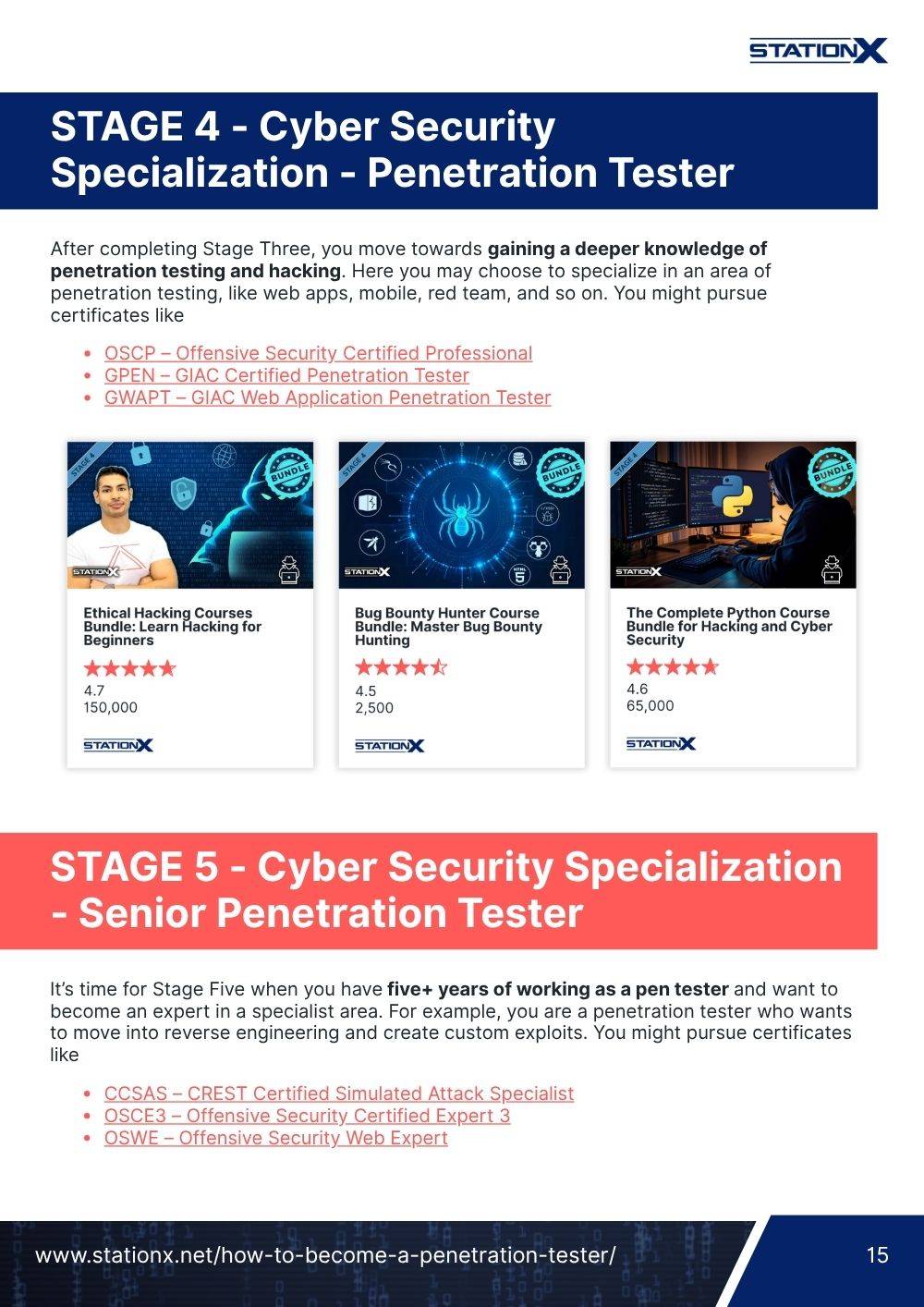
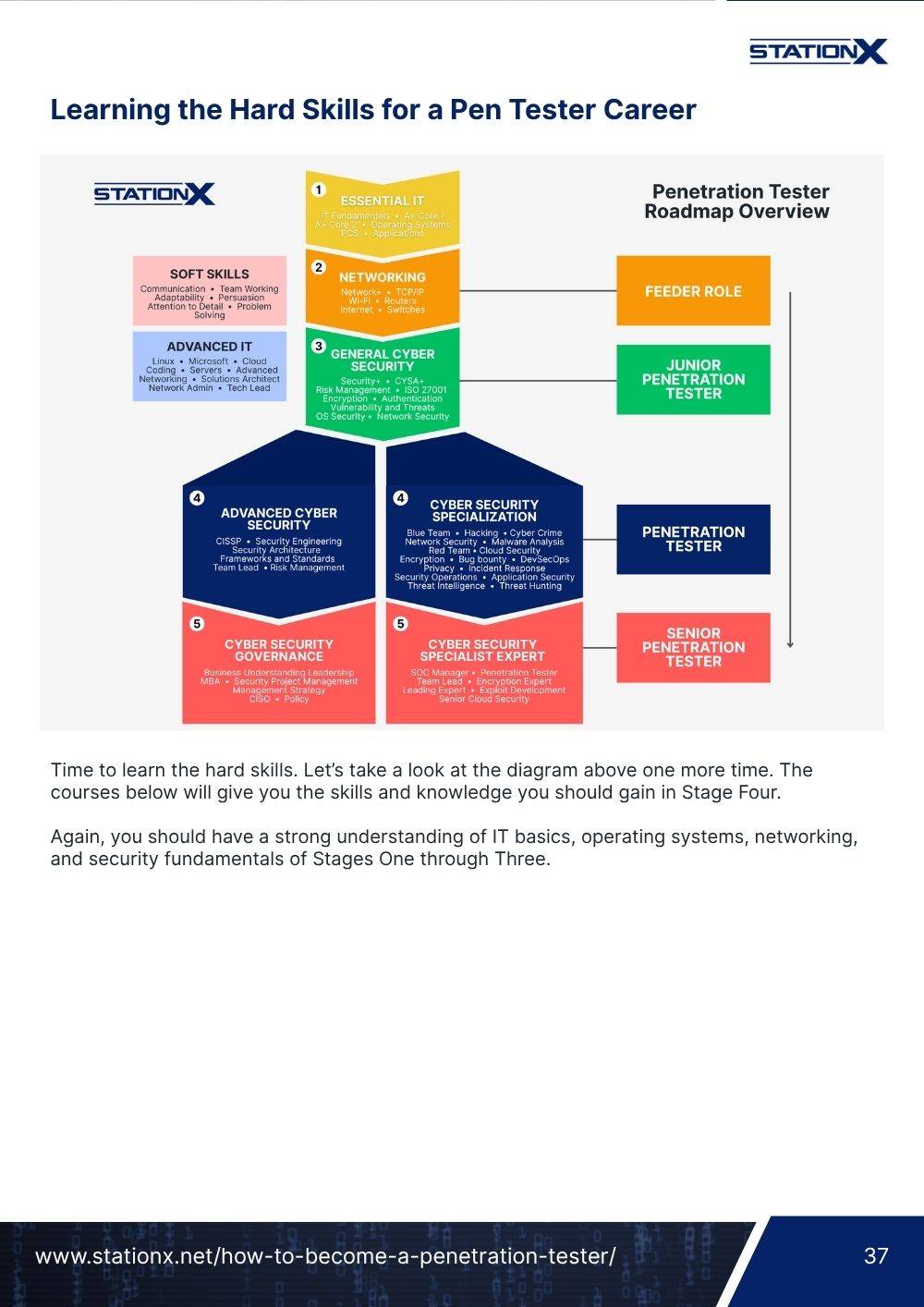
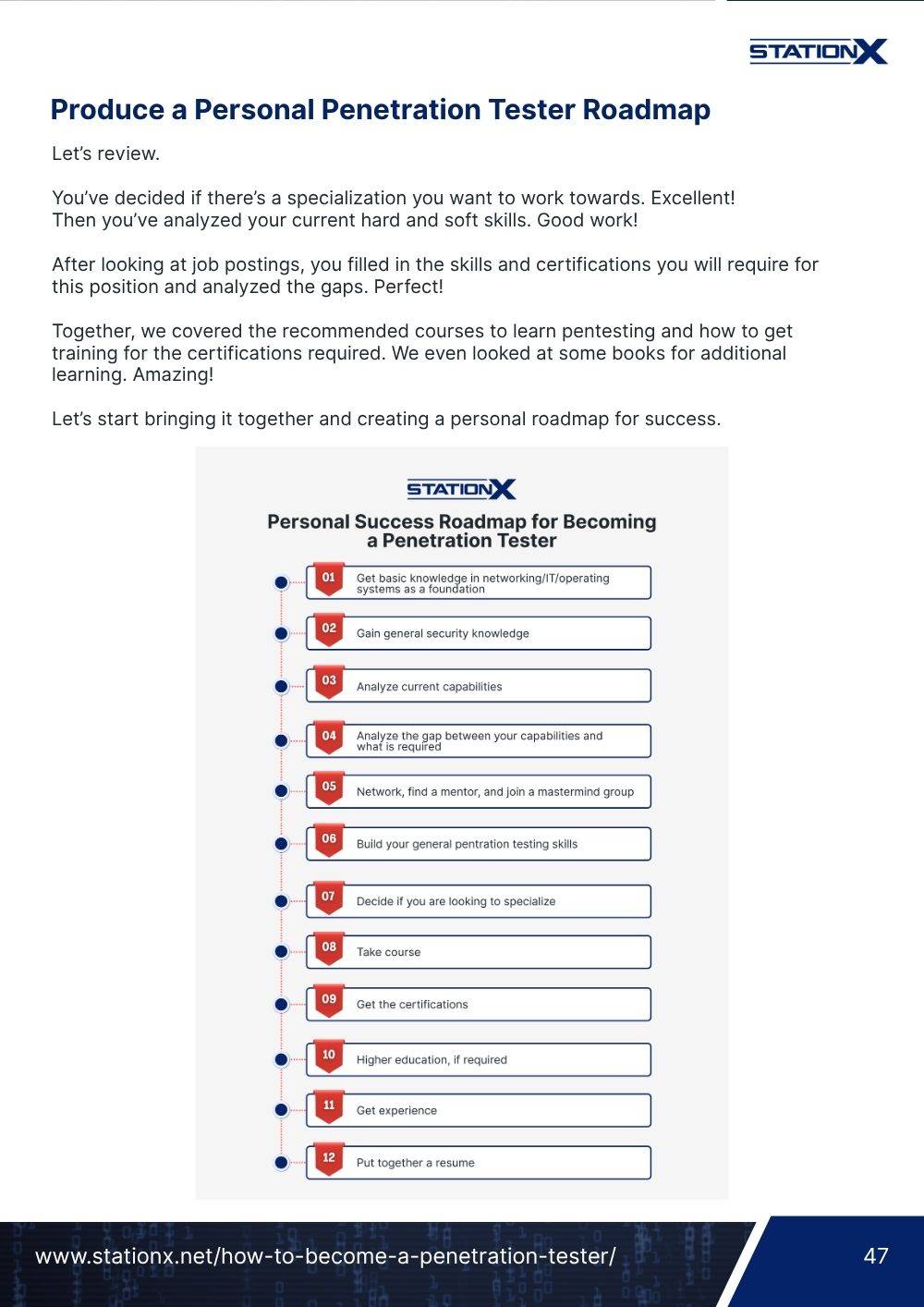
- Finally, let's take a look at the skills roadmap below. You would pursue CEH when you enter stage three, as you are ready to develop a stronger, albeit general, knowledge of cyber security. PenTest+, covering legal and administrative details, proper procedures, and some hands-on questions, would be pursued in stage four, where you begin to develop the knowledge and skill to specialize and gain a deeper understanding of cyber security.
Winner: CEH
CEH is widely considered the easier exam to pass due to the strict multiple-choice format, narrower scope, and longer sit time.
We give this verdict with a caveat. This is not to say that CEH is an easy exam, nor that you should be discouraged from writing PenTest+. Whether you think a lower comparative difficulty is a benefit or a deterrent is subjective.
Recognition and Reputation
How are PenTest+ and CEH viewed in the industry? Let’s discuss the reputation of these certifications and the organizations they belong to.
CEH’s Reputation
When it comes to recognition, CEH has a lot going for it. It’s been around for over 19 years and has long been a standard for regulatory compliance, being included in DoD Directive 8570 and recognized by ANSI/IEC/ISO 17024 long before PenTest+ came on the scene.
CEH is famous enough that even those with only a periphery knowledge of offensive cyber security have heard of it, which is great when you’re trying to get noticed by a potential employer’s human resources department.
When it comes to grabbing the attention of a hiring director who isn’t themselves a cyber security expert, the title “Certified Ethical Hacker” says it all. According to the EC-Council, 92% of employers prefer CEH graduates for ethical hacking jobs.
Unfortunately, the prestige stops there. CEH might be popular among recruiters and human resource managers, but it isn’t well-respected among cyber security professionals.
CEH does not cover report writing. Nor does it cover rules of engagement, compliance, resources and budgets, legal documents, or memorandum of agreements. Most notably, there is no practical testing, unlike PenTest+ or the more recognized and difficult OSCP.
PenTest+ Reputation
PenTest+ is fairly new to the scene, having launched in July 2018. Since then, it has become DoD 8570/ANSI/IEC/ISO 17024 approved, becoming a solid alternative to CEH. Unfortunately, it is still gaining traction in terms of name recognition.
“Pentest” is an industry-specific term, unlike “hacker,” which has its own mystique and romanticism in popular culture. When a non-technical hiring manager reads resumes, CEH certainly jumps out more.
For those in the trenches, it’s a different story. PenTest+ has the benefit of CompTIA’s reputation. Thanks to certifications like A+ and Security+, CompTIA is well known and respected among information security professionals.
The other consideration is the relevance of the knowledge gained. CEH teaches you the tips, tricks, tools, and techniques you need to know. What many people forget is that clients aren’t paying you for that.
Clients aren’t paying for you to break into their network, that’s simply a means to achieve the end goal. They’re paying for an audit report. They want a document they can hold in their hands that says what their problem is, shows them proof, and most importantly, says how to fix it.
Winner: CEH
PenTest+ covers essential material missed by CEH that you will need to know to be successful as a penetration tester. Unfortunately, it is still flying under the radar for many organizations.
CEH has its fame among recruiters and years in the marketplace, but it lacks the challenges and content to be respected by cyber security professionals.
Both certifications have opposing benefits and flaws, but the fact that CEH is more well-known gives it a slight advantage in this category.
Job Opportunities
CEH
According to the EC-Council, earning the Certified Ethical Hacker (CEH) certification is an excellent way to launch your cybersecurity career. Each module is designed to equip you with the skills and practical knowledge required to step into roles such as:
- Security Analyst / SOC Analyst - $80K–$120K
- Vulnerability Assessment Analyst - $90K–$130K
- Cyber Defense Analyst - $85K–$125K
- Cyber Security Engineer - $100K–$150K
- Cyber / Information Security Auditor - $95K–$135K
- Security Administrator - $75K–$110K
- Network Engineer (Security-focused) - $90K–$130K
- Cyber Security Consultant - $105K–$145K
- Information Security Manager - $120K–$165K
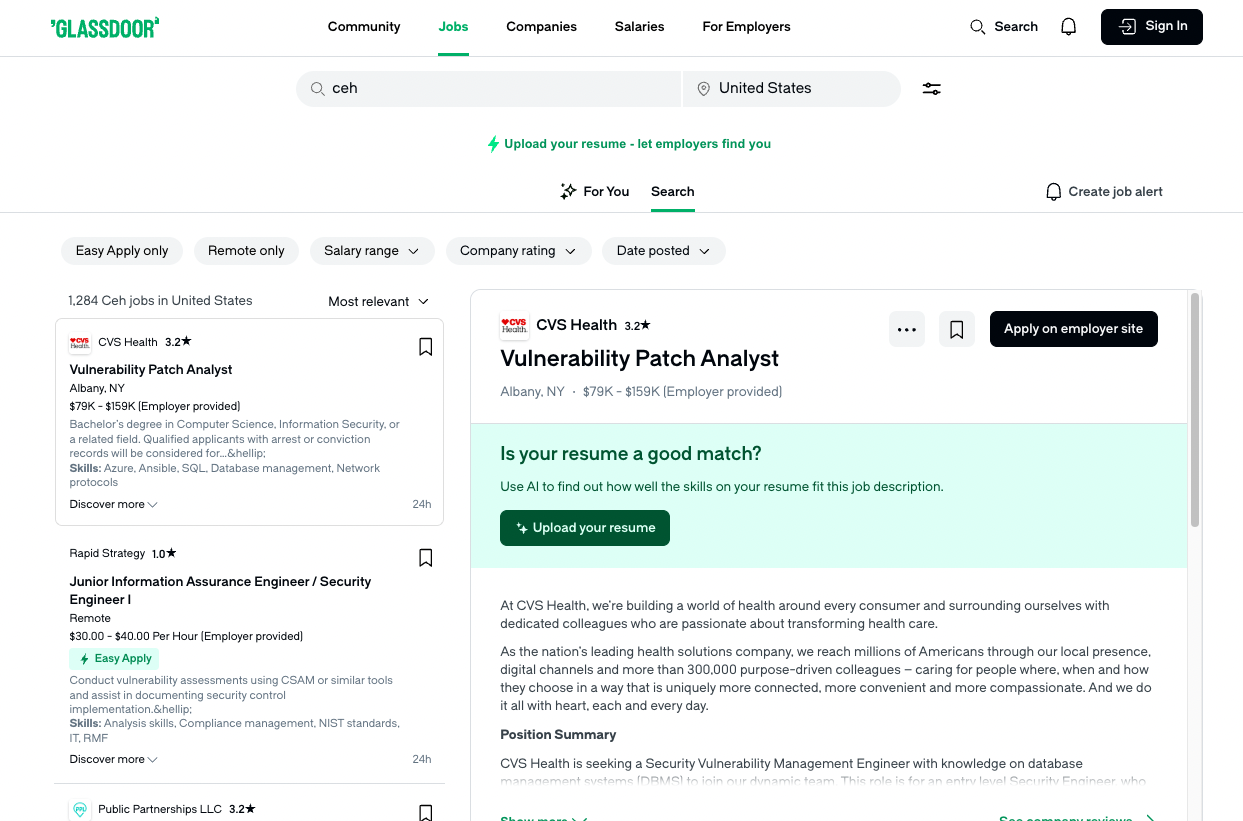
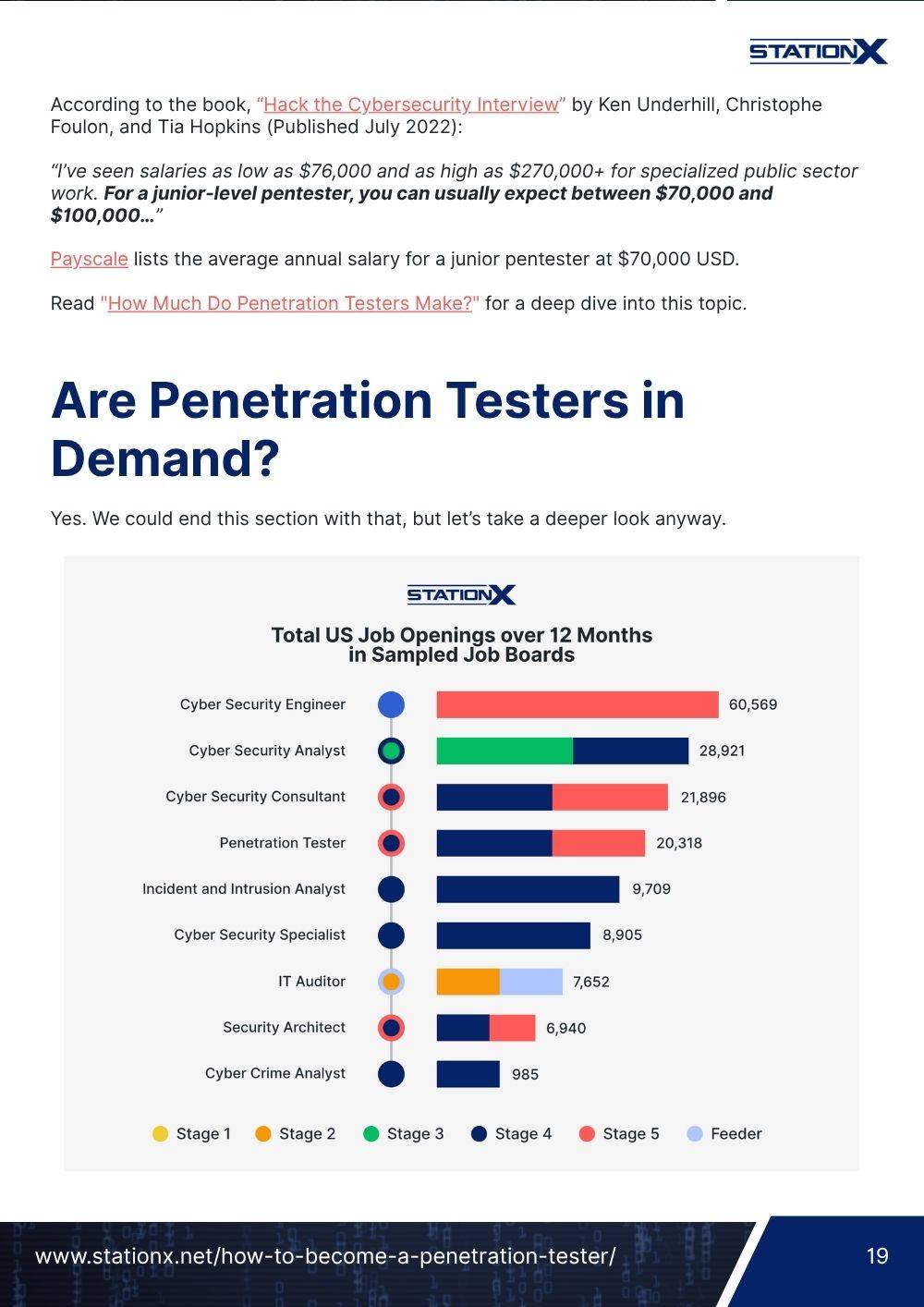
As of this writing, a brief search on Glassdoor shows over 1,200 job openings in the US that list the CEH as one of the preferred certifications for candidates to hold.
PenTest+
While CompTIA PenTest+ may not appear in as many job listings as CEH, it still qualifies you for a range of respected offensive security and vulnerability management roles. These positions often emphasize hands-on testing, reporting, and compliance awareness, making PenTest+ holders valuable for organizations seeking practical penetration testing expertise.
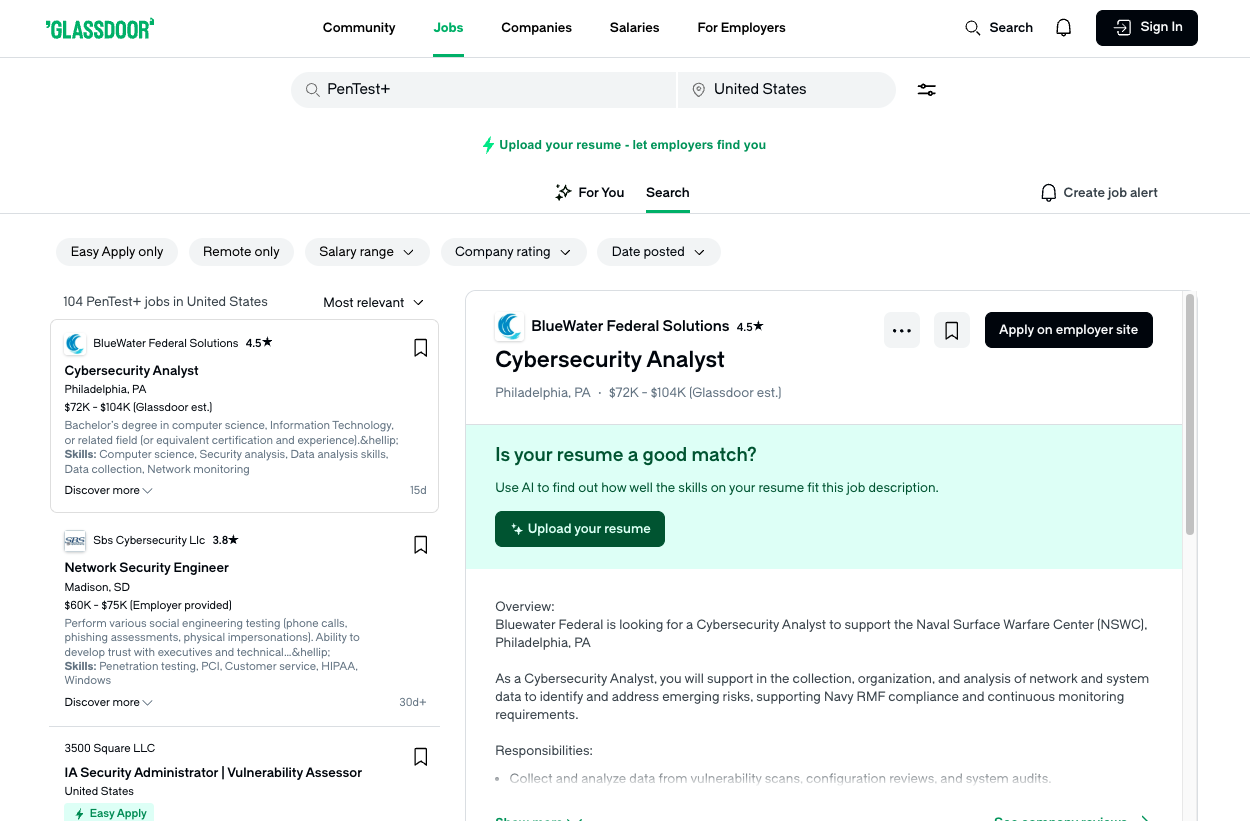
At the time of writing, there are around 104 PenTest+ jobs in the US listed on Glassdoor. However, in most real-world career paths, PenTest+ is rarely the final stop. Many professionals pair it with more advanced, performance-based certifications such as OSCP or GPEN to demonstrate their ability to perform live, end-to-end penetration tests. This combination is often seen as the gold standard for aspiring penetration testers and red team operators.
Here are some of the most common PenTest+ job titles and their average U.S. salary ranges:
- Penetration Tester - $115K–$155K
- Security Consultant - $100K–$140K
- Threat Intelligence Analyst - $90K–$130K
- Auditor - $85K–$125K
- Network Security Operations - $95K–$135K
- Vulnerability Tester - $90K–$130K
- Security Analyst (II) - $80K–$120K
- Vulnerability Assessment Analyst - $85K–$125K
- Application Security Vulnerability Analyst - $100K–$140K
Winner: CEH
The numbers don’t lie. While many of the job listings require multiple other certifications or industry experience, CEH appears over and over while PenTest+ does not.









Cost and Recertification
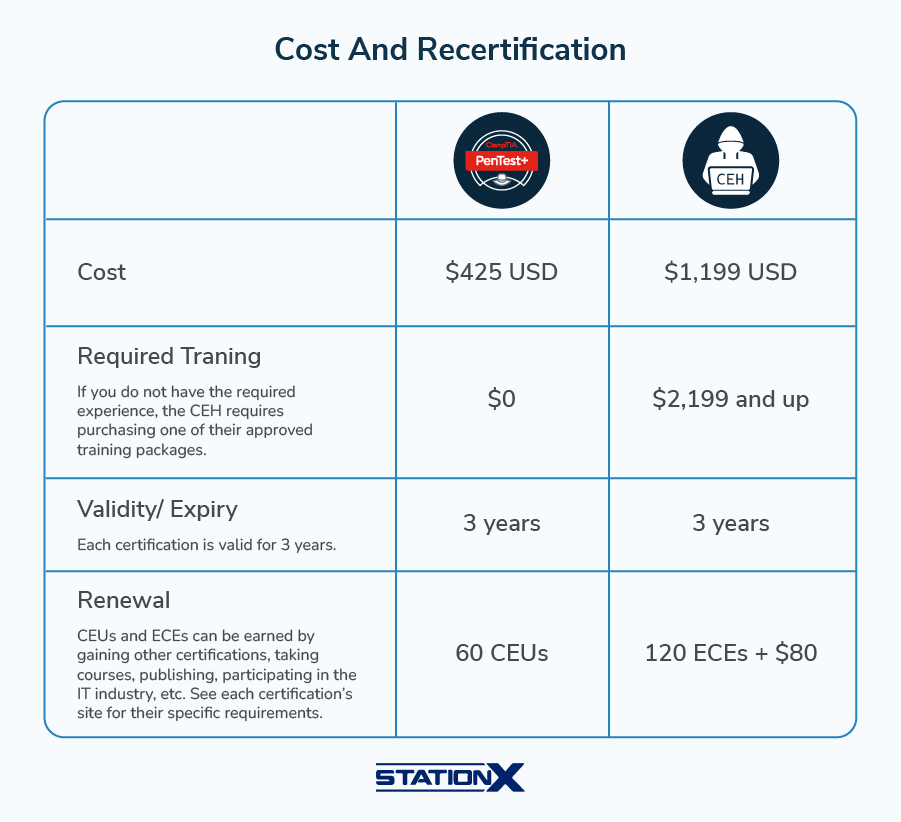
There are significant differences between the costs and renewal requirements of these certifications. CEH is not only more than four times as expensive, it requires additional costs if you don’t have industry experience. Let’s break this down further.
CEH Cost
The Pearson VUE exam voucher currently costs $1,199 USD. If you do not have the two-years industry experience, you will be required to take an EC-Council partnered training course. Since there are a variety of options, the cost ranges from USD $1,699 to USD $3,499, depending on the options you choose.
If you self-study, you’ll need to apply for exam eligibility which costs an additional $100.
Beyond training and exam fees, there are other hidden or optional costs:
- Exam retake voucher: ~$499 (if you fail on your first try)
- Additional study material: $100 – $300
- Practice exams: $99 – $299
- Membership fees: EC-Council annual membership might be required
CEH is valid for 3 years but requires an $80 annual membership fee.
Unlike PenTest+ which only requires the 60 CEU’s be completed within three-years of the certification’s start date, CEH requires 40 ECE (EC-Council Continuing Education) credits each year for a total of 120 credits.
PenTest+ Cost
At the time of this writing, PenTest+ costs $425 USD for a single attempt. There are no other fees associated with writing the exam.
The certification is valid for three years. It can either be renewed by rewriting the exam or earning 60 CEUs (Continuing Education Units). CompTIA has the last word on what they will consider an applicable CEU, but training courses, being involved in industry events, publishing, and gaining other certifications are all ways to earn CEUs.
When renewing with CEUs, there is an additional cost of $150. If you earn your CySA+ or SecurityX (formerly CASP+), the PenTest+ certification renews without additional cost.
Winner: PenTest+
The costs involved in earning CEH are certainly hard to swallow when compared with PenTest+, so you will need to weigh that against what you hope to get out of being a certificate holder.
CEH vs PenTest+ - The Final Verdict
If your goal is quick visibility in cybersecurity, the Certified Ethical Hacker (CEH) remains the more recognizable option. It’s globally recognized, HR-friendly, and can help you stand out early — especially for roles requiring DoD 8570 compliance.
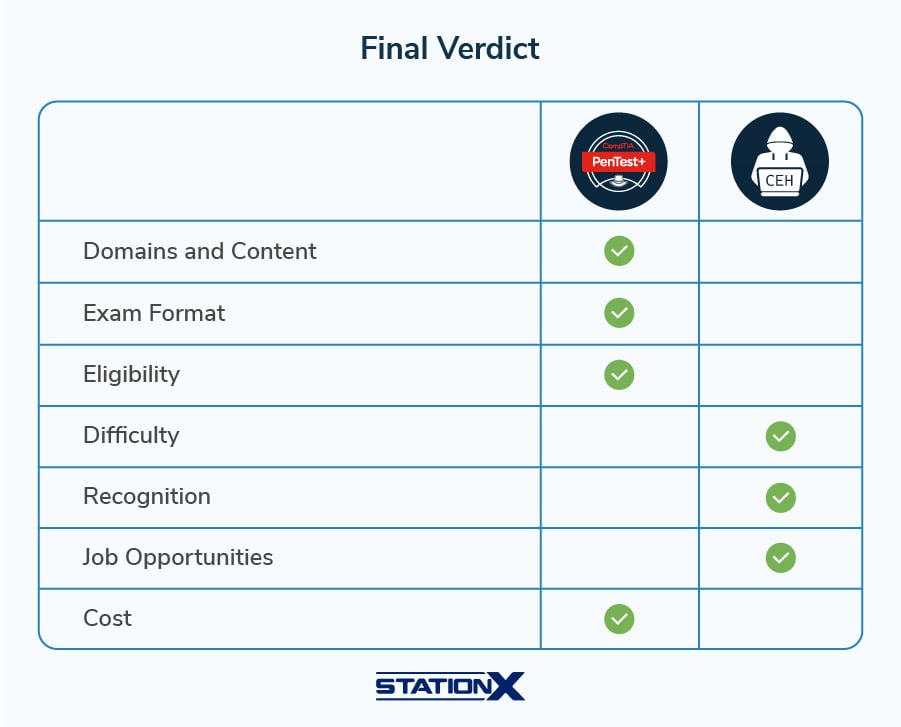
If you want to validate a stronger understanding of penetration testing methodology, CompTIA PenTest+ is the smarter next step. It’s also DoD 8570-approved and evaluates your ability to plan, scope, and report on penetration tests with professionalism and business awareness.
To help you master it, our CompTIA PenTest+ Courses Bundle includes the complete video course, 884 practice questions, and 500+ flashcards - everything you need to pass the exam and perform like a professional pentester in the field. Plus, save up to 30% off the official price when you purchase your PenTest+ exam voucher through us.
And for a long-term growth plan, the StationX Master’s Program gives you access to 30,000+ cybersecurity courses, labs, mentorship, and career pathways, helping you progress from foundational knowledge to advanced specialization with a clear direction.
The CompTIA PenTest+ Courses Bundle PT0-003 includes:
- Total CompTIA PenTest+ Course
- PenTest+ Practice Questions PT0-003
- CompTIA PenTest+ Certification Flash Cards
- Penetration Testing Training for Beginners