

So you want to break into cyber security. You've read the career guides, browsed the job boards, and now you're staring down a wall of acronyms wondering which certification actually matters. Security+? CC? GSEC? Something from Cisco with three different names?
We get it. The certification landscape is overwhelming, and picking the wrong one can cost you hundreds of dollars and months of study time with little to show for it. The right one, though, can open doors, clear HR filters, and give you something concrete to talk about in interviews.
We've broken down the seven most relevant beginner cyber security certifications, covering what each one costs, what it proves, who it's for, and (just as importantly) where it falls short. No cert is perfect, and we're not going to pretend otherwise.
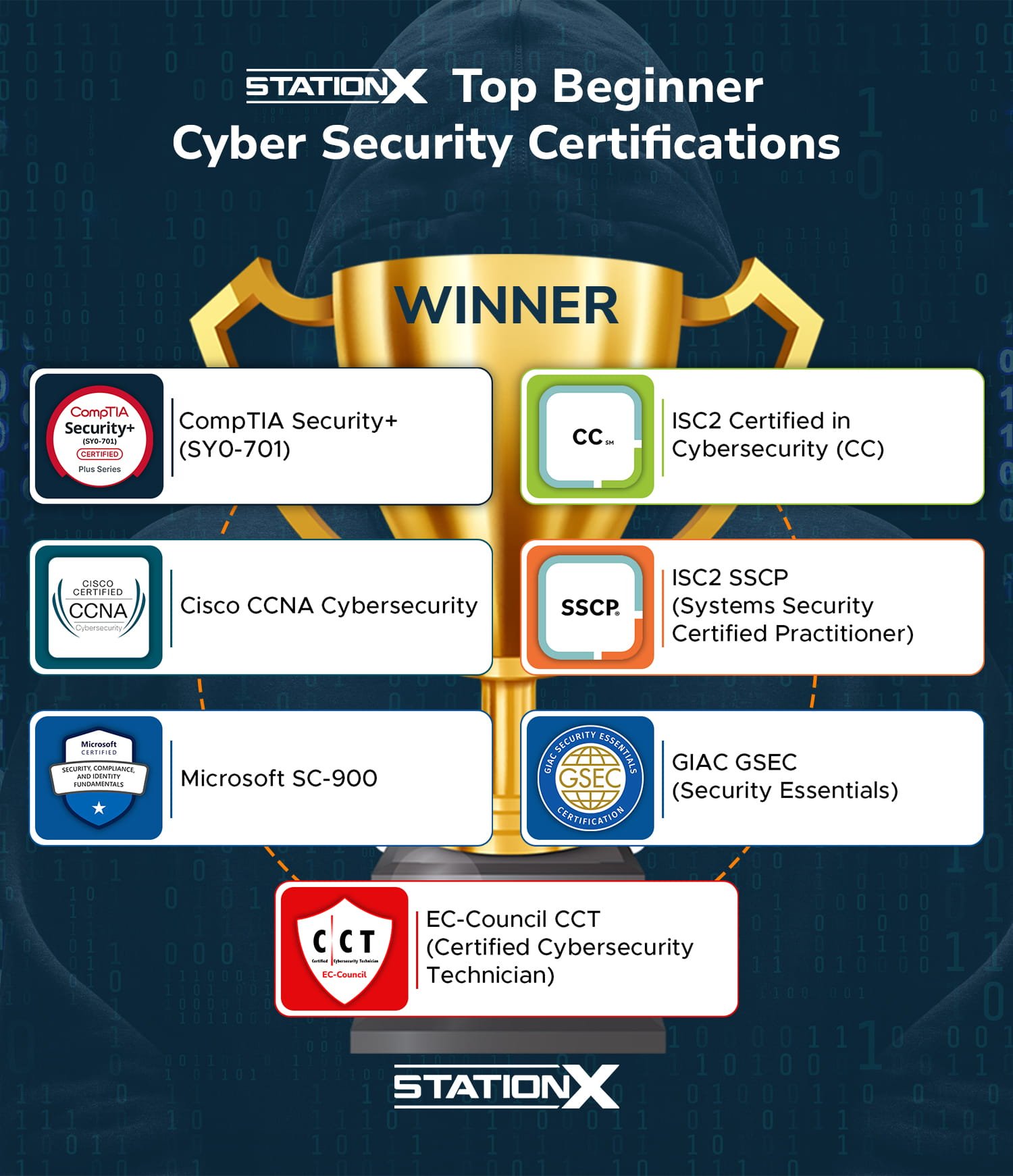
Let’s take a close look at what each of our top choices has to offer, their drawbacks, and who should consider them, starting with…
- CompTIA Security+ (SY0-701)
- ISC2 Certified in Cybersecurity (CC)
- Cisco CCNA Cybersecurity
- ISC2 SSCP (Systems Security Certified Practitioner)
- Microsoft SC-900
- GIAC GSEC (Security Essentials)
- EC-Council CCT (Certified Cybersecurity Technician)
- So, Which of the Beginner Cyber Security Certifications Should You Get?
- Frequently Asked Questions
CompTIA Security+ (SY0-701)
| Vendor: | CompTIA (vendor-neutral) |
| Exam Cost: | $425 |
| Questions: | Up to 90 (multiple choice + performance-based) |
| Time: | 90 minutes |
| Passing Score: | 750/900 |
| Prerequisites: | None required |
| Renewal: | Every 3 years, 50 CEUs |
| DoD 8140 Approved: | Yes |
This isn't a recommendation so much as a statement of fact. Security+ appears in roughly 63,000 to 70,000 job postings, making it the single most requested certification that doesn't require years of experience to earn. It's the baseline for government and military cyber security roles, and if an entry-level job listing mentions only one cert, it's almost always this one.
In terms of demand, nothing else at the entry level comes close. The only certification that outpaces it overall is CISSP, which requires five years of experience, a different conversation entirely.
Entry-level Security+ holders typically earn between $55,000 and $80,000, with an estimated 10-20% salary bump over uncertified peers. At $425, the exam fee pays for itself in your first month of employment.
Here's the catch, though. Security+ proves you understand cyber security concepts. It doesn't prove you can do anything with them. The exam is primarily multiple choice with some performance-based questions, meaning you can pass without ever touching a firewall, a SIEM, or a command line. Employers know this, which is why Security+ alone rarely gets you hired. You need to pair it with hands-on experience (labs, CTFs, personal projects) to convert the certification into actual interviews.
ISC2 Certified in Cybersecurity (CC)
| Vendor: | ISC2 |
| Exam Cost: | FREE (through ISC2's "One Million Certified in Cybersecurity" program, still active; standard price $199) |
| Annual Fee: | $50/year maintenance |
| Questions: | 100-125 (CAT format, updated Oct 2025) |
| Time: | 2 hours |
| Prerequisites: | None |
| Renewal: | Every 3 years, 45 CPEs |
| DoD 8140 Approved: | Yes (20 work roles as of 2024) |
If you're looking for the lowest possible barrier to entry, this is it. Free exam, free training, no experience required, and it's backed by ISC2, the same organization behind CISSP. Since gaining DoD 8140 approval across 20 work roles, its biggest former weakness has been eliminated. For career changers or anyone just testing the waters, this certification removes every excuse not to start.
Demand is growing but still sits well behind Security+. The CC launched in 2022, so employer recognition is still building. That said, the ISC2 name carries real weight even when the specific cert is newer.
There's limited standalone salary data given how recently it was introduced. Its best use is as a confidence-builder and a resume line item while you study for Security+. And with a free price tag, the ROI is technically infinite if it helps you land even one interview.
The downsides are worth knowing. The CC covers less depth than Security+; this is foundational awareness, not practitioner-level knowledge. Some employers still don't recognize it. The $50 annual maintenance fee means "free" only applies to the exam itself; you'll pay $150 over three years just to keep it active. And there's a real risk of earning the CC and feeling like you're done, when Security+ is still the cert most employers are actually screening for.
Cisco CCNA Cybersecurity
| Vendor: | Cisco |
| Exam: | 200-201 CBROPS v1.2 |
| Exam Cost: | $300 |
| Questions: | 95-105 (multiple choice, drag-and-drop, labs) |
| Time: | 120 minutes |
| Prerequisites: | None required |
| Renewal: | Every 3 years |
| DoD 8140 Approved: | Gaining recognition |
If you already know you want to sit in a SOC, pay attention. This is the only entry-level certification built specifically around SOC analyst work: security monitoring, host-based analysis, network intrusion analysis, and incident response. It maps to the SOC analyst job description more directly than Security+ does, and the recent rebrand into the CCNA family gives it recognition parity with CCNA Networking, a name employers already know and trust.
A quick note on that rebrand: this cert has gone through three names in quick succession. It started as CyberOps Associate, became Cisco Certified Cybersecurity Associate in January 2026, and then landed on CCNA Cybersecurity as of February 3, 2026. It's the same exam and the same material, just a different label. Expect some confusion in job postings and study materials for a while as things catch up.
Demand is moderate. It's particularly valued in Cisco-heavy environments and dedicated SOC roles, though it's not as universally requested as Security+. SOC analyst positions pay $55,000 to $80,000 at the entry level, and at $300, the exam is cheaper than Security+ while being more role-specific.
The trade-off is that it's Cisco-centric. The tools, terminology, and workflows lean toward Cisco's ecosystem. If you end up in a non-Cisco shop, some of the specifics won't transfer directly. It's also less universally recognized; fewer ATS filters scan for it, and HR departments are less likely to know what it is compared to Security+.
ISC2 SSCP (Systems Security Certified Practitioner)
| Vendor: | ISC2 |
| Exam Cost: | $249 |
| Questions: | 100-125 (CAT format, updated Oct 2025) |
| Time: | 2 hours |
| Passing Score: | 700/1000 |
| Prerequisites: | 1 year paid experience (degree substitutes; Associate pathway available) |
| Renewal: | Every 3 years, 60 CPEs |
| DoD 8140 Approved: | Yes |
The SSCP is an underrated option that deserves more attention than it gets. It offers more technical depth than either Security+ or the CC, it costs less than Security+ at $249, and it covers access controls, security operations, risk identification, incident response, cryptography, and network security. If you have a relevant bachelor's or master's degree, it substitutes for the one-year experience requirement, meaning recent graduates can earn it right away.
It's also the on-ramp to CISSP; same vendor, same knowledge domains, just with a lighter scope. For DoD roles, it's approved and it's the cheapest approved cyber security cert on this entire list.
Holders typically earn between $65,000 and $85,000 at the entry level. For anyone with a degree who wants to skip the CC and differentiate from the Security+ crowd, the SSCP punches well above its price point.
That said, the one-year experience requirement is a real gate for people without a degree. The Associate pathway exists (you pass the exam, earn a provisional title, and have two years to build the required experience or you lose it) but it adds complexity. Outside of ISC2-aware organizations, it's also less recognized than Security+. Hiring managers who aren't familiar with ISC2's cert hierarchy may not know where SSCP fits. And at 60 CPEs every three years, the maintenance burden is heavier than Security+'s 50 CEUs.
FREE Cyber Security Career Guide
Thinking of a career in cyber security? Our Cyber Security Career Guide walks you through the industry landscape, skill-paths, certifications, and realistic timelines to become job-ready.
Microsoft SC-900
| Vendor: | Microsoft |
| Exam Cost: | $165 |
| Questions: | 40-60 |
| Time: | 45 minutes |
| Passing Score: | 700/1000 |
| Prerequisites: | None |
| Renewal: | None — never expires |
| DoD 8140: | No |
| Last Updated: | November 2025 |
At $165 with no renewal costs ever, the SC-900 is the cheapest cert on this list and the only one that never expires. It covers the Microsoft security ecosystem that most enterprises actually run: Microsoft Entra for identity, Microsoft Defender for threat protection, and Microsoft Purview for compliance. If you're going to work in an enterprise environment, odds are you'll encounter this stack.
Its real value, though, is as a stepping stone. The SC-900 is the entry point to SC-200 (Security Operations Analyst) and SC-300 (Identity and Access Administrator), which are the Microsoft certifications that actually show up in job postings.
Demand as a standalone cert is low. It rarely appears in job requirements on its own, and the standalone salary impact is minimal. But if it helps you talk intelligently about Microsoft Entra and Defender in an interview, it's already paid for itself.
Let's be direct about what this isn't. The SC-900 is a fundamentals awareness badge, not a practitioner certification. Forty to sixty questions in 45 minutes; it's designed to be easy. There's no hands-on component. It won't teach you to configure, investigate, or respond to anything. Listing SC-900 alone on a resume signals that you watched some Microsoft Learn modules, not that you can do cyber security. Treat it as supplementary. You would never pursue this as your only cert.
GIAC GSEC (Security Essentials)
| Vendor: | GIAC / SANS Institute |
| Exam Cost: | $999 standalone; ~$8,525+ for SANS SEC401 course (exam not included) |
| Questions: | 106 |
| Time: | 4 hours |
| Passing Score: | 73% |
| Format: | Open book |
| Prerequisites: | None formally |
| Renewal: | Every 4 years, 36 CPEs (or retake for $499) |
| DoD 8140 Approved: | Yes |
If you can afford it, the GSEC is in a class of its own at the entry level. GIAC certifications collectively appear in over 41,000 job postings. The GSEC is the broadest entry point, covering active defense, networking, cryptography, incident handling, Linux and Windows security, cloud security, and web security, all at significantly greater depth than Security+. It's an open-book exam because the point isn't memorization; it's whether you can apply the knowledge. SANS training is widely considered the gold standard in cyber security education, and employers who know GIAC respect it enormously.
GIAC holders earn a $10,000 to $15,000 premium over non-certified peers, with entry-level salaries in the $70,000 to $90,000 range. The salary premium is real.
Now for the elephant in the room: cost. The exam alone is $999, and most people take the accompanying SANS SEC401 course at over $8,500 on top of that. That's roughly 2 to 20 times the cost of every other cert on this list. For a self-funded career changer, this is likely out of reach. You can get Security+, ISC2 CC, CCNA Cybersecurity, and SSCP combined for less than the GSEC certification alone.
The GSEC makes sense if your employer is paying, you have a GI Bill, or you've budgeted specifically for SANS training. The knowledge is excellent and the certification is deeply respected. But the price tag makes it inaccessible for most people just entering the field.
EC-Council CCT (Certified Cybersecurity Technician)
| Vendor: | EC-Council |
| Exam Cost: | ~$999 (includes official training, courseware, labs, and exam voucher) |
| Annual Maintenance: | $80/year |
| Questions: | 60 (50 multiple choice + 10 hands-on practical) |
| Time: | 3 hours |
| Prerequisites: | None formally |
| DoD 8140: | No |
| Launched: | ~2022 |
CCT is EC-Council's answer to the criticism that CEH is too expensive and not entry-level. It was designed as the on-ramp, covering network defense, ethical hacking fundamentals, digital forensics basics, security operations, and incident handling across 22 modules. The training package includes 85 hands-on labs, giving it a practical angle that Security+ and the CC lack. And unlike every other cert on this list, 10 of the 60 exam questions are hands-on practical, not just multiple choice.
That practical component is genuinely noteworthy. Most entry-level certs are entirely knowledge-based. Having even a small hands-on element in the exam itself sets the CCT apart structurally.
The problem is market recognition, or rather, the lack of it. The CCT is too new for meaningful job posting data, and most hiring managers won't know what it is if they see it on your resume. EC-Council's brand reputation is also mixed in the cyber security community; the controversies around CEH (exam leaks, aggressive marketing, high pricing) affect how the entire certification lineup is perceived.
At $999 plus $80 per year in maintenance, you're paying more than Security+ for a cert that far fewer employers recognize. The 85 hands-on labs are part of the training package, not the exam itself, though the exam's 10 practical questions offer more than most at this level.
This is the "one to watch" rather than the "one to get." If EC-Council builds employer adoption over the next two to three years, the CCT could become a solid entry-level option. Right now, it's a gamble.
Remote Cyber Security Jobs Database
Looking to work from anywhere? Tap into our Remote Cyber Security Jobs Database — over 360 remote-friendly companies, 70+ cyber employers hiring remotely, and 50+ niche job boards all organised into one curated resource.
So, Which of the Beginner Cyber Security Certifications Should You Get?
With seven certifications on the table, here's how to think about your path.
If you're brand new and budget-conscious, start with the ISC2 CC. It's free, it builds confidence, and it gets you familiar with certification exams. But don't stop there; treat it as a stepping stone to Security+.
If you want the single cert that opens the most doors, it's Security+. No question. It won't teach you hands-on skills, but it clears more HR filters than anything else at this level. Pair it with a home lab, some CTF platforms, or a personal project portfolio, and you have a compelling entry-level profile.
If you know you want SOC analyst work, look at the CCNA Cybersecurity. It's cheaper than Security+ and maps directly to the role. Just understand that it's more niche.
If you have a degree and want to stand out, the SSCP offers more depth than Security+ at a lower price and puts you on the ISC2 track toward CISSP.
If your employer is paying, the GSEC is the strongest entry-level cert available. Full stop.
And if you're heading into a Microsoft-heavy enterprise, tack on the SC-900 as a low-cost supplement. Just don't rely on it as your primary cert.
The best certification strategy isn't about picking one and hoping for the best. It's about understanding what each cert proves, what it doesn't, and how it fits into the larger picture of getting hired.
Click the banner below to see our CompTIA Security+ Training Bundle. For a one-time purchase, get lifetime access to multiple Security+ exam prep courses, practice tests, flashcards, and more.
The CompTIA Security+ Course & SY0-701 Practice Test Bundle includes:
Frequently Asked Questions

Guarantee Your Cyber Security Career with the StationX Master’s Program!
Get real work experience and a job guarantee in the StationX Master’s Program. Dive into tailored training, mentorship, and community support that accelerates your career.
- Job Guarantee & Real Work Experience: Launch your cybersecurity career with guaranteed placement and hands-on experience within our Master’s Program.
- 30,000+ Courses and Labs: Hands-on, comprehensive training covering all the skills you need to excel in any role in the field.
- Pass Certification Exams: Resources and exam simulations that help you succeed with confidence.
- Mentorship and Career Coaching: Personalized advice, resume help, and interview coaching to boost your career.
- Community Access: Engage with a thriving community of peers and professionals for ongoing support.
- Advanced Training for Real-World Skills: Courses and simulations designed for real job scenarios.
- Exclusive Events and Networking: Join events and exclusive networking opportunities to expand your connections.
TAKE THE NEXT STEP IN YOUR CAREER TODAY!


Thanku