So, you want to know whether technology is a good career path? You've come to the right place.
In this article, you’ll learn everything you need to know about a future career in various technology domains and make the right decision for your future.
We'll break down the different options available, delve into the job market and demand for various technologies, discuss salaries, and weigh the pros and cons of each career path.
By the end, you'll be equipped to make an informed decision about whether a technology career is right for you. We’ll also help you kickstart your technology career journey by discussing how you can start your technology career path in detail.
So, without further ado, let's try to answer our main question: "Is technology a good career path?"
Career Fields in Technology
First, we’ll explore what fields in the technology industry are booming.
Cyber Security
Cyber security is one of the most popular technology fields. Cyber security professionals protect computer systems and networks from unauthorized access, use, disclosure, disruption, modification, or destruction. Some of the jobs that you can target in this field as a beginner are Security Analyst, Penetration Tester, Security Engineer, and more.
Software Development
Software development is another highly popular technology domain that involves coding and programming for the development of software and web applications that we use in our day-to-day lives. Software developers design, build, and maintain end-to-end software applications. Front-end developers, back-end developers, full-stack developers, and mobile developers are some common positions in this field.
Data Science and Analytics
Data science is another fascinating technology field that involves playing with large amounts of data in order to derive an objective-oriented result. Data science and analytics involve extracting insights from vast datasets to make informed strategic decisions, predictions, and trends. Careers in this technology field include Data Scientist, Data Analyst, and Business Intelligence Analyst.
Cloud Computing and Virtualization
Cloud computing and virtualization involve storing and accessing data and applications over the Internet. Cloud specialists manage virtualized infrastructure, optimizing the scalability and efficiency of organizational cloud infrastructure. Some of the roles in this technology field include Cloud Engineer, Cloud Architect, and Solutions Architect.
IT Project Management
Project managers plan, execute, and oversee technology initiatives, ensuring timely delivery and alignment with business objectives. Some positions in this technology field include IT Project Manager, Scrum Master, Business Analyst, and Agile Coach.
Network Administration
Network administrators install, configure, and maintain computer networks to support secure and seamless connectivity. Some job roles in this domain include Network Engineer, Systems Administrator, and Network Security Specialist.
AI and Robotics
Artificial intelligence (AI) and robotics are rapidly growing fields that involve developing intelligent machines and systems. AI and robotics engineers develop intelligent systems to automate tasks and enhance productivity. Careers in this exciting field include AI Engineer, Robotics Engineer, Machine Learning Engineer, and Machine Learning Specialist.
DevOps
DevOps is another booming field that is attracting many people to opt for a career option. DevOps is an extended version of software development but here, DevOps engineers combine software development (Dev) and IT operations (Ops) to streamline the process of building, testing, and deploying software. Some of the famous roles in this technology field include DevOps Engineer, Release Manager, Site Reliability Engineer (SRE), and Automation Architect.
Blockchain
Blockchain is a distributed ledger technology that enables secure, transparent, and tamper-proof transaction recording. Blockchain professionals leverage decentralized technology to secure transactions and streamline processes. Some of the positions you can target include Blockchain Developer, Blockchain Architect, Blockchain Engineer, Smart Contract Developer, and Blockchain Analyst.
Technology Job Market and Demand
The technology job market remains strong and continues to evolve, with high demand for skilled professionals across multiple domains. According to Hakia’s 2025-2026 tech market analysis, overall tech employment stands 3.2% above pre-pandemic levels, while software engineering roles are growing at 8.1% year-over-year, indicating robust hiring momentum despite broader economic uncertainty.
According to the US Bureau of Labor Statistics, employment in computer and information technology roles is expected to grow significantly faster from 2024 to 2034, with around 317,700 openings projected each year due to growth and workforce turnover.
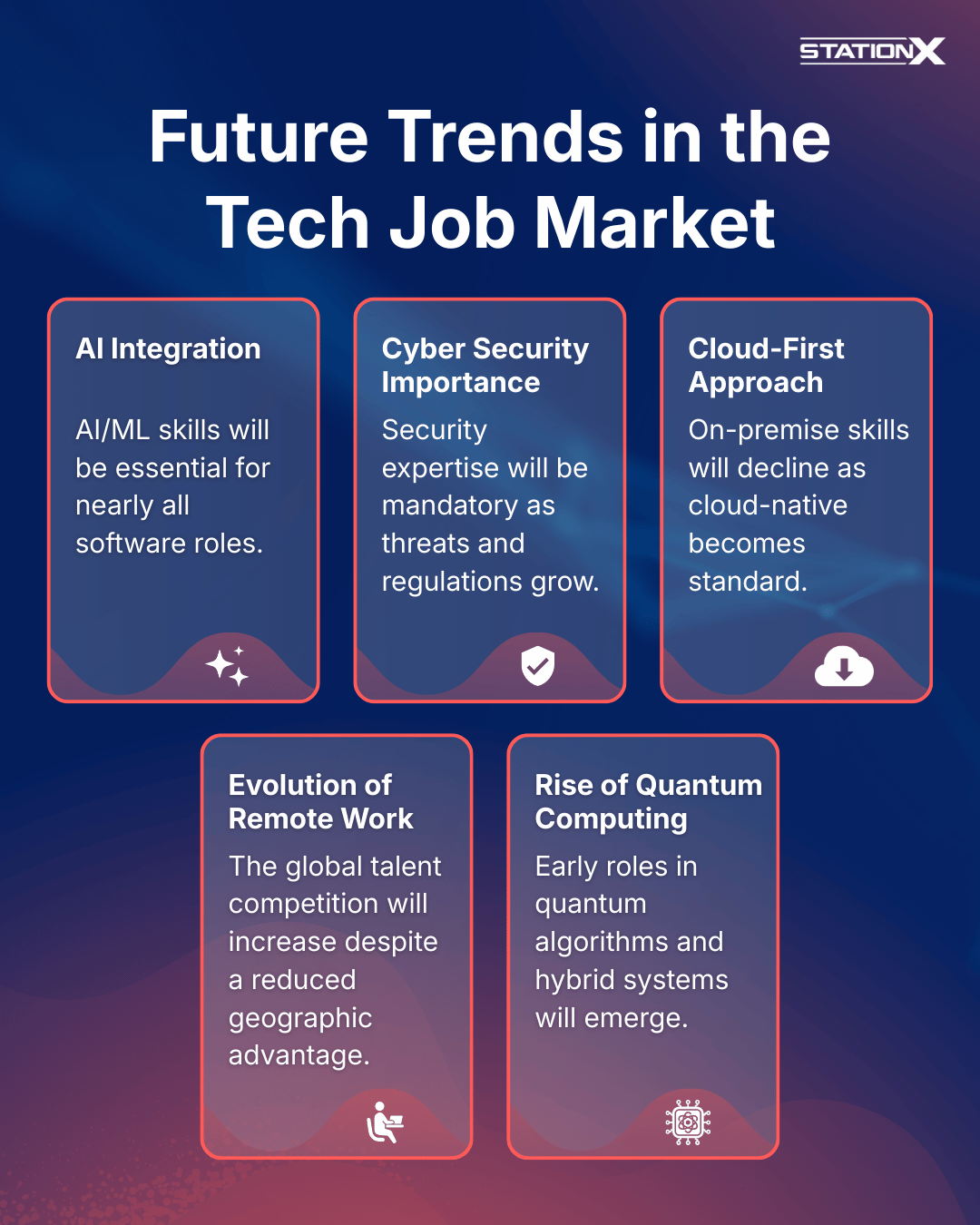
Emerging skill areas like cyber security and AI are seeing some of the highest demand and salary growth, with security professionals experiencing salary increases of 12-15% as companies prioritize protection against escalating threats. Meanwhile, tech roles overall are expected to grow faster than the national average, with opportunities spanning cloud, data science, DevOps, and machine learning specialties.
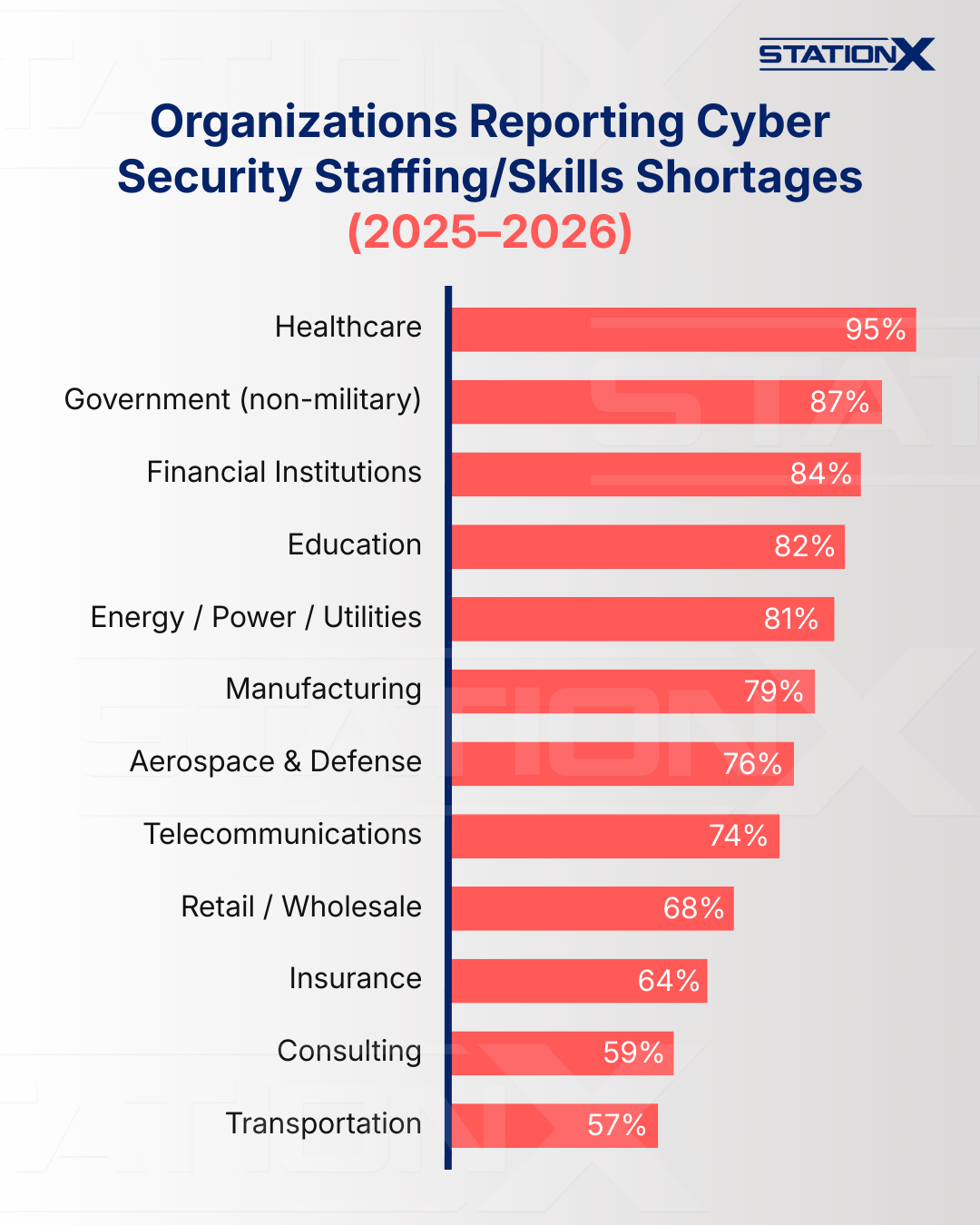
The data also shows that cyber security skills face one of the largest talent shortages, with millions of unfilled positions globally, further underscoring the strength of the job market for professionals who can bridge this gap.
In 2026-2027, the most successful tech professionals will be the ones who cultivate T-shaped skills and possess deep expertise in a core area while maintaining a broad understanding across multiple domains.
Demand for security professionals is reflected in job growth projections, with roles like cyber security analyst growing around 32% through 2032, far above the national average for all occupations.
The report also notes that AI and machine learning engineers are in high demand, with projected job growth of 34%, focusing on developing and deploying machine learning models, and earning a median salary of $165,000.
Cyber security analysts, responsible for security monitoring and incident response, are also highly sought after, with 19% growth and a median salary of $118,000.
Software engineers specializing in application and system development see steady demand, with 8% growth and a median pay of $127,000, while DevOps engineers, who automate and streamline infrastructure deployment, experience 12% growth and a median salary of $135,000.
Other data-focused roles are also expanding. Data scientists, who analyze data and build machine learning applications, remain in demand, with 6% projected growth and a median salary of $142,000.
These figures highlight that the technology job market offers competitive compensation across multiple career paths, rewarding specialized skills and experience, while presenting ample opportunities for growth in emerging fields like AI, cyber security, and data science.
Is Technology a Good Career Path?
This question is probably on many people's minds, since the tech industry is one of the drivers of the rapid development of our societies.
This is probably a question on the minds of a lot of people since the tech industry is one of the drivers for the rapid development of our societies.
It’s increasingly important to critically examine the opportunities and challenges presented by the technology industry as a whole. So, let’s try to answer this question by identifying some pros and cons of the technology industry as a whole.
Pros
Cons
As we’ve seen, despite these minor challenges, the pros always outweigh the cons. Many enjoy a fulfilling career in tech, leveraging their skills to build the best possible life, make meaningful contributions, and drive positive change. As the field continues to develop, more tech professionals will have tremendous opportunities to innovate, build, and shape the future.
Is Technology a Good Career Path for Students?
So, now let’s understand whether technology is a good career path for students or someone who’s just entering the job market.
For students looking to work in tech, the career prospects are just as rosy as ever. In fact, the Bureau of Labour Statistics still projects strong growth in the job market for tech skills, with multiple paths for entrance and advancement.
Those who are still in school and thinking of a career in tech need to be careful with their planning and make smart decisions about selecting a degree or a certification, considering cost as well as opportunity.
Many junior roles in the technology sector don’t require paid experience, and less expensive certifications are better investments than expensive four-year degrees.
For instance, you could become a Cyber Security Analyst, Web Developer, or Data Analyst without a degree or paid work experience. Some employers might even prefer a candidate with demonstrable work experience, even if unpaid or as a personal project.
This can be achieved, for example, through a work placement or internship. Once you have experience working in the technology industry, you can pursue more senior positions, such as an IT Consultant or SOC Analyst.
While a four-year degree offers the broadest possible education—for example, in computer science or computer algorithms and systems—a certification is more focused and less expensive.
Certifications allow you to zero in on gaining the necessary skills for a specific career. With this in mind, many are choosing to combine a degree with certifications to chase their dream career, depending on their financial situation.
Depending on the desired role, it may be possible to bypass the degree entirely and let certifications represent your knowledge. You’ll need to do your research to determine the best path for you.
AI and machine learning will most certainly require formal post-secondary education, while cyber security or coding roles can be attained through certifications and building a strong portfolio showcasing projects and achievements.
To succeed in the tech industry, students also need to develop soft skills such as communication, critical thinking, and collaboration, which are equally as important as traditional technical skills. College students are also advised to opportunity-hunt through internships, hackathons, and industry meet-ups to build a strong professional network and connect with the right people in the industry who can act as mentors.
How to Start a Career in Tech
Technology remains one of the most accessible and rewarding career paths for students, career switchers, and entry‑level professionals. With roles spanning software development, cyber security, cloud computing, AI, and networking, the tech industry values skills and practical experience as much as traditional credentials.
The key to starting a career in tech is understanding the foundational skills required, proving your capabilities, and building real‑world experience.
Build the Right Foundation
Before choosing a specific role, it’s important to understand the core skills that most technology careers share. These include basic technical literacy (how systems, networks, and software work), problem‑solving, analytical thinking, and the ability to continuously learn as tools and platforms evolve. You don’t need to know everything upfront; successful tech careers are built progressively by stacking knowledge and skills over time.
Showcase Your Skills and Projects
One of the most effective ways to break into tech is by showing what you can do. Employers increasingly value hands‑on proof over theory alone. Personal projects, labs, internships, freelance work, and GitHub repositories can clearly demonstrate your abilities. Even unpaid or self‑directed work counts if it shows a practical understanding of the technology you want to work with.
Education, Certifications, and Experience
A college degree is not required for many tech roles, though some employers may prefer one, depending on location and specialization. What matters most is relevant knowledge, certifications, and practical experience.
Industry‑recognized certifications help validate your skills, while project work and real‑world scenarios prove you can apply them effectively. Combining learning with hands‑on practice is often the fastest path into the industry.
Support, Guidance, and Community
Structured programs can help tie all of this together by offering curated learning paths, certifications, and guided practice. Beyond technical training, mentorship, peer groups, and professional communities play a major role in long‑term success.
Networking through industry events, meetups, and conferences exposes you to current trends, best practices, and potential job opportunities, connections that are often just as valuable as your technical skills.
Students will also need additional industry connections to secure employment and receive expert advice on their careers. Attending tech meetups and parties, visiting industry conferences, and networking with “thought leaders” gives you the chance to learn about new trends and acquire a wealth of practical knowledge about current best practices.
Programs like our StationX Master’s Program focus on building this complete ecosystem by combining foundational knowledge, certifications, hands‑on practice, mentorship, and community support to help learners move confidently from education to employment.
Transitioning Into Tech From Another Career
Switching into a tech career is common and increasingly achievable, even for professionals who have spent years in a different field. The key is identifying transferable skills such as communication, problem-solving, project management, and analytical thinking, and mapping them to tech roles that value those strengths.
For example, teachers often transition successfully into cyber security training, GRC, or security awareness roles due to their ability to explain complex concepts clearly and manage structured learning environments. Similarly, professionals from sales or customer-facing roles are well-suited for technology sales, solutions engineering, or cloud and infosec consulting, where technical knowledge combined with strong communication is essential.
Rather than starting from scratch, career changers can build on their existing experience by adding targeted technical skills, certifications, and hands-on practice. This approach shortens the transition period and helps professionals position themselves competitively for roles that align with both their background and long-term career goals.
Common Misconceptions About Starting a Tech Career
There are many myths surrounding careers in technology that discourage people from even getting started. These misconceptions often create unnecessary barriers and make tech seem more exclusive or intimidating than it actually is.
In reality, the industry is far more accessible and flexible than many people realize. Clearing up these common misunderstandings can help you approach a tech career with confidence and realistic expectations.
- You need to be good at advanced math - False. While some roles use math more heavily, many tech careers rely far more on logic, problem‑solving, and practical thinking than complex mathematics.
- You must know multiple programming languages - False. Mastering one language or core technology is far more valuable than shallow knowledge of many.
- You need to work long hours or burn out to succeed - False. While some roles can be demanding, many tech jobs prioritize efficiency, flexibility, and sustainable work habits over excessive hours.
- Tech careers are only about coding - False. Many tech roles focus on security, cloud infrastructure, data analysis, system design, testing, or strategy, with little or no coding required.
- It’s too late to start after 40 - False. Many professionals successfully transition into tech later in life, bringing valuable transferable skills.
- You need a college degree to get hired - False. Many employers prioritize skills, certifications, and proven ability over formal education.
Tech rewards curiosity, consistency, and hands‑on learning. With the right foundation, proof of skills, and support system, starting a career in technology is achievable at almost any stage of life.
Conclusion
Technology continues to be a promising career path for everyone, especially students, offering abundant opportunities for growth, reward, innovation, and impact.
Whether you're a seasoned professional or a student just starting out, the tech industry presents a wealth of possibilities if you’re willing to embrace change, adapt to new technologies, and continuously invest in your skills and knowledge.
All you need is a strategy that suits your goals. The StationX Master's Program is the best place to start your journey with access to over 30,000 courses and labs. You can also purchase course bundles and get lifetime access with a single purchase. See some of our bundles below.
Ready to land your dream cyber security job? Our Resume Writing Services apply ATS-optimized, industry-specific expertise to boost your interview rate by an average of 60% — trusted by thousands of tech professionals worldwide.