If you’re trying to decide between CompTIA SecAI+ vs. Security+, you’re probably wondering which certification makes more sense for your goals. Are they interchangeable? Is one more advanced? Which one gives you better career traction right now? That’s exactly what we’ll break down in this guide.
While both certifications come from CompTIA and focus on cyber security, Security+ vs. SecAI+ is not a simple beginner versus advanced comparison. They serve different purposes, validate different skill sets, and align with different career trajectories. Whether you are planning to build a security foundation or leaning toward AI-driven security, you’re in the right place.
Below, we will compare CompTIA Security+ and SecAI+ across concepts covered, difficulty, target audience, exam focus, job alignment, and overall long-term value to provide you with a clear understanding of how the two stack up, and which fits best based on your experience level and career direction.
What Are SecAI+ and Security+
CompTIA Security+ and SecAI+ are not competing certifications in the traditional sense. They are designed for different stages of your cyber security career.
While Security+ has long been considered a foundational credential for anyone entering the field, SecAI+ is a new, specialized certification focused specifically on artificial intelligence as applied to cyber security. If you are comparing the two, the real question is not whether one is “better” than the other, but rather if you are building a foundation or specialization.
Before we examine the specifications, let’s look at what each certification is fundamentally designed for.
About SecAI+
CompTIA SecAI+ is the world’s first vendor-neutral certification focused specifically on securing artificial intelligence systems and understanding how AI reshapes cyber security operations.
SecAI+ validates knowledge around the following topics:
- Core AI concepts as applied to cyber security
- Protection and defense of AI systems through technical safeguards and risk mitigation
- Application of AI techniques in operations to enhance corporate security posture
- Impact of governance, risk management, and compliance on AI deployments
This certification reflects a broader shift in the industry. Organizations are no longer just asking how to secure networks and endpoints. They are asking how to secure AI-assisted decision systems, AI-enhanced detection tools, and machine learning models integrated into production environments. With 97% of organizations adopting AI technologies as of 2026, AI is no longer theoretical; it is operational, and SecAI+ exists to bridge that gap.
However, this certification does not teach you cyber security from scratch and is designed with the assumption that you already have a core understanding of cyber security principles and want to apply that knowledge to AI operations. This is something to keep in mind as you weigh your options between the two certifications.
About Security+
CompTIA Security+ remains one of the most established and widely recognized cyber security certifications in the world. It validates foundational security knowledge across technical, operational, and governance domains.
Security+ tests your understanding of the following:
- Core security principles
- Common attack vectors and defensive strategies
- Secure architecture and implementation concepts
- Operational security controls and monitoring, response, and continuity practices
- Risk management and compliance fundamentals
The certification persists because organizations still need professionals who understand security fundamentals before specializing. Unlike SecAI+, Security+ is not focused on an emerging niche. Instead, it is broad by design, and that breadth is precisely why it continues to serve as a standard entry point in cyber security roles.
While considering the two certifications, take note that Security+ confirms that you understand cyber security as a discipline. Even as the industry is moving toward AI-centric operations, Security+ still establishes credibility across environments.
Career Progression and Certification Pathways
Understanding where SecAI+ and Security+ fit into your professional development is often more important than comparing the certifications directly. Instead of viewing them as isolated achievements, think of these certifications as markers along a professional development path.
Cyber security careers rarely begin with specialization. They begin with broad technical understanding, followed by a gradual movement into focused domains such as penetration testing, cloud security, GRC, or in your case, AI security.
This progression is relevant because modern security environments are layered. Thus, AI security systems still operate on traditional infrastructure foundations. Before securing advanced systems, professionals need to understand how security works at its core.
Who Are These Certifications For?
Security+ is typically pursued by professionals entering cyber security or transitioning from general IT roles. The appeal is for individuals looking to establish credibility without committing to a niche too early.
This typically includes:
- Student or career changers looking to enter cyber security
- IT or network professionals moving into security
- Professionals seeking foundational knowledge before choosing a specialty
- Professionals interested in government or defense sector positions
Because cyber security touches nearly every part of modern infrastructure, Security+ functions as a universal starting point. Whether you choose to ultimately move toward offensive or defensive security, digital forensics, or security management, the foundational knowledge you gain with Security+ remains necessary.
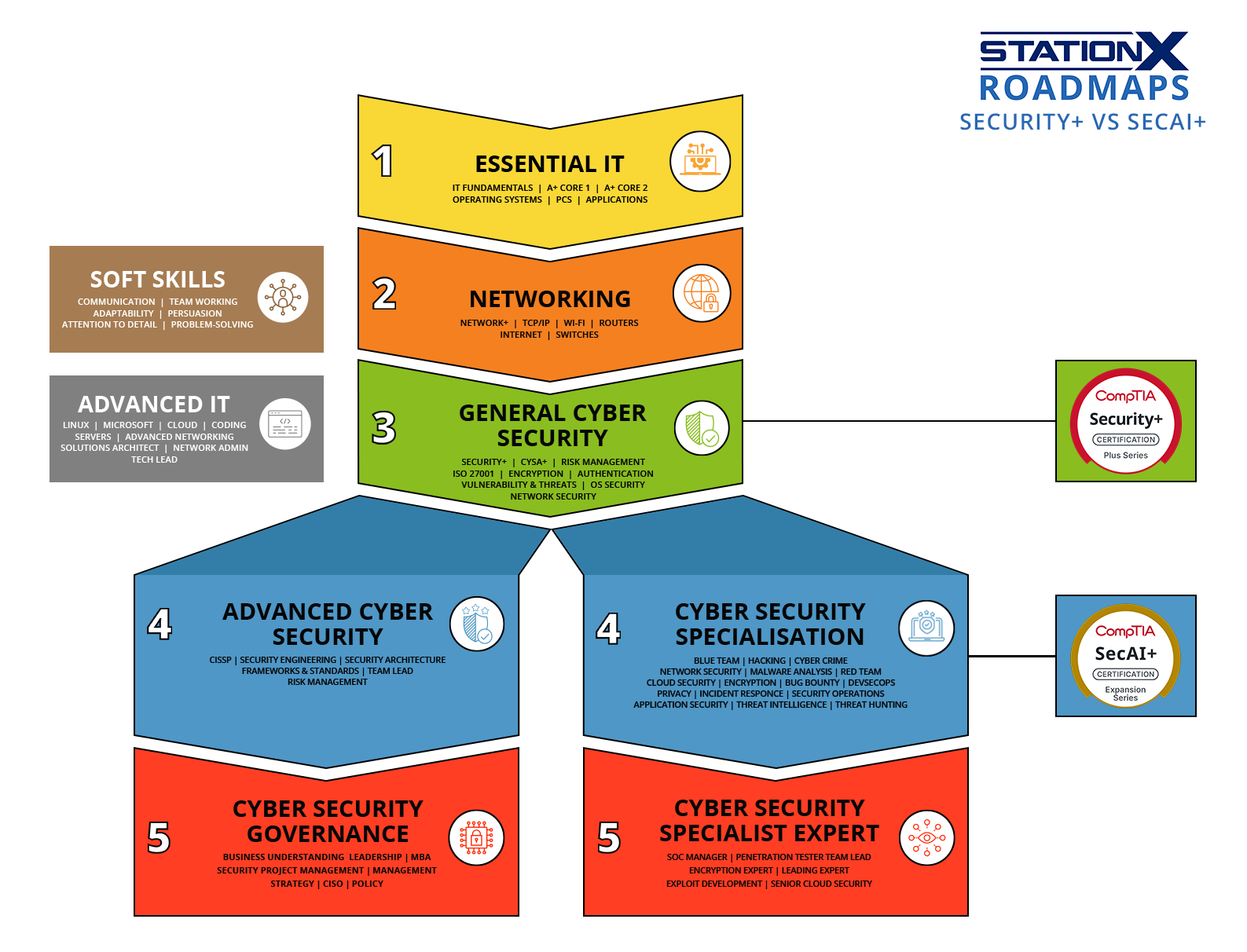
By contrast, SecAI+ targets professionals who already understand cyber security fundamentals and want to specialize at the intersection of security and artificial intelligence.
Ideal candidates include:
- Security analysts working with AI-enabled tools
- Cloud or security engineers supporting AI workloads
- Governance, Risk, and Compliance (GRC) professionals addressing AI risks
- Data professionals intersecting with machine learning systems
As organizations increasingly integrate AI into production workflows, the responsibilities of cyber security professionals expand beyond the traditional security architecture. SecAI+ reflects this shift toward specialization rather than entry-level competency.
Recommended Certification Pathway
CompTIA certifications are intentionally designed to follow a progression model. While not mandatory, the ideal pathway for obtaining these certifications is as follows:
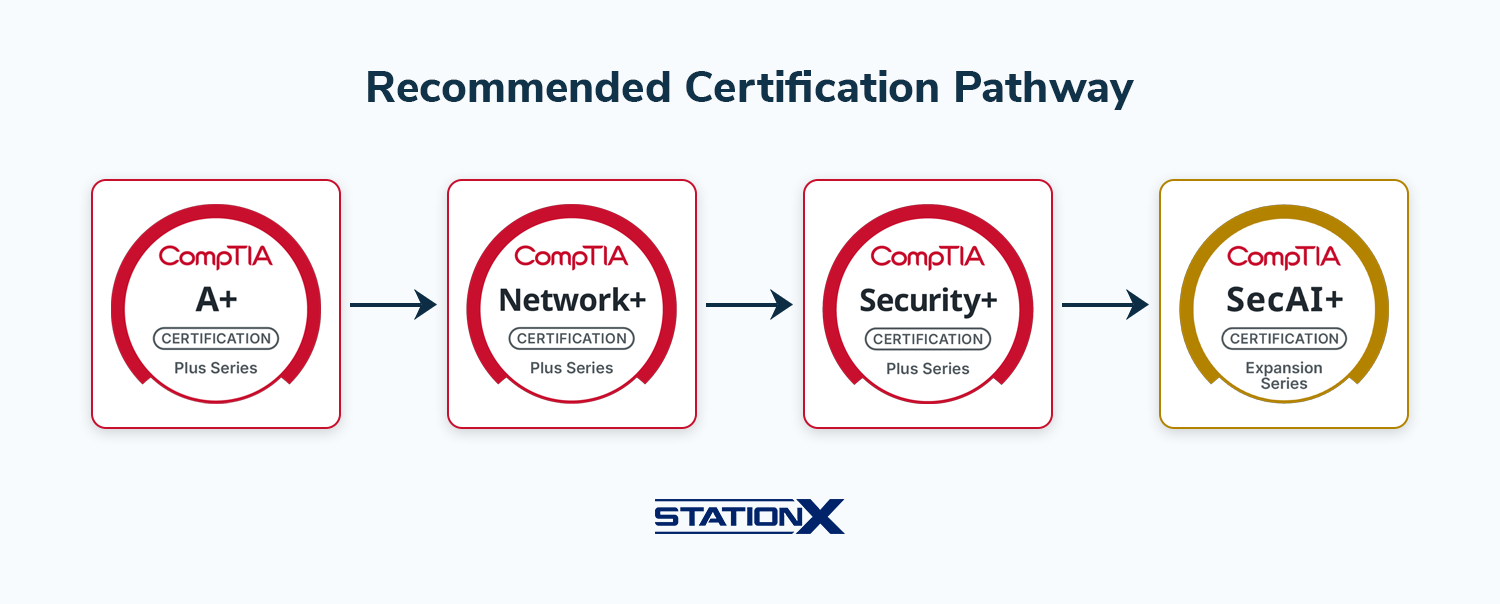
Each of the steps builds context for the next, as follows:
- CompTIA A+ Core 1 & 2 establish general IT knowledge
- CompTIA Network+ develops networking fundamentals
- CompTIA Security+ introduces cyber security principles across environments
- CompTIA SecAI+ applies those principles to AI-integrated systems
This sequence clearly demonstrates that these certifications are strategically complementary rather than competitive. Security+ and SecAI+ represent different phases of your professional journey in cyber security.
While skipping foundational certifications is sometimes possible, especially if you have prior experience, specialization without baseline knowledge often creates gaps that become apparent in real-world environments. Be aware of your skill set and career trajectory when deciding between certifications.
Exam Details
SecAI+ vs Security+ both follow CompTIA’s standardized testing model, formatted to include a mixed style of questions.
Throughout, you will be answering multiple-choice questions that may have single or multiple answers. Designed to assess your applied knowledge, many of these questions are scenario-based, requiring you to apply concepts to real-world situations rather than simply recall memorized definitions. These can take the form of, ‘given this scenario, which is the most appropriate action,’ followed by a specific situation.
However, you will also encounter between one and ten weighted performance-based questions, or PBQs. These are designed to assess your critical thinking and technical skills. The number of PBQs you are given will impact the number of multiple-choice questions you will answer.
When comparing the two, exam structure alone does not tell the full story because they differ greatly in scope, depth, and domain emphasis.
SecAI+ Exam Details
SecAI+ (CY0-001) officially launched on February 17, 2026, as CompTIA’s newest AI-focused cyber security certification and is currently in its first release cycle (V1).
If you choose to take this exam, you will face a maximum of 60 questions in a 60-minute testing window. It is administered as a closed-book and requires a score of 600 for you to pass on a scale of 100 to 900.
The exam is currently offered only in English and is expected to follow CompTIA’s typical 3-year life cycle before retirement.
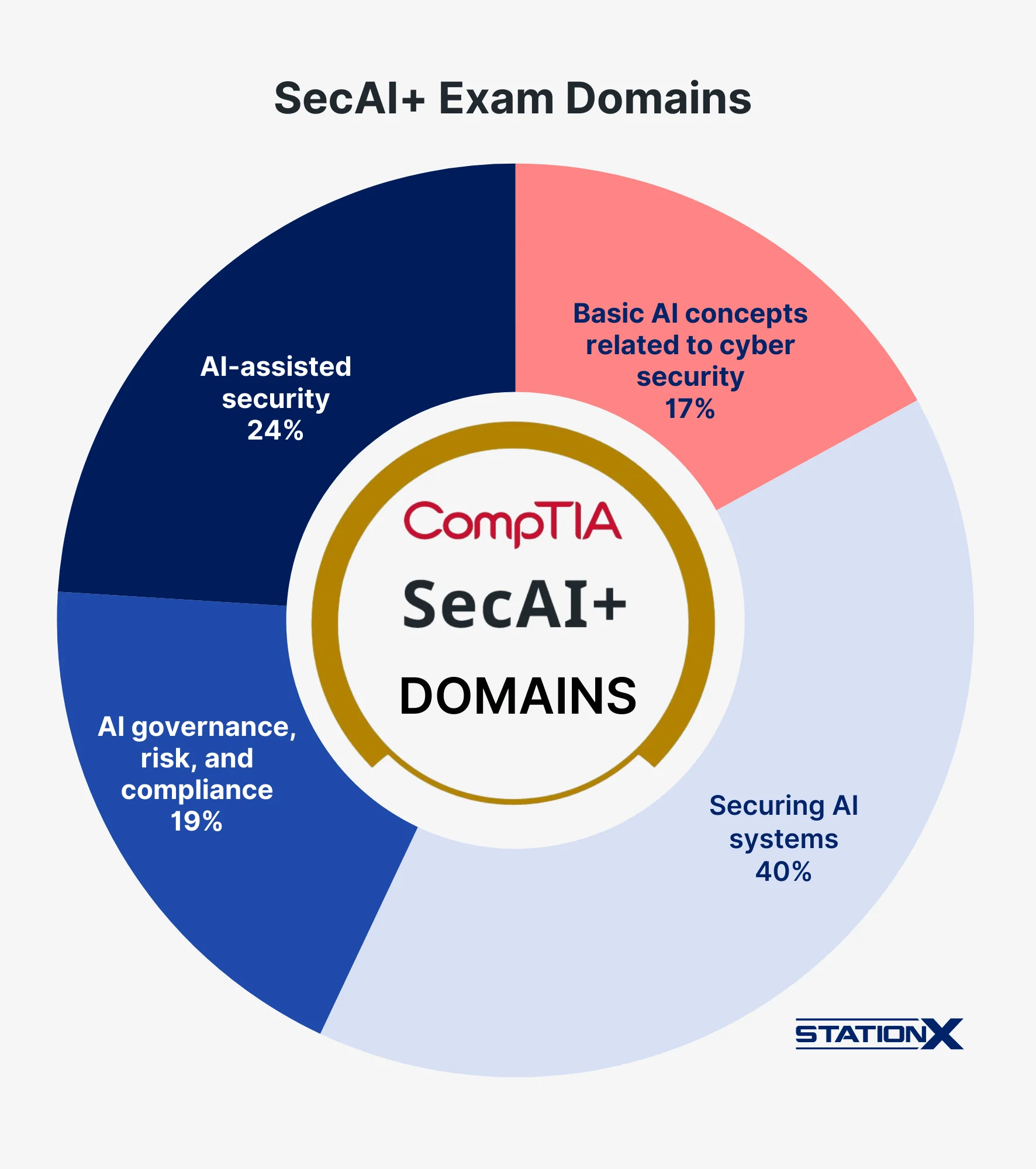
SecAI+ is structured around four domains as follows:
| Domain | % of Exam | Focus Area |
|---|---|---|
| 1.0 Basic AI Concepts Related to cyber security | 17% | Foundations of AI and ML, common AI security use cases, and emerging AI-driven threats |
| 2.0 Securing AI Systems | 40% | Threat modeling, implementing security controls and mitigating risks across AI infrastructure |
| 3.0 AI-assisted Security | 24% | Using AI tools for threat detection, automation, and security operations |
| 4.0 AI Governance, Risk, and Compliance | 19% | Managing regulations, frameworks, and organizational governance |
Note that nearly half the exam tests your ability to secure AI systems directly. That weighing reflects where CompTIA expects you to demonstrate applied competence in addition to foundational knowledge. Thus, SecAI+ is structurally focused and specialized.
Security+ Exam Details
Security+ (SY0-701) launched on November 7, 2023, and is currently on its seventh release cycle (V7). Note that it follows CompTIA’s typical 3-year life cycle before retirement, which means it is set to expire sometime in 2026.
If you decide to take this one, you will face a maximum of 90 questions in a 90-minute testing window. It is also administered as a closed-book test and requires a score of 750 on a 100 to 900 scale to pass.
Because it is a long-established certification, Security+ is offered in multiple languages and also aligns with DoD 8140 work roles.
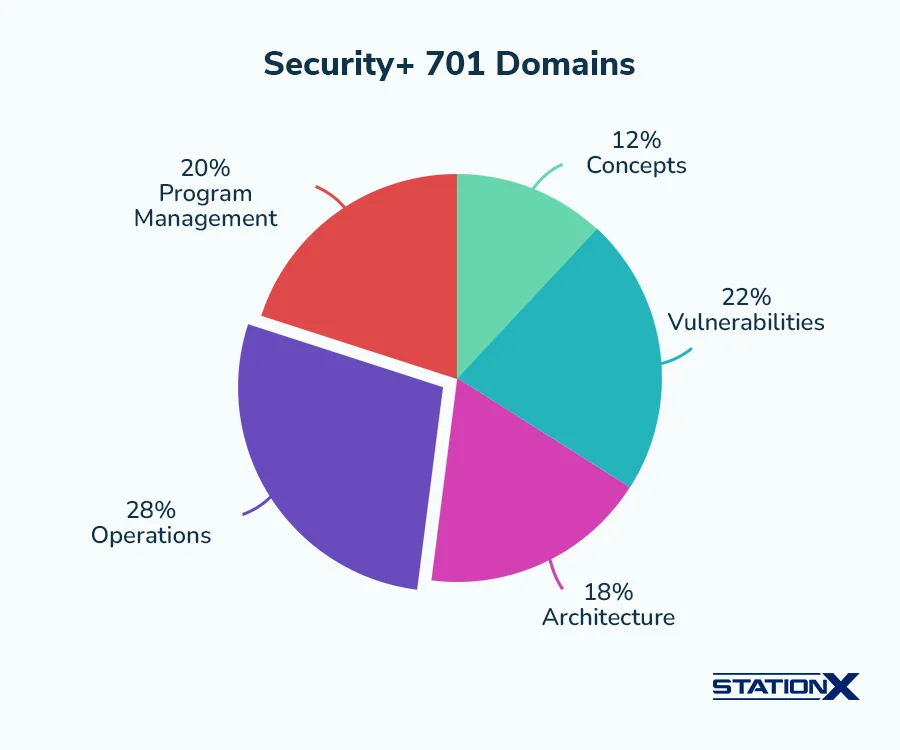
Security+ is structured around five domains as follows:
| Domain | % of Exam | Focus Area |
|---|---|---|
| 1.0 General Security Concepts | 12% | Fundamental security principles, security controls, risk concepts, cryptographic solutions |
| 2.0 Threats, Vulnerabilities, and Mitigation | 22% | Identifying threat actors, attack methods, system vulnerabilities, and defensive countermeasures |
| 3.0 Security Architecture | 18% | Securing enterprise environments and data for resilience and recovery |
| 4.0 Security Operations | 28% | Monitoring, incident response, identity management, vulnerability management, and operational security controls |
| 5.0 Security Program Management and Oversight | 20% | Governance, risk management, compliance, audits, and security awareness |
Unlike SecAI+, Security+ is intentionally broad. It validates competency across technical, operational, and governance dimensions of cyber security.
Winner: Draw
If you are looking at exam coverage, this section is a draw because these certifications test different dimensions of knowledge.
If the goal is to demonstrate wide-ranging foundational knowledge, Security+ has the advantage. If the goal is to demonstrate applied expertise in a rapidly evolving niche, SecAI+ carries the weight.
One is important due to the breadth of knowledge it covers, the other is important due to the depth of knowledge it covers.
Eligibility Requirements
The good news here is that neither Security+ nor SecAI+ has hard requirements. You do not need formal approval, prior certifications, or documented job experience to register and sit for the exam.
If you are ready to schedule it, you can. The thing to consider when doing so is the difference in recommended experience.
SecAI+ Requirements
In practicality, SecAI+ assumes that you already understand cyber security fundamentals.
CompTIA recommends that you have three to four years of IT experience before attempting SecAI+, at least two of which should be hands-on cyber security experience. They also suggest holding a baseline certification such as Security+, CySA+, PenTest+, or having equivalent knowledge.
This is not a requirement. Rather, it is guidance to achieve the best-intended results from the process.
Security+ Requirements
Security+ is designed as an entry to intermediate certification. CompTIA recommends A+ and Network+ as base IT knowledge, and about two years of experience working in security or system administration roles.
Again, this is not enforced.
Security+ assumes more baseline technical knowledge than specialization. With structured study, hands-on labs, and practice exams, you can easily pass the exam without full-time job experience in cyber security.
Winner: Security+
Neither exam requires formal approval or prerequisites.
However, Security+ is easier to approach if you are just starting out in your career. The recommended experience level is lower, and the certification is designed as a starting point. Meanwhile, SecAI+ assumes deeper exposure, builds on prior knowledge, and recommends a higher level of experience.
If your goal is to simply get in an exam chair with fewer assumptions about your background and get a certification under your belt, Security+ takes the cake.
Exam Difficulty
Since both exams have the same layout and are by the same company, the testing format will be at the same level of difficulty, with multiple-choice and PBQs. You will be expected to apply knowledge, not just memorize definitions.
That said, let’s look at the specs of both exams briefly below:
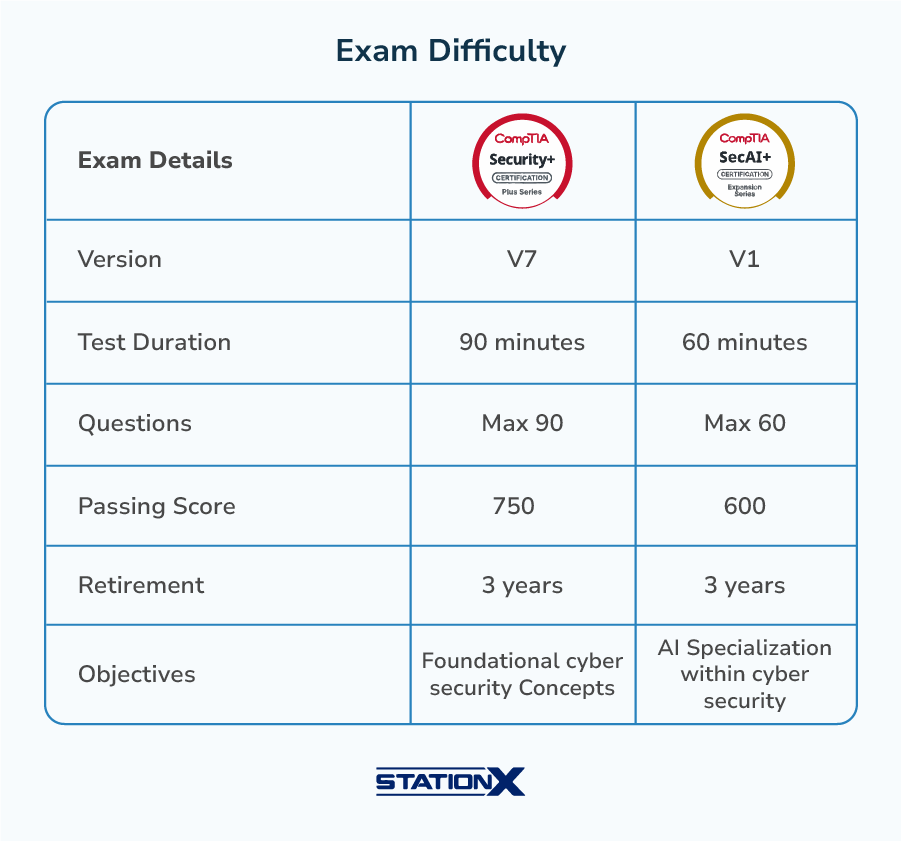
If you look strictly at structure, Security+ is the longer exam. It gives you up to 90 questions in 90 minutes, and you need 750 out of 900 to pass. It comprises five knowledge domains.
SecAI+ gives you a maximum of 60 questions in 60 minutes, a passing score is 600 out of 900, and four domains to cover over the span of the test. At first glance, this looks much easier: fewer questions, lower passing score, less material, shorter test.
But difficulty is not just determined by length or scope. In this case, the consideration is the depth of the material being covered in the two exams.
Security+ is broad. There’s more material, yes, but it stays at a foundational level, and the preparation path is more straightforward. In contrast, SecAI+ requires you to layer AI knowledge on top of existing security knowledge. That means more focused study time and a stronger technical baseline.
Winner: Security+
The easier certification to pass is Security+, and it’s simple why. While Security+ requires endurance, SecAI+ demands integration.
Security+ may be longer and require a higher passing score, but the material is foundational, and more importantly, well-supported. From a preparation standpoint, SecAI+ requires deeper technical maturity and more targeted study with less support offered due to its recent release.
Job Opportunities
It is at this point that Security+ and SecAI+ separate in a practical way.
Security+ has two decades of market recognition. That matters because it translates directly to hiring filters: recruiters search for it, and applicant tracking systems flag it. It is embedded in job descriptions.
Although officially released, the drawback for SecAI+ is that it has not yet appeared in job postings. That is expected, as certifications take time to be embedded into HR frameworks.
Regardless, there are plenty of opportunities for both certifications in the field.
SecAI+ Job Opportunities
According to the most current cyber security job statistics, “AI is now the #1 most-needed skill in cyber security, cited by 41% of respondents… 64%+ of cyber security job listings in 2026 require AI, ML, or automation skills.”
This means obtaining the SecAI+ puts you ahead of the curve. Even though the certification itself has not yet been embedded into job listings, the types of roles SecAI+ aligns with already exist.
Potential job titles for these roles include the following:
- AI Security Architect
- AI Risk Analyst
- AI/ML Security Engineer
- AI Governance and Compliance Specialist
- Advanced AI Data Trainer
The salary range for AI-based cyber security roles starts at $70K for entry-level and can go as high as $240K for advanced roles. This varies depending on job title, experience level, and location.
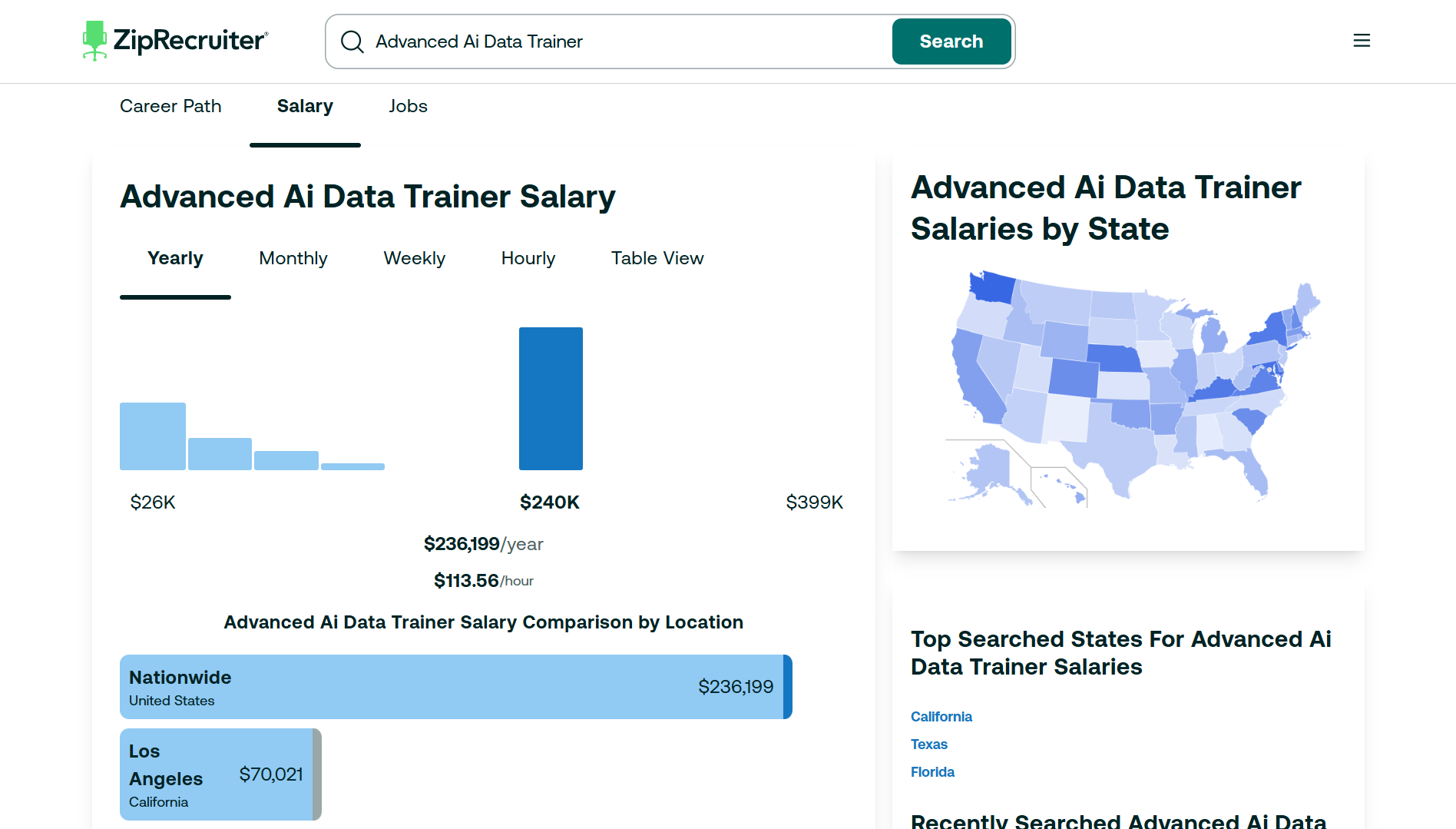
ZipRecruiter maps out salaries nationwide for different AI security roles, comparing the data based on percentiles, highest earners by state and city, and even a breakdown of hourly, weekly, and yearly wages.
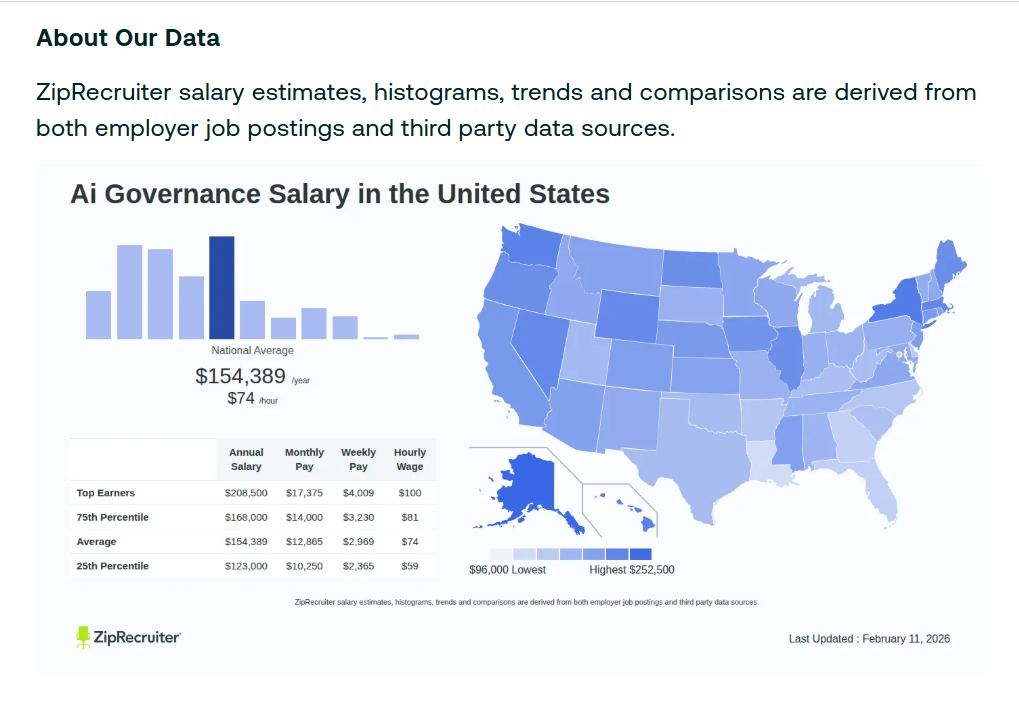
All that said, this is speculative for the value of this certification. SecAI+ is too new to appear on job postings. Employer recognition takes time.
What we can infer, however, is that this certification will likely be adopted as a standard in the industry. For general AI security, it's first-to-market and comes from the same organization as Security+, which has long served as the baseline security certification for both private and government roles. If this happens and it receives DoD recognition, SecAI+ can likely become a requirement or a preferred certification for these positions.
For more detailed information on SecAI+ demand in the job market, relevant job titles, salary ranges for specific roles, and career progression, check out CompTIA SecAI+ Salary: What to Expect in AI Security Roles.
Security+ Job Opportunities
If you’re here to figure out which certification opens doors for you sooner rather than later, CompTIA boasts that Security+ is the one.
If you search for job boards today, you will find thousands of listings across platforms that explicitly require or prefer Security+, with over 100K job listings on LinkedIn alone, and salary ranging from $60K - $180K, depending on job title, experience level, and location.

There are many entry-level roles that are attainable with only a Security+ and some experience, such as:
- Security Information Analyst
- Technical Operations Level 1
- Systems Administrator
- IT Help Desk Technician
- Junior SOC Analyst
For more detailed information on Security+ demand in the job market, relevant job titles, salary ranges for specific roles, and career progression, check out Top CompTIA Security+ Jobs to Pursue.
Winner: Security+
Right now, Security+ wins purely in terms of immediate, measurable job access. It is proven, recognized, and embedded into hiring requirements.
That said, SecAI+ is still worth keeping an eye on, as it will gain traction quickly and likely become the more prevalent certification with a higher payout.
FREE Cyber Security Career Guide
Thinking of a career in cyber security? Our Cyber Security Career Guide walks you through the industry landscape, skill-paths, certifications, and realistic timelines to become job-ready.
Cost and Recertification
Cost is a practical part of the certification decision. You want to make an informed decision about not just your first attempt, but what it costs to keep the certifications active long-term.
Here’s how Security+ and SecAI+ compare:
| Cost Component | Security+ | SecAI+ |
|---|---|---|
| First Attempt | $425 USD | $359 USD |
| Validity | 3 years | 3 years |
| Continuing Education Units (CEUs) | 50/year | Expected same CE requirement* |
| Exam Renewal (CE Fees) | $0-$150 (3 yrs) | Expected same CE structure |
Security+ costs $425 for the exam voucher. If you purchase a bundle with retake assurance, the cost is $474. Once purchased, the voucher is valid for 12 months.
The same structure applies for SecAI+ which costs $359, with a retake bundle priced at $408.
Note that, as an authorized CompTIA partner, you can buy both the Security+ exam voucher and SecAI+ exam voucher from us at up to 30% off.
Both certifications remain valid for three years. To maintain either one, you must pay $150 over a three-year period in Continuing Education fees*. You must also earn the required CEUs during that period, which is 50 CEUs per year for Security+, and expected to be the same for SecAI+*.
Since renewal fees are normally identical for certifications for same-tier certifications under CompTIA’s CE program, the only expected financial difference is the initial exam pricing*.
*Projected: We will update any changes to this once more information is available through CompTIA.
Winner : SecAI+
Because renewal costs are expected to be the same, and SecAI+ has a lower upfront price, the clear winner based on which certification is cheapest to get and maintain is SecAI+.
CompTIA SecAI+ vs Security+: Final Verdict
At this point, the question is not which credential is better, but rather which one fits your current position and your next move.
Choose Security+ If You:
- Are new to cyber security, whether a student or a professional transitioning to the field
- Need a recognized baseline credential
- Plan to pursue DoD-aligned roles and work in the government sector
- Want flexibility across multiple security career paths
Security+ is the industry standard for certifications. It is highly demanded and widely respected, and will open doors for you into cyber security immediately.
Choose SecAI+ If You:
- Already have foundational cyber security knowledge, such as the Security+ or equivalent
- Have worked or are working with AI/ML tools or environments in a security context
- Have 3-4+ years’ experience in IT, with at least two years of hands-on experience in cyber security
- Want to specialize in AI security and governance
SecAI+ positions you in a rapidly growing niche. It signals that you are a seasoned professional who is ahead of the curve. It also makes you the remedy for the growing talent gap in AI expertise within cyber security.
The Smarter Career Move?
For today’s job market, Security+ wins. For tomorrow's specialization, SecAI+ is worth serious consideration.
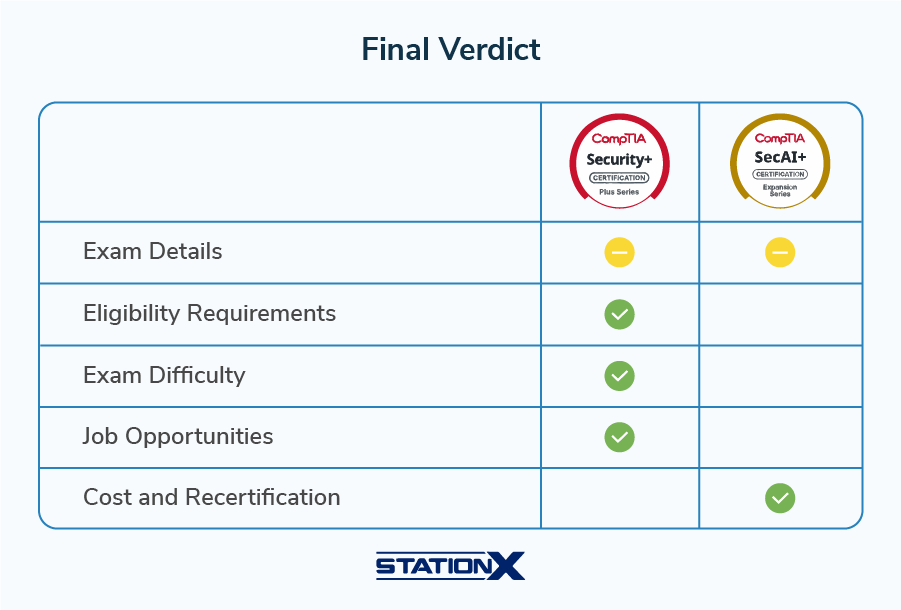
Having said that, the smartest thing to do in the current job market trajectory would be to consider taking both.
The logical and recommended path if you are interested in cyber security and AI is:
Security+ → Experience → SecAI+
To reiterate, the two certifications are complementary rather than competing. Think of Security+ as the unofficial prerequisite for SecAI+. The former builds the base, while the latter builds the specialization.
If you have neither, start with Security+ as you need the foundation. After that, SecAI+ becomes the strategic next step in your career trajectory.
To get started, check out our CompTIA Security+ Course & SY0-701 Practice Test Bundle. See the banner below.
If you’re still not sure on where to start or what direction to take with these certifications, consider joining the StationX Master’s Program. This will give you access to over 30,000 courses and labs covering major certifications like Security+, along with the practical skills, personalized mentorship, and plenty of resources needed to build a successful cyber security career.
The CompTIA Security+ Course & SY0-701 Practice Test Bundle includes: