The Network+ certification is a key credential for aspiring networking professionals, but how does it impact your earning potential? If you're considering investing time and resources into this certification, understanding the average Network+ salary and career return is a crucial part of the decision.
We will explain which positions this certification will prepare you for, and the expected CompTIA Network+ salary for these roles. Additionally, we will discuss your next steps in your career.
Let’s examine how the CompTIA Network+ certification salary can shape your career and prospects.
Overview of the CompTIA Network+ Certification
The CompTIA Network+ examination assesses your abilities in key computer networking areas.
You’ll need to answer a maximum of 90 questions that combine multiple-choice and performance-based questions (PBQs) within 90 minutes. To pass the exam, you will need a score of 720 on a scale of 100–900.
The latest CompTIA Network+ exam code is N10-009. The breakdown of the domains can be found in the chart below.

Here are key concepts you learn from each of the five domains.
Networking Concepts 23%: Explains key principles like the TCP/IP and OSI models, common networking protocols and ports, IP addressing schemes, cloud computing fundamentals, data center architectures, and virtualization.
Network Implementation 20%: Focuses on configuring and deploying network hardware, implementing wireless technologies, establishing routing and switching protocols, and ensuring proper cable management and connections.
Network Operations 19%: Discusses strategies for monitoring and managing networks, responding to incidents, recovering from disasters, and maintaining organizational policies to support uninterrupted operations.
Network Security 14%: Covers essential security concepts such as the CIA Triad, identifying vulnerabilities and attack types, applying security reinforcement techniques, and ensuring physical and network security.
Network Troubleshooting 24%: Highlights systematic troubleshooting processes, pinpointing and fixing connectivity or performance problems, leveraging diagnostic utilities, and analyzing network diagrams to identify root causes.
Studying for Network+?






What Does CompTIA Network+ Certification Prepare You For?
While it's important to note that obtaining these jobs isn't guaranteed solely by certification, the CompTIA Network+ does equip you with the skills needed for various roles in the field. Let’s explore five specific job positions for which the Network+ certification will prepare you.
Help Desk Technician
This role is focused on providing technical support and assistance to users experiencing IT issues. Help desk technicians diagnose software and hardware problems, guide users through steps to resolve issues, and escalate to higher-level staff.
Network Field Technician
This position involves installing, maintaining, and troubleshooting network hardware and software on-site. It requires hands-on skills and the ability to work under various conditions, often traveling to different locations to address network issues directly.
Network Analyst
As a network analyst, you monitor an organization's network systems to ensure they operate efficiently. This includes analyzing network data, identifying bottlenecks or issues, recommending improvements, and working closely with other staff to optimize network performance.
Network Administrator
As a network administrator, you help run and maintain a company's computer networks. This includes creating network accounts, monitoring the network's performance, implementing security measures, and fixing connectivity problems.
Network Engineer
Network engineers are responsible for designing, implementing, and maintaining complex network solutions for customers, covering LAN, WAN, wireless, and data center networking. Key tasks include troubleshooting and resolving network issues, configuring and installing network systems, and managing various projects to ensure timely completion.
Tech & Cyber Security Resume Writing Services
Ready to land your dream cybersecurity job? Our Resume Writing Services apply ATS-optimized, industry-specific expertise to boost your interview rate by an average of 60% — trusted by thousands of tech professionals worldwide.
CompTIA Network+ Certification Salary and Job Opportunities
Having provided you with five potential careers you can obtain with the Network+ certification, let’s explore what opportunities and expected salaries you can earn.
After researching various job sites for available positions across the USA related to CompTIA Network+, we found many listings: LinkedIn has 258 job openings, ZipRecruiter shows 432, and Indeed lists 1,133. This data underscores the demand for CompTIA Network+ certified professionals in the job market.
According to ZipRecruiter, the average annual CompTIA Network+ certification salary is approximately $73,938 USD. The salary range for this qualification spans from $29,000 USD to as high as $144,500 USD.

Remember that the range of salaries we will be showing you is greatly affected by position (such as whether it's a junior role), location, education, experience, and if you hold other industry certifications.
Help Desk Technician
For a help desk technician role, employers often look for other certifications besides Network+, such as CompTIA Tech+ and CompTIA A+. While one year of experience is preferred, the typical range is around three years. These positions are generally available as full-time, with onsite or remote work options.

According to ZipRecruiter, the average annual salary of a help desk technician is around $47,000 USD.

Similar roles:
- Help Desk Support Specialist
- Desktop Support Specialist
- IT Support Analyst
Network Field Technician
Most network field technician roles are offered as either full-time or contract positions, requiring on-site presence. These positions commonly seek candidates with at least one to two years of experience. Sometimes, employers consider a relevant degree as a substitute for hands-on experience. Additionally, possessing a CompTIA A+ certification is often requested.

Based on information from ZipRecruiter, the average annual salary for a network field technician in the United States is $52,387 USD.

Similar roles:
- Field Service Technician
- Field Technician
- Hardware Technician
Network Analyst
The network analyst positions we researched typically require a bachelor's degree in computer science or a related field and two to five years of experience, often starting in entry-level roles. These roles are available as full-time, part-time, contract, and remote options. In addition to Network+, employers sometimes ask for certifications like CCNA and Security+.

According to ZipRecruiter, the average annual salary of a network analyst in the United States is around $80,000 USD.

Similar roles:
- Network Specialist
- Network Support Analyst
- Network Operations Manager
Network Administrator
Most network administrator positions are full-time, with many offering flexible work arrangements, including hybrid or remote options. Typically, these jobs require some form of post-secondary education or equivalent work experience, often around an average of three years.
Positions range from junior to senior levels, with salaries varying accordingly to reflect the role's seniority. Besides Network+ certification, employers frequently seek candidates with other certifications, such as CompTIA A+ and CCNA.

Based on data from ZipRecruiter, a network administrator in the United States currently earns an average annual salary of approximately $80,000 USD.

Similar roles:
- LAN Administrator
- Linux Administrator
- Network/Server Administrator
Network Engineer
Employers typically look for a mix of education and experience for the network engineer role. Some roles require a bachelor's degree in computer science or a related field and at least five years of engineering or technical experience, while others ask for three years of experience in lieu of a degree.
Most positions require a minimum of five to ten years of IT experience. In addition to Network+, certifications like Security+ and Server+ are often requested. These roles are predominantly full-time, with some requiring on-call availability.

According to ZipRecruiter, a system engineer’s average annual salary in the United States is around $108,000 USD.

Similar roles:
- Network Systems Engineer
- Communications Engineer
- Network Security Engineer
Network+ vs. CCNA and JNCIA
As you can see, having Network+ opens many doors for networking jobs, but this is not the only network certification out there. Let's consider how CompTIA Network+ certification salary and job opportunities stack up against other prominent network certifications such as CCNA (Cisco Certified Network Associate) and JNCIA-Junos (Juniper Networks Certified Internet Associate - Junos).
The table below shows salary data from ZipRecruiter, highlighting the average annual salaries associated with each of these certifications. We also have provided you with the number of job postings you can expect to find across different job platforms.
| CompTIA Network+ | CCNA | JNCIA-Junos | |
| Salary | $73,938 | $73,924 | $72,460 |
| Glassdoor | 815 | 5,141 | 42 |
| Indeed | 1,133 | 5,125 | 66 |
| ZipRecruiter | 432 | 6,386 | 33 |
| 258 | 77 | 52 |
Career Progression
Having the Network+ various pathways have opened for your career advancement. In addition to the five job roles we've highlighted, you can explore opportunities as a network support specialist or an IT consultant, expanding your career options.
You could also look at moving into more senior roles within networking. Whether you aim for a penetration tester senior network administrator or a senior network engineer position, gaining experience is key.
Here are five career paths to consider:
Cloud Architect Career Path
Start with Network+ Skills
- Learn routing/switching, IP addressing, subnetting
- Understand DNS, DHCP, and common protocols
- Practice basic troubleshooting and protocol analysis
Next Steps After Network+
- Study cloud models (IaaS, PaaS, SaaS), storage types, and virtualization
- Learn cloud networking, security fundamentals, and connectivity
- Earn Cloud+ or AWS Cloud Practitioner as an entry-level cloud cert
Advanced Progression
- Build skills in IAM, VPC design, load balancing, HA architectures, and monitoring
- Use tools like Terraform or CloudFormation for automation
- Target: AWS Solutions Architect or Associate or Azure Administrator Associate
Senior-Level Cloud Roles
- Understand hybrid cloud designs, multi-cloud strategy, and cost optimization
- Prepare for AWS/Azure Solutions Architect - Professional or Advanced Networking Specialty

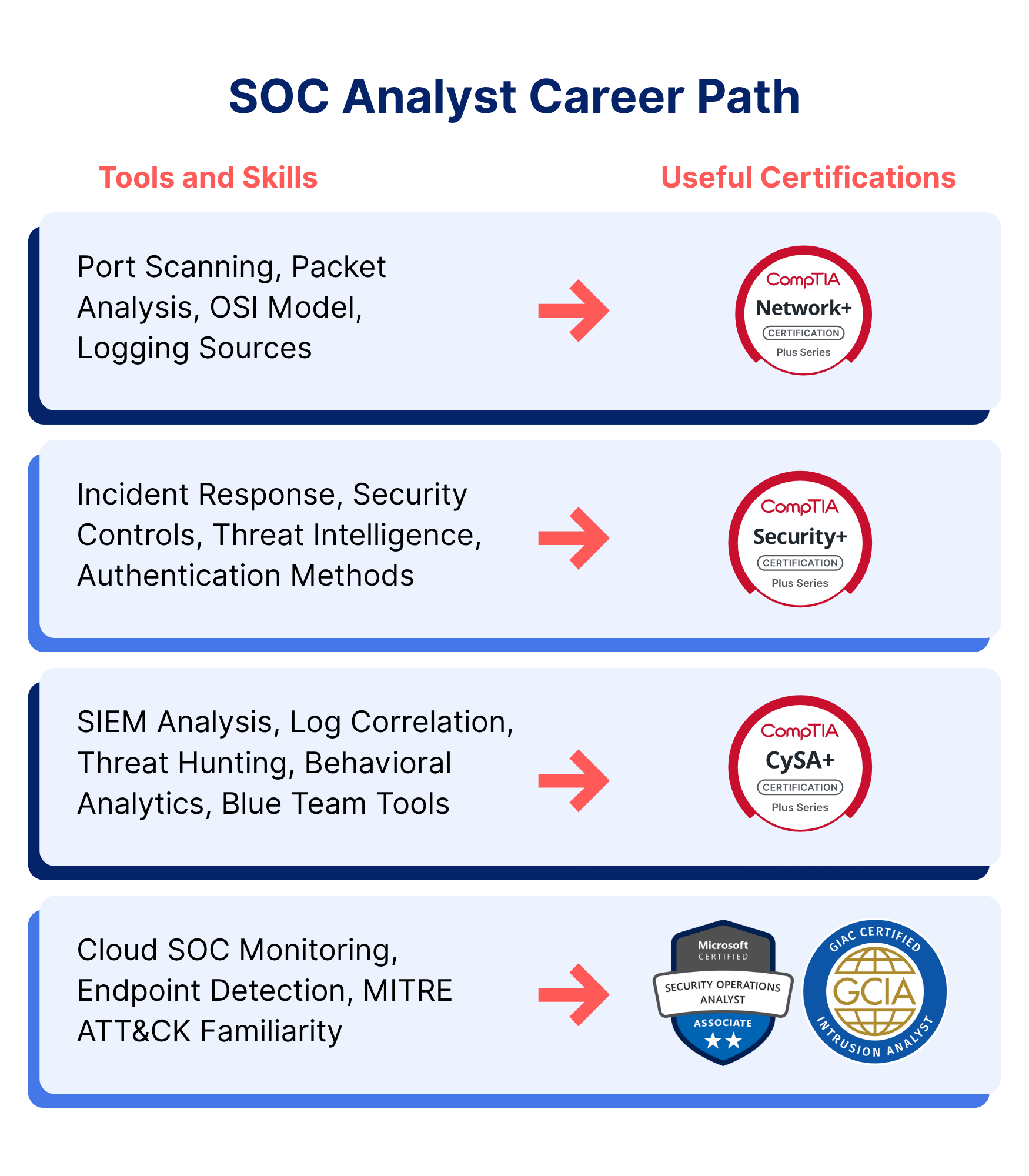
SOC Analyst Career Path
Start with Network+ Skills
- Learn basic port scanning and packet analysis
- Understand the OSI model and logging sources
- Build foundational troubleshooting skills
Next Steps After Network+
- Study security controls, incident response steps, and threat intelligence
- Learn authentication methods, common attack vectors
- Earn CompTIA Security+
Mid-Level Progression
- Work with SIEMs (Splunk, ELK), log correlation, and threat hunting
- Use Blue Team tools: CrowdStrike, Suricata, etc.
- Target: CySA+ (Cybersecurity Analyst+)
Advanced Progression
- Gain experience in cloud SOC monitoring and endpoint detection
- Study MITRE ATT&CK framework
- Optional: Microsoft Security Operations Analyst, GCIA, or C|SA
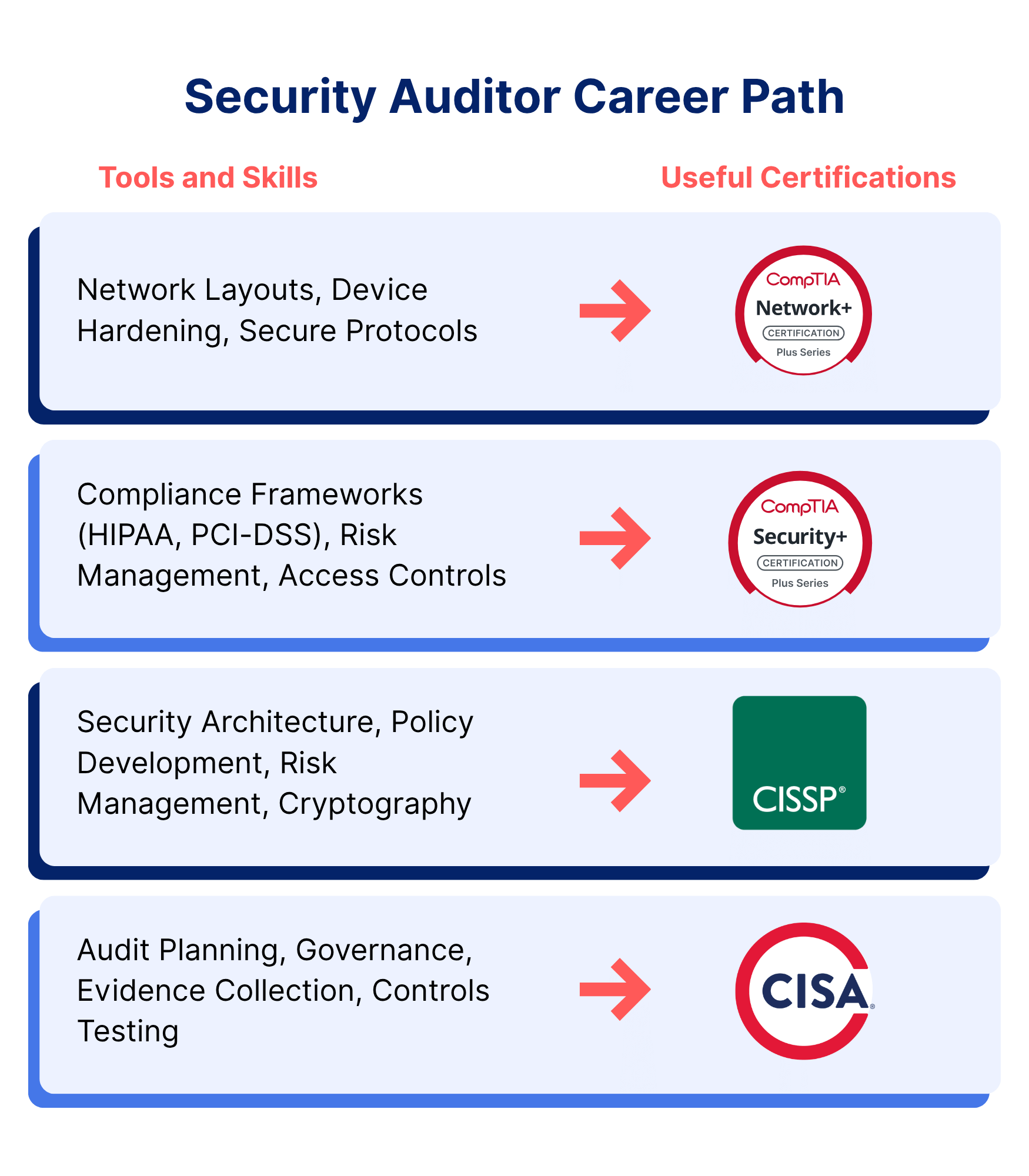
Security Auditor Career Path
Start with Network+ Skills
- Understand network topologies, device hardening, and secure protocols
Practice documenting access controls and common vulnerabilities
Next Steps After Network+
- Learn compliance frameworks: HIPAA, PCI-DSS, NIST, etc.
- Focus on risk management and policy development
- Earn Security+
Mid-Level Progression
- Master audit planning, control testing, cryptography, and governance
- Target: CISSP (especially if pursuing senior-level GRC roles)
Advanced Progression
- Learn how to collect evidence, conduct formal risk evaluations, and ensure regulatory compliance
- Certification goal: CISA (Certified Information Systems Auditor)
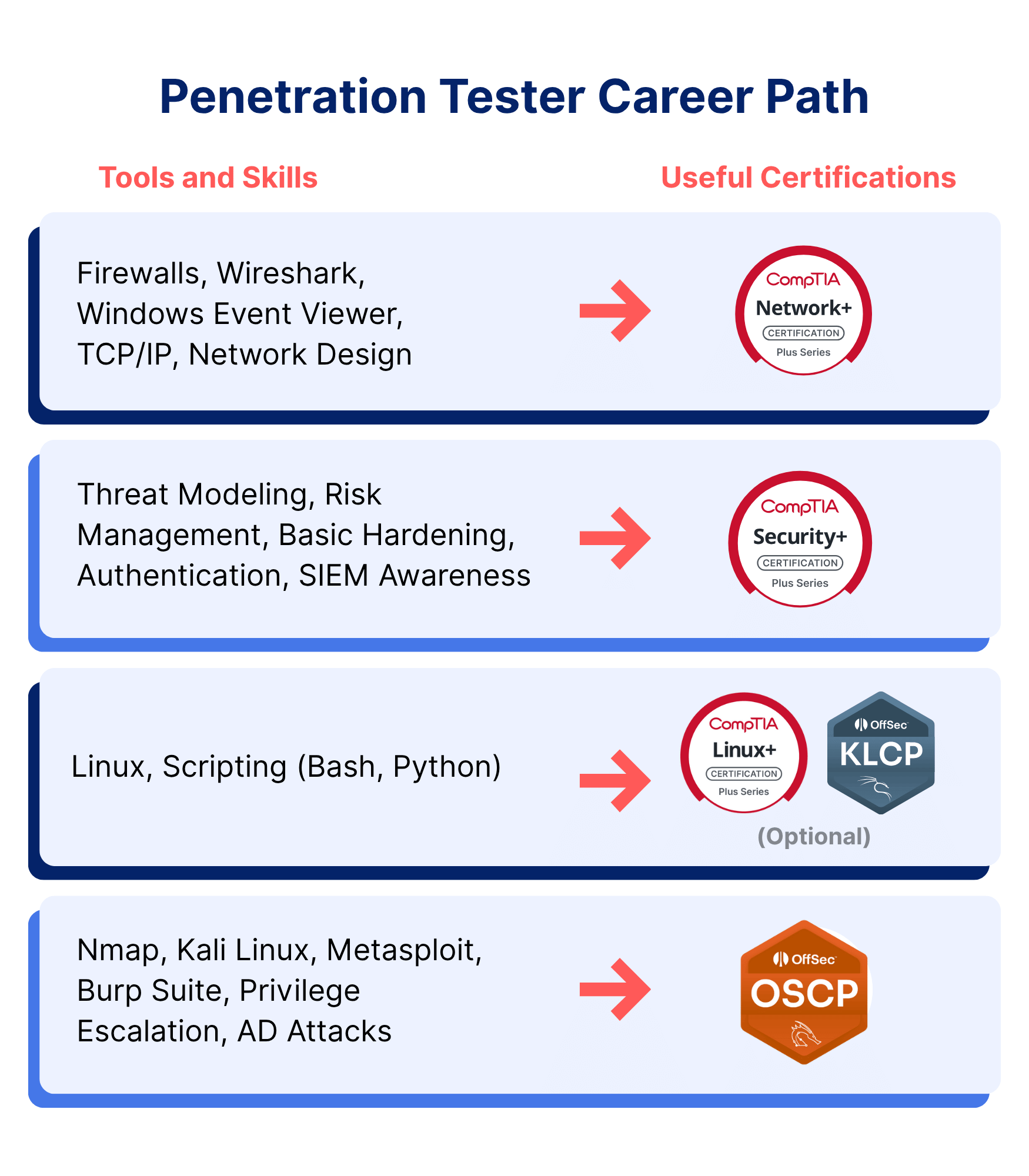
Penetration Tester Career Path
Start with Network+ Skills
- Understand firewalls, TCP/IP, and Windows Event Viewer
- Use Wireshark to analyze traffic
- Practice basic network design and segmentation
Next Steps After Network+
- Study threat modeling, risk management, and system hardening
- Build authentication knowledge and SIEM awareness
- Earn Security+
Mid-Level Tools & Skills
- Learn Linux fundamentals and scripting (Bash, Python)
- Completely optional, but may be helpful: Linux+, KLCP (Kali Linux Certified Professional)
- Start working with Nmap, Kali Linux, Burp Suite, Metasploit
Advanced Progression
- Dive into buffer overflows, privilege escalation, pivoting, and AD exploitation
- Certification target: OSCP (OffSec Certified Professional)
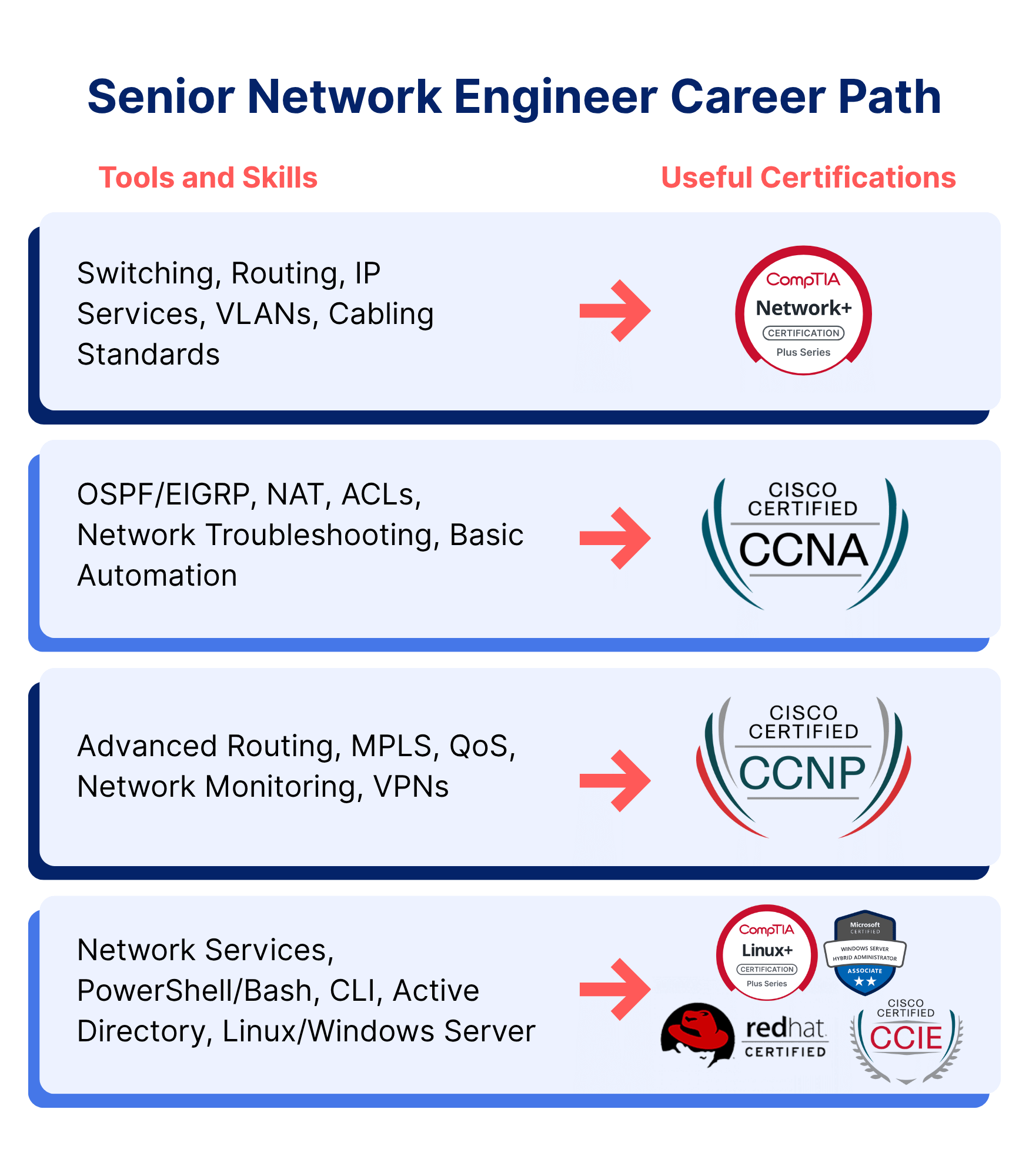
Senior Network Engineer / IT Infrastructure Manager Career Path
Start with Network+ Skills
- Master switching, routing, VLANs, IP addressing, and cabling standards
- Understand IP services like DHCP, DNS, and NAT
Next Steps After Network+
- Build knowledge in OSPF/EIGRP, ACLs, redundancy, and VPNs
- Add basic scripting (PowerShell, Bash) and network automation awareness
- Optional, considering you already have Network+, but valuable: CCNA
Mid-to-Senior Progression
- Focus on MPLS, QoS, network monitoring, and advanced routing
- Target: Cisco CCNP
Broader Infrastructure Skills
- Gain skills in Active Directory, Azure AD Connect, and Linux system administration
- Relevant certs: CompTIA Linux+, RHCSA, Windows Server Hybrid Administrator, or CCIE (advanced goal)
CompTIA Network+ Salary Conclusion
As you can see, holding Network+ can open many careers opportunities in network administration, cloud computing, and cyber security. We’ve also looked at the CompTIA Network+ certification salary you can expect in these positions.
The knowledge gained from this certification can be a stepping stone to advanced roles and certifications in these fields.
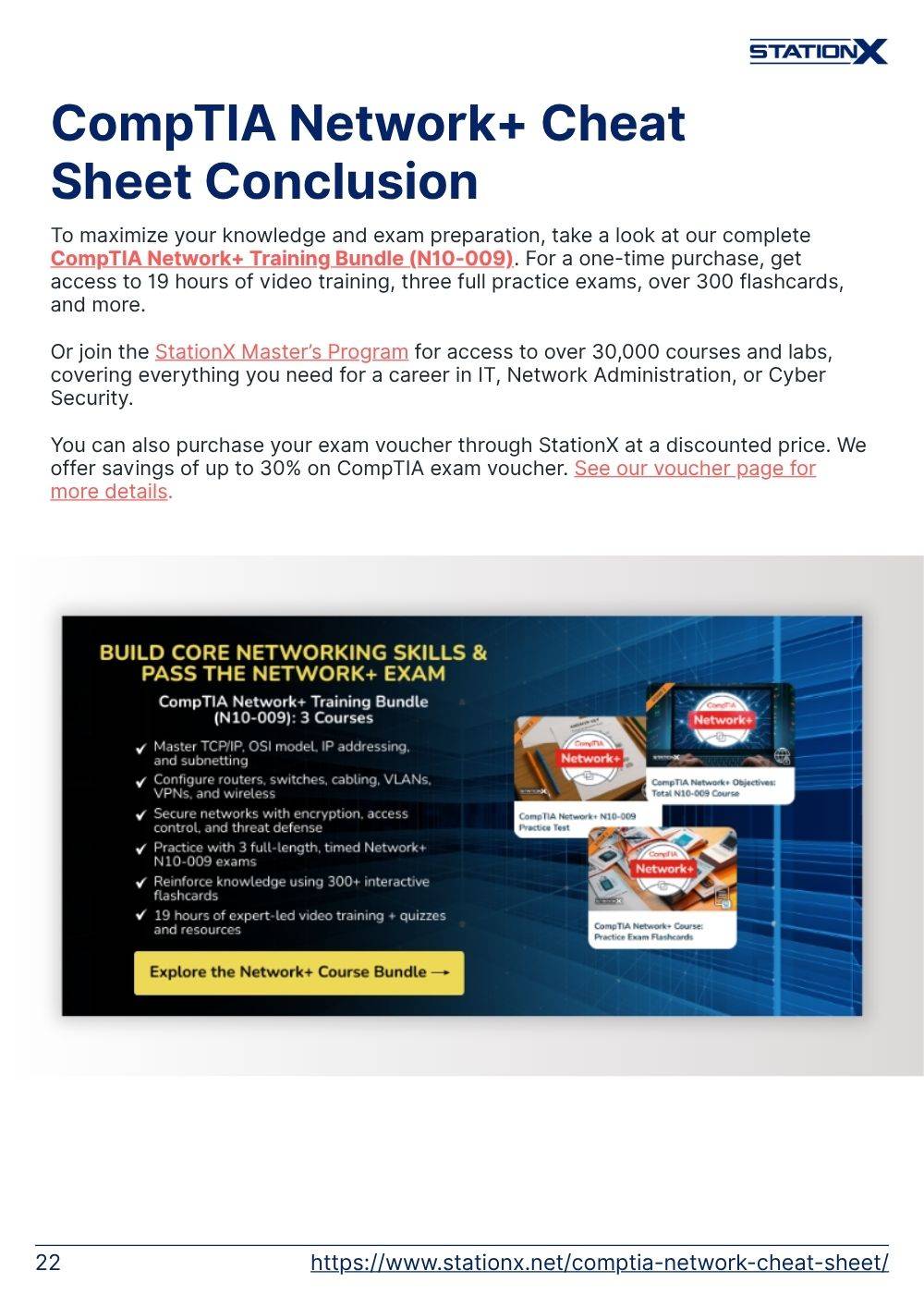
When you’re ready to start pursuing this in-demand certification, you can get lifetime access to the CompTIA Network+ Training Bundle (N10-009): 4 Courses. This bundle includes everything you need to study effectively and prepare with confidence: 35 hours of on-demand video, 5 full-length practice exams, 19 quizzes, 300+ flashcards, mobile access, and a certificate of completion.
Additionally, you can grab your Network+ voucher from us and save up to 30% off the official price.Lastly, if you want to take your career to the next level, make sure you join our Master's Program. With over 30,000 courses and labs, 1:1 mentorship, roadmaps, and study groups, we’ll help you ace your Network+ exam and other IT or cyber security career milestones.
This CompTIA Network+ Training Bundle (N10-009): 4 Courses contains:
- CompTIA Network+ Objectives: Total N10-009 Course
- CompTIA Network+ Study Guide: Master N10-009 Objectives
- CompTIA Network+ N10-009 Practice Test
- CompTIA Network+ Course: Practice Exam Flashcards