

The IT industry reached 6.1 million this past year, according to CompTIA, and demand continues to outpace supply across nearly
every specialization.
Whether you're making a career change or choosing your first direction, the path you pick matters. Each one requires different skills, certifications, and experience.
In this article, we break down over 20 roles across eight major IT career paths, including responsibilities, average salaries, abilities, and certifications that employers look for.
From cyber security to data science, let's navigate this dynamic and exciting world and help you choose your IT career path.
- Starting Your Journey Towards Top IT Career Paths
- 1. Cyber Security Path
- 2. Software Development Path
- 3. Data Science and Analytics Path
- 4. Cloud Computing Path
- 5. IT Project Management Path
- 6. Network Administration Path
- 7. Artificial Intelligence and Machine Learning Path
- 8. DevOps Engineering Path
- Conclusion
- Frequently Asked Questions
Starting Your Journey Towards Top IT Career Paths
It can be scary to start an IT career because there are so many options and paths to take. However, understanding basic concepts and skills can make the process much easier.
The CompTIA A+ certification is a good place to start because it gives you a broad understanding of IT and can help you get started in a number of IT careers. Let's look at some of the most important things that CompTIA A+ covers.
- Hardware
Understanding how computer components like motherboards, processors, RAM, and storage devices interact. - Networking
Fundamentals of networking, including types of networks, protocols, IP addressing, and basic troubleshooting. - Mobile Devices
Familiarity with common mobile devices, their operating systems, and basic troubleshooting. - Operating Systems
Knowledge of major operating systems (Windows, macOS, Linux) and their administration. - Software Troubleshooting
Diagnosing and resolving common software issues, understanding application installations and configuration. - Security
Fundamental security concepts, including types of threats, vulnerability management, and basic security practices. - Operational Procedures
Best IT operations practices include safety, professionalism, and effective communication.
Here is a full breakdown of the newest Core 1 and Core 2 domains:
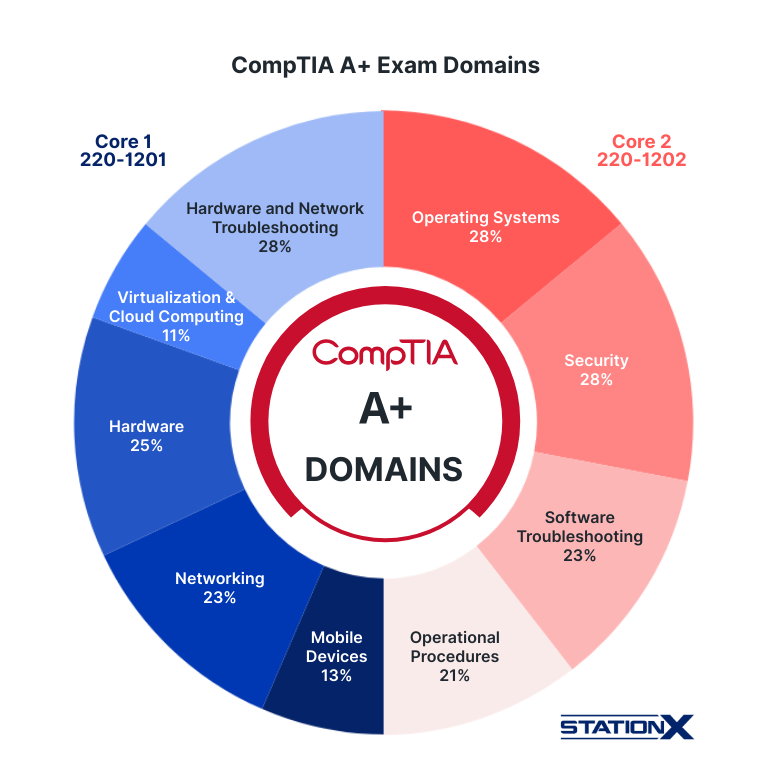
Even if you decide not to pursue CompTIA A+, learning the syllabus will give you a solid understanding of IT. Once you have this knowledge, it will give you a great foundation for almost any IT career path you choose.

Remember that you can start a career in IT with or without a degree, and you can begin to learn and even hone the necessary skills by utilizing various resources, such as online forums, blogs, and labs, and by taking related certifications to prove your knowledge.
Here are 20 popular careers in eight categories. In each category, we will give you a high overview of the particular field in IT, then we will break down the responsibilities, average salary, and some of the skills and or certifications that are beneficial to each job listed.
1. Cyber Security Path
Cyber security is an ever-evolving IT field that protects networks and data from cyber threats and attacks. The demand for skilled cyber security professionals has grown with the increase in attacks.
To succeed in this career, you will need foundational skills, such as understanding networking protocols and operating systems, risk analysis and management, and security tools and technologies.
CompTIA Security+ is one certification you can use that offers a broad security overview before deciding on your area of specialization, where you could consider other certifications, such as the OSCP or CEH for offensive or the CySA+ for defensive security.
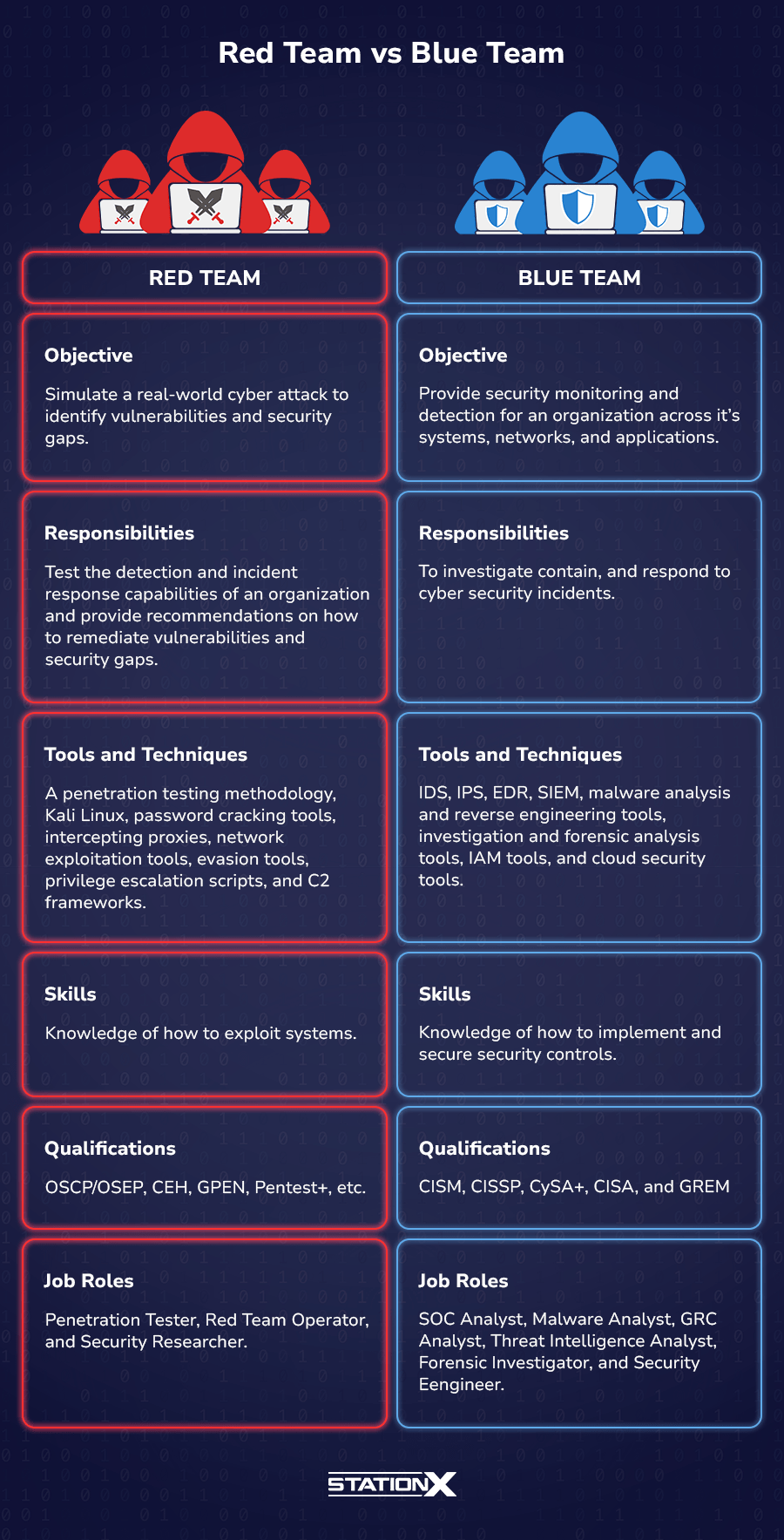
Role 1: Red Team / Offensive Cyber Security
- Identifies system, network, and application vulnerabilities.
- Provides detailed reports and analysis of security breaches and recommends improvements.
- Conducts simulated cyber attacks on an organization's infrastructure to assess its security.
- This includes roles such as Penetration Tester, Ethical Hacker, and Vulnerability Assessor.
Average Salary:
$119,895 USD
Certifications or Skills:
- Offsec Security Certified Professional (OSCP)
- Certified Ethical Hacker (CEH)
- Strong problem-solving skills to think like an attacker and identify weak points.
- Ability to communicate findings effectively to technical and non-technical stakeholders.
Role 2: Blue Team / Defensive Cyber Security
- Constantly monitors network and system activities.
- Regularly assesses the organization's digital infrastructure.
- Develops and enforces security policies and procedures.
- Includes roles like SOC Analyst, Cyber Security Analyst, and Incident Responder.
Average Salary:
$99,157 USD
Certifications or Skills:
- CompTIA Security+
- ISC2 Systems Security Certified Practitioner (SSCP)
- Cybersecurity Analyst+ (CySA+)
- Strong analytical skills to interpret security data and identify trends.
- Skills in incident detection, response, and management.
Role 3: Consulting, Auditing, and Management
- Identifies risks in IT systems and ensures compliance with laws and regulations.
- Oversees and directs the cyber security department within an organization.
- Provides expert advice to organizations on using cyber security to meet business objectives.
- Roles include Cyber Security Consultant, Auditor, Architect, and Manager.
Average Salary:
$109,707 USD
Certifications or Skills:
- ISACA Certified Information Systems Auditor (CISA)
- Certified Information Systems Security Professional (CISSP)
- Ability to develop and implement security strategies aligned with business goals.
- Proficiency in managing large-scale security projects and resources.




Explore our range of cyber security certification articles to boost your skills and advance your career!
The 10 Best Cyber Security Certifications for Beginners
Top Entry Level Cyber Security Certifications for You
2. Software Development Path
Software development remains one of the largest IT career paths, but the day-to-day work has changed significantly. AI-assisted coding tools like GitHub Copilot, Cursor, and Claude Code are now standard in most development teams, handling boilerplate, suggestion implementations, and catching bugs in real time.
This doesn't mean developers are less important. It means the bar has shifted. Employers now expect developers to write code and work effectively with AI tools, review AI-generated output for correctness, and understand when automated suggestions are wrong.
To be successful in this career, you will need a core foundation of programming skills, such as proficiency in languages like Java, Python, JavaScript, C++, and C#. Knowledge of software development methodologies like Agile and experience working with version control systems like Git are also essential.
What's changed is the addition of AI fluency: knowing how to prompt effectively, integrate AI services into applications, and evaluate AI-generated code.
Certifications like Oracle's Java or Microsoft Certified: Azure Developer Associate certifications can help demonstrate your qualifications in certain areas. Degree programs in computer science are common, though self-taught developers and coding boot camp graduates continue to get hired.
Role 1: Front-End Developer
- Designs and implements the visual elements that users see and interact with in web applications.
- Creates engaging and visually appealing user interfaces to enhance user experience.
- Coordinates with back-end developers to integrate server-side applications with the front-end.
- Ensures the website or web application functions correctly across various browsers and devices.
- Uses AI-assisted coding tools to accelerate UI development and component generation.
Average Salary:
$110,412 USD
Certifications or Skills:
- Microsoft Technology Associate (MTA) Developer certification.
- Knowledge in using and implementing HTML and CSS.
- Proficiency in using Javascript.
- Familiarity with version control/Git.
- Working knowledge of AI coding assistants (Copilot, Cursor) for faster development workflows.
Role 2: Back-End Developer
- Develops and maintains server-side logic, databases, and APIs.
- Manages and optimizes databases for performance and reliability.
- Integrates third-party services, including AI and machine learning APIs, into applications.
- Works on optimizing the application for speed, scalability, and security.
Average Salary:
$120,086 USD
Certifications or Skills:
- Oracle Certified Professional, Java SE Programmer.
- Proficiency in languages like Java, Python, Ruby, PHP, or Node.js.
- Familiarity with version control tools like Git.
- Experience with API development (REST, GraphQL) and cloud deployment (AWS, Azure, GCP).
Role 3: Full-Stack Developer
- Works across the entire application stack — front-end, back-end, databases, and deployment.
- Integrates AI-powered features into applications, including LLM APIs, AI search, and automated workflows.
- Collaborates with designers, product managers, and other developers to ship complete features.
- Performs testing, debugging, and code review across all layers, including reviewing AI-generated code for correctness and security.
Average Salary:
$123,262 USD
Certifications or Skills:
- HTML, CSS, JavaScript, and frameworks like React or Next.js.
- Skilled in back-end languages such as Node.js, Python, Go, or Java.
- Knowledge of databases (PostgreSQL, MongoDB) and cloud platforms.
- Experience integrating AI services and APIs into production applications.
- Strong problem-solving skills and the ability to evaluate AI-generated code critically.


3. Data Science and Analytics Path
Data science and analytics is another growing field within IT. Data science combines computer science, mathematics, and statistics to analyze and extract insights from data to drive business decisions.
Some core skills and knowledge needed include programming languages like Python and R and using visualization tools like Tableau. You'll need to learn how to gather different data types and prepare them for analysis.
It's important to have a degree in subjects like applied math, computer science, or statistics and work experience or self-study. A career in data science can also be helped by relevant certifications, such as Certified Analytics Professional (CAP) and Open Certified Data Scientist.
Role 1: Data Analyst
- Collects, extracts, and interprets data from various systems.
- Identifies trends, patterns, and relationships in large data sets.
- Collaborates with key stakeholders across departments to identify solutions and opportunities.
- Ensures the accuracy and consistency of data.
Average Salary:
$82,640 USD
Certifications or Skills:
- Tableau Certified Data Analyst.
- Knowledge of statistical concepts and techniques.
- Strong math and quantitative skills.
- Ability to communicate technical data insights to non-technical audiences.
Role 2: Data Scientist
- Applies state-of-the-art machine learning algorithms and statistical techniques.
- Develops models to predict future trends or patterns based on existing data.
- Cleans and preprocesses data for analysis.
- Communicates data insights, methodologies, and solution recommendations to stakeholders.
Average Salary:
$122,738 USD
Certifications or Skills:
- Microsoft Certified: Azure Data Scientist Associate.
- Expertise in languages like Python, R, and SQL.
- Familiarity with big data platforms like Hadoop, Spark, or others.
- Ability to clearly communicate complex technical concepts to a non-technical audience.



4. Cloud Computing Path
Cloud computing has blown up over the last several years and shows no signs of slowing down, particularly as many businesses continue to work from home or have a hybrid home/office model. Not only does it reduce start-up costs for businesses, but it also allows for the quick expansion of resources without requiring the purchase of expensive new hardware.
When choosing a career path in cloud computing, you must consider which type of cloud you want to work with Azure, AWS, Google, or on-premises. Consider the CompTIA Cloud+ as a base or the foundational certification for your direction, such as AWS Cloud Practitioner, Azure Fundamentals, or Google Associate Cloud Engineer.
Role 1: Cloud Architect
- Designs and implements cloud computing strategies.
- Manages cloud infrastructure.
- Oversees application architecture.
- Optimizes the organization's cloud infrastructure's performance, reliability, and security.
Average Salary:
$149,424 USD
Certifications or Skills:
- AWS Certified Solutions Architect (Associate and Professional)
- Microsoft Certified Azure Administration Associate and Solutions Architect Expert
- Google Certified Professional Cloud Architect.
Role 2: Cloud Engineer
- Designs, implements, and manages cloud architecture on AWS, Google Cloud, and Azure platforms.
- Manages and deploys cloud services, ensuring efficient operation and scalability.
- Monitors cloud systems to ensure optimal performance and to identify and resolve issues.
- Integrates third-party services like databases with cloud platforms.
Average Salary:
$130,802 USD
Certifications or Skills:
- Google Cloud Professional Cloud Network Engineer
- Microsoft Certified: Azure Network Engineer Associate
- Expertise with cloud automation tools like Terraform, Docker, and Kubernetes.
- Skills in scripting languages like Python, Bash, or PowerShell.
Role 3: Cloud Security Specialist
- Designs and implements cloud data and systems security controls.
- Implementations of network security and encryption technologies.
- Conducts security audits and ensures compliance with regulations.
- Provides technical security guidance on cloud projects and architecture.
Average Salary:
$148,000 USD
Certifications or Skills:
- CompTIA Cloud+
- ISC2 Certified Cloud Security Professional (CCSP)
- Experience with security tools like antivirus, firewalls, IDS/IPS.
- Ability to create technical security documentation.

See The Best Cloud Security Certifications to Boost Your Career and The Latest Guide to the Best Azure Security Certifications for more information on other certifications available in cloud security.
5. IT Project Management Path
Leading technology projects from planning to execution and completion is what IT project management is all about. Managing stakeholders, making a budget, allocating resources, keeping an eye on the big picture, and lowering risks are all important skills for success.
A lot of technical knowledge about the systems and technologies involved is also very important. Popular methods for managing projects, such as Agile, Scrum, and Waterfall, require experience to be properly implemented.
Great IT project managers also have soft skills like communicating, leading, negotiating, and thinking strategically. Getting certifications like Prince2, CompTIA Project+, ITIL4, or Project Management Professional can show that you are knowledgeable.
Role 1: Agile Coach / Scrum Master
- Guide teams to deliver high-quality products using frameworks like Scrum or Kanban.
- Organizes and facilitates key Agile meetings, including daily stand-ups, work planning, reviews, and feedback sessions.
- Identifies and addresses obstacles that hinder the team's progress.
Average Salary:
$120,688 USD
Certifications or Skills:
- Professional Scrum Master I Certification.
- Expertise in agile software development processes (Scrum, XP, etc.)
- Service mindset with the ability to motivate teams.
- Skills in resolving conflicts and promoting a collaborative team environment.
Role 2: Technical Project Manager
- Coordinates development teams to deliver technical projects on schedule.
- Responsible for managing budgets, resources, and timelines for technical projects.
- Monitors technical progress with tools like JIRA and Confluence.
- Facilitates communication, collaboration, and workflow between teams.
Average Salary:
$117,465 USD
Certifications or Skills:
- Project Management Professional (PMP) certification.
- Prince2 Certification
- Technical expertise to understand software architecture and infrastructure.
- Ability to lead and motivate a team, ensuring effective collaboration and productivity.
- Strong communication (written and verbal) abilities.
6. Network Administration Path
Network administration is a critical field within IT focused on managing and maintaining an organization's computer networks. Strong troubleshooting and analytical thinking skills are needed to find and fix connectivity issues.
Some of the knowledge required in network administration includes network security best practices, such as firewall policies and VPN configuration, wireless networking, network protocols like TCP/IP, and routing and switching principles.
Certifications like the CompTIA Network+ and Cisco CCNA validate critical job-ready skills. A more advanced certification available once you begin to seek higher-level roles is the Cisco CCNP.
See Top 8 Networking Certifications for Your Success for more information on the available certifications, and Best Networking Courses for Beginners: Top 15 Picks to begin your journey.
Role 1: Network Engineer
- Designs, implements, and manages networks to ensure they meet the organization's needs.
- Perform network performance tests and troubleshoot issues.
- Implement network security systems such as firewalls.
- Upgrade network architecture for better connectivity and performance.
Average Salary:
$109,040 USD
Certifications or Skills:
- CompTIA Network+
- Cisco Certified Network Associate (CCNA)
- Working knowledge of physical and virtual networking
- Skills in configuring network hardware like routers, switches, and firewalls.
Role 2: Systems Administrator
- Installs, configures, and maintains servers and other computer systems.
- Manages the organization's network infrastructure to ensure connectivity and performance.
- Sets up user accounts, permissions, and profiles.
- Develops and updates system documentation.
Average Salary:
$88,927 USD
Certifications or Skills:
- CompTIA Server+
- Experience with systems and server administration (Windows/Linux).
- Ability to use essential troubleshooting tools and log analysis techniques.
- Scripting skills using Python, Bash, or PowerShell.
Role 3: Network Security Specialist
- Develops and implements network security policies and controls.
- Monitors networks to detect anomalies and events using IDS and SIEM tools.
- Develops and updates network security policies and ensures compliance with industry standards and regulations.
- Remediates vulnerabilities by implementing security controls and software patches.
Average Salary:
$124,948 USD
Certifications or Skills:
- CompTIA Security+.
- Cisco Certified Network Professional (CCNP) Security
- Knowledge of network security protocols and encryption standards.
- Strong ability to analyze network traffic and identify anomalies that could indicate security threats.


See The 10 Best Network Security Certifications for other certification options in network security.
7. Artificial Intelligence and Machine Learning Path
Many industries have transformed thanks to artificial intelligence (AI) and machine learning (ML), increasing the demand for specialized skills. AI and ML are extremely impactful fields increasingly used in various industries, including healthcare, finance, entertainment, and retail.
Core skills in creating and implementing AI models include statistics, mathematics, and programming languages like Python and Java. Practical knowledge of machine learning frameworks and libraries like scikit-learn, PyTorch, and TensorFlow is highly sought after.
You can seek certifications such as Certified Artificial Intelligence Scientist (CAIS) or Microsoft Certified: Azure AI Engineer Associate.
Role 1: AI Developer
- Builds machine learning models and neural network architectures for AI applications.
- Performs model training, evaluation, optimization, and deployment.
- Gives advice on legal and moral issues that arise with AI.
- Stays updated on developments in AI research and tools.
Average Salary:
$129,348 USD
Certifications or Skills:
- Proficiency in languages commonly used in AI development, such as Python, R, or Java.
- A strong background in statistics and math.
- Knowledge of machine learning and deep learning techniques.
- Excellent problem-solving skills.
Role 2: Machine Learning Engineer
- Designs, builds and trains machine learning models.
- Prepares and processes large data sets for training and testing.
- Monitors models in production and retrain where necessary.
- Stays up-to-date on machine learning research.
Average Salary:
$128,769 USD
Certifications or Skills:
- Google Professional Machine Learning Engineer.
- Solid understanding of statistics and applied mathematics.
- Skills in data modeling, evaluation, and the ability to interpret the outcomes of various models.
- Excellent problem-solving and analytical thinking abilities.
Role 3: AI Application Engineer
- Builds products and features powered by large language models and generative AI services.
- Designs and implements retrieval-augmented generation (RAG) systems, AI-powered search, and conversational interfaces.
- Integrates AI APIs and services (such as OpenAI, Anthropic, and open-source models) into production applications.
- Evaluates model outputs for accuracy, safety, and cost, and implements guardrails and monitoring.
Average Salary:
$138,500 USD
Certifications or Skills:
- Experience building applications with LLM APIs (OpenAI, Anthropic, Google Gemini).
- Proficiency in Python and familiarity with frameworks like LangChain, LlamaIndex, or Semantic Kernel.
- Understanding of vector databases (Pinecone, Weaviate, pgvector) and embedding models.
- Strong software engineering fundamentals (this role is developer-first, not research-first).

Discover more about AI in our latest articles – dive in now!
Top 18 Cyber Security GPTs and How to Use Them
Will AI Replace Cyber Security Jobs? The New Cyber Future
What Is Microsoft Security Copilot? A Comprehensive Guide
Unlock ChatGPT for Hacking: Jailbreaking Ethical Restrictions
8. DevOps Engineering Path
DevOps engineering is another important IT area that includes the collaboration between software development (Dev) and IT operations teams (Ops). The main goal of DevOps is to minimize the development lifecycle while still ensuring it delivers features and frequent updates while maintaining business objectives.
Some of the valuable skills needed in DevOps engineering are having experience with infrastructure as code tools like Terraform, version control with Git, and configuration management with Ansible or Chef. Knowledge of containerization platforms, including Docker and Kubernetes, is essential.
Certifications like Hashicorp Certified Terraform Associate, AWS Certified DevOps Engineer, and others demonstrate knowledge.

Role 1: Automation Architect
- Develops and implements DevOps strategies to automate development and deployment processes.
- Selects and integrates optimal tools in the DevOps toolchain.
- Sets up a continuous build environment to speed up the process of deploying and developing software.
- Leads the setup and configuration of DevOps tools like Jenkins, Docker, etc.
Average Salary:
$143,528 USD
Certifications or Skills:
- Expertise with DevOps tools - Git, Jenkins, Docker, Kubernetes, etc.
- Experience with cloud platforms like AWS, Google, and Azure.
- Strong passion for automation and optimization.
- Excellent collaboration and communication skills.
Role 2: DevOps Engineer
- Creates and manages continuous integration and continuous deployment (CI/CD) pipelines to automate software development and deployment processes.
- Deploys and configures DevOps tools such as Jenkins, Docker, Kubernetes, etc.
- Collaborates with developers to ensure CI/CD best practices are adopted.
- Collaborates closely with development, operations, and other IT teams.
Average Salary:
$125,908 USD
Certifications or Skills:
- Certified Kubernetes Administrator (CKA).
- Proficiency in coding and scripting languages like Python, Bash, or Ruby.
- Knowledge of automation techniques and orchestration tools.
- Strong problem-solving skills to address challenges in software delivery.

Conclusion
The IT sector presents diverse career opportunities, each offering unique challenges and growth potential.
Whether your interest lies in cyber security, software development, AI, or any other area, choosing the right route from these top IT career paths is key to a rewarding and successful career.
By aligning your skills and interests with the right path, you can begin a fulfilling journey that puts you at the cutting edge of innovation.
If you want to enter cyber security, join our Master's Program today and take advantage of our over 30,000 courses. You’ll have access to a career roadmap, mentors who can help you on your journey, and much more.
Frequently Asked Questions

Guarantee Your Cyber Security Career with the StationX Master’s Program!
Get real work experience and a job guarantee in the StationX Master’s Program. Dive into tailored training, mentorship, and community support that accelerates your career.
- Job Guarantee & Real Work Experience: Launch your cybersecurity career with guaranteed placement and hands-on experience within our Master’s Program.
- 30,000+ Courses and Labs: Hands-on, comprehensive training covering all the skills you need to excel in any role in the field.
- Pass Certification Exams: Resources and exam simulations that help you succeed with confidence.
- Mentorship and Career Coaching: Personalized advice, resume help, and interview coaching to boost your career.
- Community Access: Engage with a thriving community of peers and professionals for ongoing support.
- Advanced Training for Real-World Skills: Courses and simulations designed for real job scenarios.
- Exclusive Events and Networking: Join events and exclusive networking opportunities to expand your connections.
TAKE THE NEXT STEP IN YOUR CAREER TODAY!


